




TEAM GENIUS – The challenge of ingenuity
Logic, strategy and problem-solving games in the open air. Ingenuity is a team game.
A chessboard, a shared move, a bridge to build: what will be your next move?
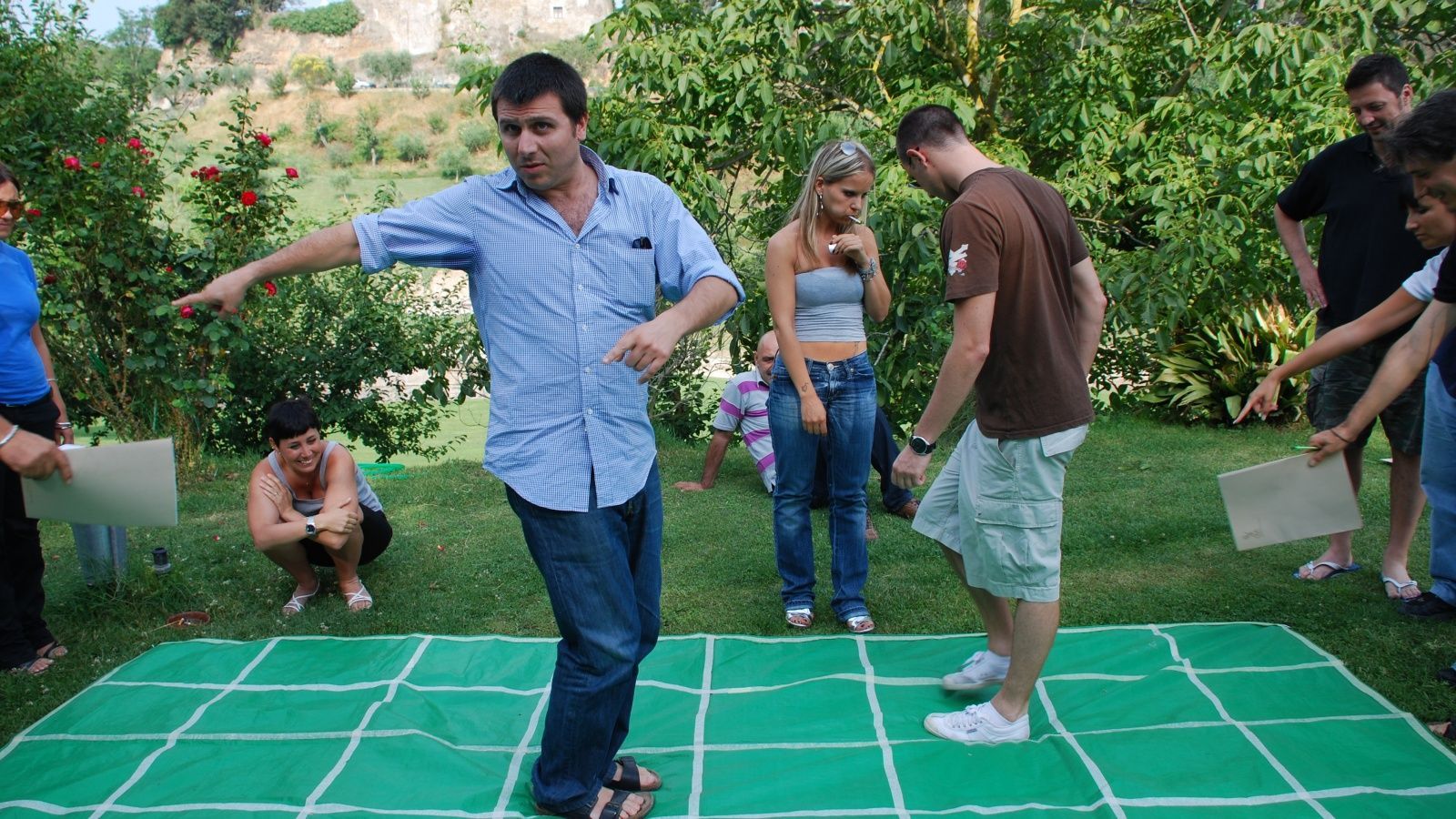
In front of you there’s a large chessboard. The right path exists, but nobody knows it. One colleague takes the first step, another watches, someone remembers the square that stopped the previous attempt. The solution starts to take shape when you put together what each person has discovered.
Team Genius is an outdoor team-building experience that combines the energy of big team games with trials of logic, coordination and problem solving. In a park, in a hotel garden, or on the grounds of an estate, participants tackle a circuit of challenges: crossing, building, orienting, and finding a shared method.
Each challenge changes the rules of the game. You need memory and observation on the chessboard, a shared rhythm in the Big Foot challenge, and planning in the Bridge of Leonardo. Decisive intuition can come from anyone, and the group must recognize it and turn it into action.
Observe, compare, test your ideas. The next solution is born from the team.
HOW THE CHALLENGE WORKS
A circuit of challenges, a strategy to build together
The format generally includes three or four challenges, selected based on the location, the number of participants, and the time available. Teams face the same challenges in sequence, or rotate between different stations.
- Briefing and team formation. The Game Master presents the mission, explains the rules, and clarifies how results are assessed.
- Entry into the circuit. Each team reaches its station, observes the problem, and decides how to distribute tasks.
- Attempts and new strategies. The group experiments, gathers information, and adjusts the method before moving on to the next challenge.
- Final comparison. Results are shared, and you discover which team faced the challenges best, according to the criteria announced at the start.
A final mission may be included in the program, requiring participants to connect the clues or information collected across the different challenges.
Roles change, talents emerge
Each team chooses how to organize itself: who observes, who memorizes attempts, who coordinates movement, and who checks the solution. With the move to the next challenge, roles can change.
Who identifies the route on the chessboard can rely on a colleague during the bridge-building phase. Who finds the rhythm in the Big Foot challenge can step aside and let the lead go to whoever reads the map best. Leadership moves alongside skills.
THE CHALLENGES: LOGIC, BALANCE AND COLLABORATION
The silent chessboard
A large grid hides a single correct path. Participants cross it one at a time and, during the challenge, cannot talk. Each step reveals information: a correct square, a choice to avoid, a road to remember.
The team must observe the attempts and build a shared memory, using non-verbal communication as well. Those who go after can move further thanks to what their teammates have discovered.
The challenge: turn individual mistakes into useful information for everyone.
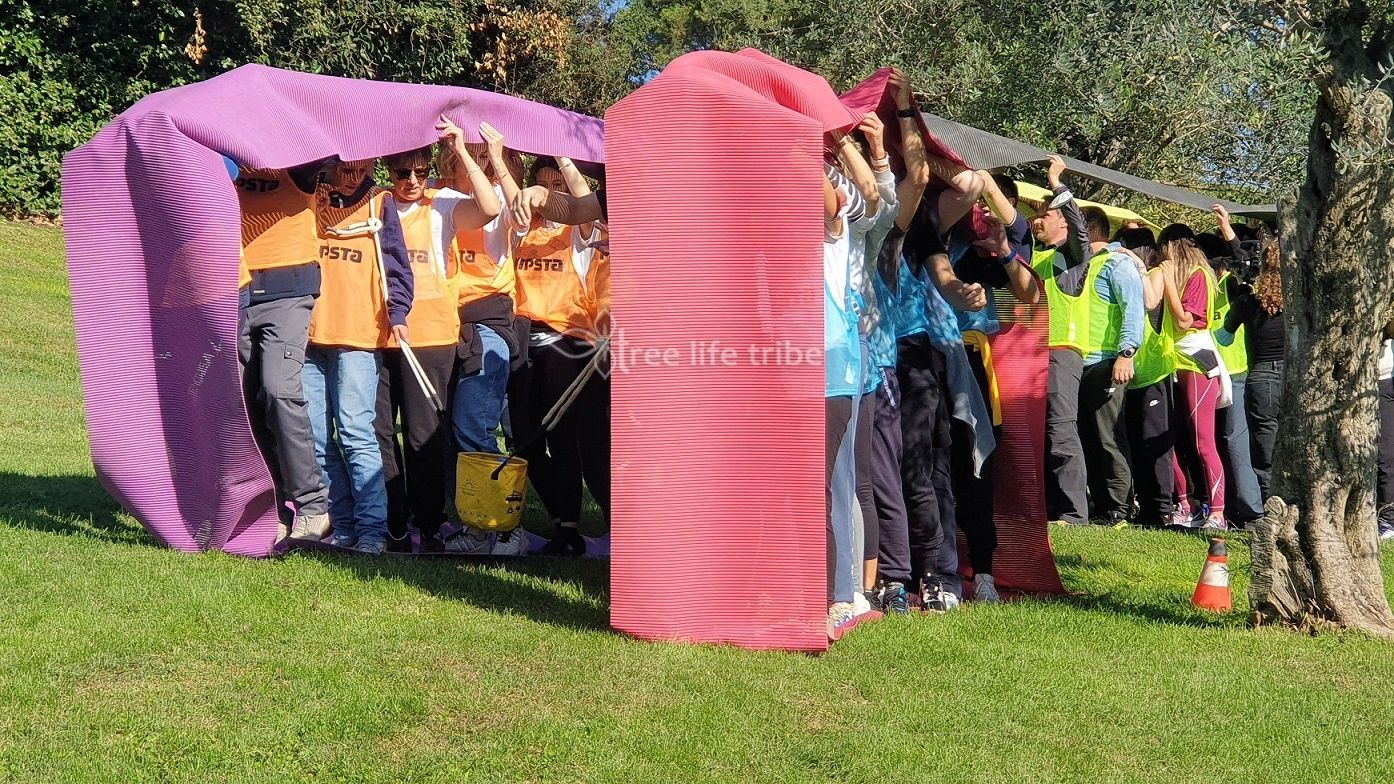
Big Foot: find the same step
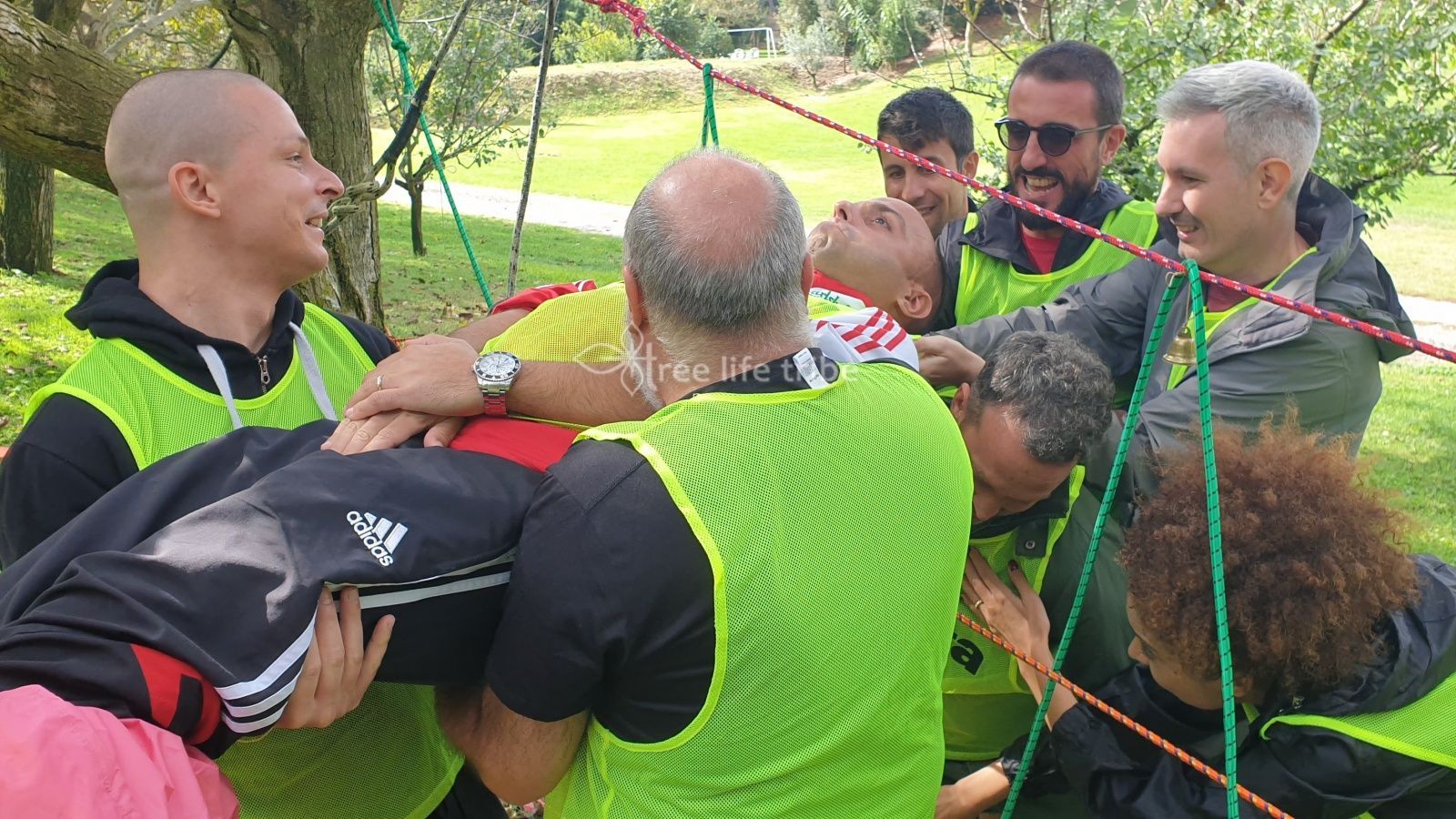
The group advances using shared support. To move, they must find a common rhythm and coordinate their steps: if someone anticipates or falls behind, the entire team must reorganize.
Through attempts, laughter, and small adjustments, participants learn to give clear instructions and respect each other’s timing.
The challenge: turn many different rhythms into a shared movement.
Leonardo’s Bridge
The team receives the elements to build a self-supporting structure inspired by Leonardo da Vinci. You need to understand how the parts support each other, assign tasks, and choose the assembly sequence.
A good intuition becomes effective when the group can communicate it, verify it, and build it together. Each element finds its place thanks to everyone’s contribution.
The challenge: move from the idea to a real solution, through design and collaboration.
Orientation and finding the stations
When the spaces allow it, an orienteering challenge invites teams to read a map, recognize references, and reach the points indicated in the play area.
Participants compare the information available, choose a route, and verify their decisions along the way.
The challenge: choose a shared direction and correct the route when needed.
The combination of challenges is defined for each event. In some configurations, the Via Sacra may also be included: a precision and collaboration challenge adapted to the available spaces.
WHY CHOOSE TEAM GENIUS
A dynamic day that makes room for different skills
Team Genius alternates movement, observation, and building. The variety of challenges allows participants to contribute in different ways and gives the group real opportunities to experience collaboration.
- Engagement: each station presents a new problem and a chance to get involved.
- Different contributions: memory, organization, hands-on skills, and listening ability all find their place in the circuit.
- Adjustable competition: the experience can highlight comparison between teams or a shared goal.
- Customization: challenges and intensity are adapted to the group and the location.
Ideal for which groups
It’s a proposal well-suited for meetings, conventions, incentive days, and outdoor corporate events. It can be chosen by newly formed teams, groups from different departments, and companies that want to dedicate time to communication and problem solving.
The format can also be designed for international groups, by agreeing on the language used for facilitation and instructions.
SKILLS AND GROUP DYNAMICS
What the team can put to the test
Communication and listening
Teams try out how to share information, give clear instructions, and recognize others’ signals. On the chessboard, even a gesture or a moment of observation can become decisive.
Problem solving and planning
Each station invites participants to formulate a hypothesis, test it, and evaluate the outcome. The group decides when to act, when to stop and observe, and when to change the method.
Distributed leadership
The challenges require different skills and offer the opportunity to pass leadership to different people, recognizing each person’s contribution.
Coordination and error management
Big Foot makes visible how much each individual’s movement affects the group. The chessboard shows how a disrupted attempt can help the next teammate move forward.
Debriefing: from the game to teamwork
On request, the experience can end with a facilitated debriefing. The group revisits some moments from the challenges and reflects on the behaviors that helped or slowed down reaching the goal.
- What information did we share, and what did we miss?
- How did we decide who would lead the team?
- When did we realize it was time to change strategy?
- Which useful behavior can we bring into everyday work?
So the challenges become a concrete starting point for talking about collaboration and organization.
CUSTOMIZE YOUR EVENT
A circuit built around your group
The Team Genius structure makes it possible to choose the challenges and organize them according to the business day. The program is agreed on considering participants, duration, spaces, and event goals.
- Three or four challenges, with different combinations of logic, building, and coordination.
- Rotating teams or a shared sequence of challenges.
- Physical intensity appropriate to the participants’ characteristics.
- A competitive format or a collaboration goal between groups.
- A final mission, if included in the program.
- A dedicated debriefing focused on communication, leadership, and error management.
The day can be paired with an aperitif, lunch, or dinner, depending on the services available at the selected location.
Bring us your group and your idea for the day: together we’ll choose the scenario and the challenges.
FAQ AND USEFUL INFORMATION
Do we need to be trained/athletic?
The challenges involve generally light to moderate physical effort, adaptable to the group. Observation, memory, design/planning, and coordination are central to the experience. Any mobility needs are taken into account when selecting the challenges and roles.
How many challenges are planned?
Generally three or four. The combination is defined based on the available time, the number of participants, and the location’s spaces.
How long does it take, and how many people can participate?
Duration and capacity are defined in the quote depending on the chosen circuit, the number of teams, and the available stations. You can schedule the activity as part of a meeting program or dedicate a portion of the corporate day to it.
Do the teams face all the same challenges?
Yes. The order can change through a rotation of teams between stations, so you can organize the circuit and keep waiting times under control.
Can we organize it at our hotel or at our company?
Yes, when there are suitable outdoor spaces available for the selected challenges. Gardens, lawns, and dedicated areas are assessed to build the program around your premises.
What happens if it rains?
When the location has an adequate indoor room, some challenges can be adapted for indoor use. Any indoor alternative and how to handle bad weather are agreed on during planning.
Can we add a training component?
Yes. On request, it’s possible to include a facilitated debriefing, with questions and observations about the dynamics that emerged during the challenges.
PROPOSED LOCATIONS
CHOOSE THE SCENARIO FOR THE CHALLENGE
A park, an estate, or the garden of your hotel: the circuit takes shape around the location.
Team Genius takes place in a play area organized into stations. These are the types of locations to consider for the event, in Rome and the surrounding area.
IN THE GREEN
-
Parks and dedicated green areas
A setting to alternate logic and movement. Usable areas and the possibility of setting up stations are checked for the chosen location.
-
Estates and agritourism farms
Country-side spaces around Rome to assess for a corporate day with a circuit of challenges and a social moment.
IN A HOTEL OR IN A VILLA
-
Hotel and resort gardens
A solution to integrate into the meeting, using the hotel’s outdoor spaces where the group is hosted.
-
Villas and event venues
Gardens and dedicated areas for organizing the challenges and, when available, pairing with catering services or an indoor room.
CLOSE TO YOUR TEAM
-
Corporate outdoor spaces
Courtyards, gardens, or campuses to assess to bring the experience directly to your site.
-
Your event location
An outdoor area at the restaurant or venue you’ve already selected: challenges and rotations are designed based on the spaces actually available.
Customizable circuit. The location is confirmed based on availability and the spaces needed: surfaces suitable for the challenges, the possibility of distributing the stations, and sizes appropriate for the group. Any orientation activity is included when the area allows it.


