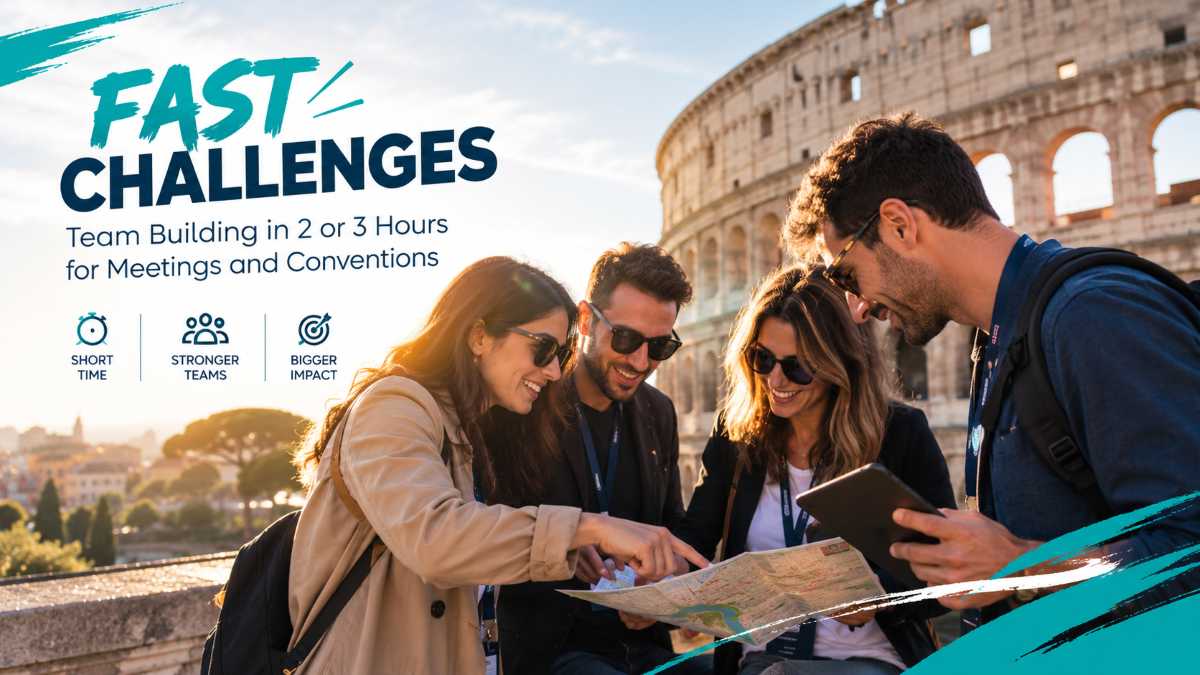
Fast Challenges: Team Building modules of 2 or 3 hours per meeting and convention
When time is short, Team Building must become smarter
A corporate convention can be perfectly organized, a full day of meetings can have an impeccable agenda, and a training session can be rich in content.
Yet, after hours spent sitting and listening to presentations, analyzing data, and discussing strategies, there comes that moment when attention starts to slip.
People need to change pace.
Not necessarily by interrupting the day with half a day off.
Not necessarily by adding an entire extra day to the corporate schedule.
Sometimes just two or three hours are enough.
This need gives rise to the concept of Fast Challenges: short, dynamic Team Building modules that can be easily slotted in alongside a meeting, a convention, a congress, or a corporate event.
The goal is not simply to “do something fun”.
It is to re-energize, restore communication and collaboration, using a relatively brief window to turn the group from passive audience into an active team of protagonists.
In Rome, this formula gains an additional advantage: the activity can move out of the room and use the city as the backdrop, shifting in just a few minutes from the conference dimension to an experiential one.
What are Fast Challenges
A Fast Challenge is a Team Building experience designed specifically to have a contained duration, generally between about 2 and 3 hours, and to be integrated within a broader corporate program.
The key feature is not only the duration.
It is the ability to concentrate the experience.
Instead of dedicating an entire day to an activity, you build a challenge with:
-
quick briefing;
-
team division;
-
a clear mission;
-
connected tasks;
-
collaboration moments;
-
measurable goals;
-
a shared finale;
-
a concluding debriefing.
The result is an agile format, especially suitable for companies that must stick to a precise schedule.
A Team Building that does not interrupt the corporate program
Let’s think of a one-day convention.
09:00 – opening remarks.
10:30 – corporate presentation.
11:30 – workshop.
13:00 – lunch.
14:30 – strategic session.
16:00 – break.
16:30 – closing remarks.
In a schedule like this, it can be difficult to fit in a traditional Team Building.
A Fast Challenge, on the other hand, can be placed between two moments of the day.
For example, from 16:00 to 18:30.
The meeting pauses.
People stand up.
The group is divided into teams.
In just a few minutes, they change language, space, and dynamics.
Laptops make way for a map.
PowerPoint slides make way for a mission.
Theoretical discussion makes way for the need to make a decision together.
And when the activity ends, the group can return to the convention with a completely different level of energy.
Why include a Fast Challenge during a convention
A particularly intense corporate agenda does not necessarily need to be extended.
It can be better structured.
Short Team Building allows, in fact, working on elements that are often sidelined during institutional activities.
Reactivating attention
After several hours of meetings, it’s normal for attention levels to drop.
A hands-on activity introduces movement, interaction, and a change of pace.
A person should not just keep listening.
They should observe, decide, communicate, and act.
Encouraging communication
A challenge forces people to share information.
Who has information must communicate it.
Who has an idea must be able to explain it.
Who is making a decision must compare notes with others.
So communication becomes a concrete necessity rather than just a topic covered during a workshop.
Creating collaboration in a short time
A Fast Challenge can be designed so that the outcome depends on the participation of more people.
A team may need:
-
someone who observes;
-
someone who interprets clues;
-
someone who manages time;
-
someone who coordinates;
-
someone who documents;
-
someone who makes decisions.
This allows you to turn role diversity into a resource.
Breaking routine
The transition from the conference hall to an experiential activity creates a real shift.
And it is precisely this shift that represents one of the interesting elements of the format.
Team Building does not necessarily have to take up a full day.
It can also be a strategic interlude within the day.
Fast Challenges in Rome: the city becomes part of the challenge
Rome offers a particularly interesting feature for this type of format.
Many experiences can be organized using the urban fabric as an integral part of the activity.
A convention can therefore begin in a convention venue and continue, after the briefing, with a short experience in the heart of the city.
The group doesn’t necessarily have to tackle a long tourist itinerary.
The route can be built around a specific mission.
From the meeting to the Urban Challenge
Let’s imagine a group that has just finished a work session.
The facilitator enters the room.
On the table, some tablets, envelopes, and materials are placed.
Then comes the sentence:
"From this moment, you have 120 minutes to complete the mission."
The teams receive the first clue.
They don’t yet know what the final destination will be.
They need to observe.
Compare notes.
Choose.
Move around.
Rome suddenly becomes a giant game board.
A square can become a checkpoint.
A monument can contain a riddle.
A photo can become a task.
An architectural detail can provide the solution.
This is the principle behind Urban Games, a category already included in the Team Building Rome offering, with experiences that use the center of Rome and venues such as Villa Borghese.
Which Fast Challenges can be organized
The short format doesn’t necessarily mean choosing just one type of activity.
On the contrary, it allows you to build challenges that are very different from each other.
Urban Treasure Hunt
An urban treasure hunt can be adapted to a time frame of about 2 or 3 hours.
The teams receive a series of missions and must complete them by moving through a specific area of Rome.
The format can include:
-
riddles;
-
photographs;
-
creative challenges;
-
cultural questions;
-
search for details;
-
tablet-based missions;
-
observation tasks;
-
bonuses and penalties.
For example, a treasure hunt in the Vatican area can use the route toward Castel Sant’Angelo as a narrative scenario. Among the proposals on the site, Angels & Demons is built specifically around the Vatican area and the conclusion of the challenge at Castel Sant’Angelo.
Photo Challenge
One of the simplest formats to include in a convention is the photo challenge.
The teams receive a set of subjects or situations to recreate.
The best photo doesn’t necessarily win.
The challenge can reward creativity, interpretation, speed, and the ability to work together.
The Paparazzi format by Team Building Rome uses exactly this kind of creative photo hunt across Rome, combining exploration and teamwork.
Tablet Urban Game
The tablet can become the tool for an urban mission.
The teams receive information progressively and must decide which route to follow.
This type of activity is particularly interesting when time is limited because it allows you to control the challenge pace and adjust the number of tasks to the available duration.
Fast Challenge at Villa Borghese
Even Villa Borghese can turn into a playing field.
One example is Without Brakes / Rome Pedal Quest, which uses assisted-pedaling boats with 4 or 6 seats and builds a challenge based on orientation, strategy, collaboration, and organization. The format is not designed as a simple speed competition: the team must decide how to use time and resources. (Teambuilding Rome)
This feature makes it interesting for a corporate Fast Challenge where movement must be present, but without necessarily turning the experience into a sports competition.
Escape and Museum Challenge
Another option is to bring the Escape Game concept into a cultural venue.
The Escape Museum experience, included among the Urban Games offered by Team Building Rome, applies the logic of escape within the museum, asking participants to collaborate to find an artwork and complete the mission.
It is a particularly interesting solution when the corporate event takes place in a central area and you want to maintain a strong connection to art and culture.
Indoor Fast Challenge: when you don’t want to leave the venue
Not all events can include moving elsewhere.
In this case, the Fast Challenge concept can be fully developed within the convention venue itself.
A meeting room can become:
-
an operations hub;
-
a creative workshop;
-
a game field;
-
an investigation room;
-
a television studio;
-
a problem-solving arena.
This approach eliminates transfer time and makes the format even easier to integrate into the agenda.
A challenge built around the corporate theme
A particularly interesting element is the ability to connect the challenge to the content of the convention.
If the meeting is about innovation, the challenge can focus on creativity.
If the theme is collaboration between departments, the tasks can require different teams to exchange information.
If the event celebrates a new product, the mission can be built around its story.
In this way, Team Building doesn’t appear as a separate element.
It becomes a hands-on experiential continuation of the meeting.
Rome’s POIs as narrative elements
One of the advantages of an urban Fast Challenge is the ability to use POIs – Points of Interest – not just as places to pass through, but as parts of the story.
Piazza Navona
Piazza Navona can become an observation point, a photo stop, or a station for a creativity task.
Its fountains, the architecture, and the layout of the square offer many elements that can easily be turned into clues.
Pantheon
The Pantheon can be used as a geographic and cultural reference within a mission.
A challenge can ask participants to recognize architectural details, reconstruct a sequence, or use historical information to solve a riddle.
Castel Sant’Angelo
The area of Castel Sant’Angelo is particularly suitable for an investigative or historical narrative.
The terrace also offers a panoramic view of the city, with recognizable points such as Villa Borghese, the Pantheon, Campidoglio, Aventine, Gianicolo, and St. Peter’s. (Turismo Roma)
Villa Borghese
For a more dynamic Fast Challenge, Villa Borghese allows you to completely change the atmosphere.
The park becomes a space where you can alternate movement, orientation tasks, creative challenges, and collaboration moments.
The Rome Pedal Quest format featured on the site shows how this location can be transformed into a true corporate game field. (Teambuilding Rome)
Fast Challenges for conventions: even the venue can become part of the format
The concept can also be applied to large facilities dedicated to meetings and conventions.
For example, the Auditorium Parco della Musica Ennio Morricone has multiple spaces with different capacities and configurations, and it’s also used for conventions, congresses, product launches, incentive events, and business meetings. (Auditorium Morricone)
So part of the day can be dedicated to the convention, and another part to a short experience designed around the available spaces or outdoor areas.
Even MAXXI is an example of a venue that can host corporate events, conferences, meetings, workshops, presentations, and exclusive visits for groups. (MAXXI)
In this case, the challenge can take on an artistic and creative dimension.
The artworks become prompts.
The spaces become checkpoints.
The architecture becomes part of the mission.
How to design an effective Fast Challenge
Its short length requires particularly careful planning.
A two-hour activity can’t afford dead time.
1. Essential briefing
The briefing must be clear and immediate.
Participants must understand:
-
the objective;
-
the rules;
-
the available time;
-
the evaluation criteria;
-
the communication method.
2. A mission that’s easy to understand
The complexity should be in the tasks, not in the explanation.
If it takes twenty minutes to explain the game, an important part of the available time is lost.
3. Pace
A Fast Challenge should have progression.
The first task should introduce the group to the dynamic.
The following tasks should gradually increase involvement.
The final task should create a recognizable closing moment.
4. Different roles
A good challenge shouldn’t only reward the fastest or most competitive people.
It’s more interesting to create situations where different skills are needed:
-
observation;
-
memory;
-
creativity;
-
orientation;
-
communication;
-
leadership;
-
analytical ability;
-
time management.
5. Debriefing
Even when time is short, the debriefing shouldn’t be eliminated.
A few minutes are enough to turn the game into an experience.
The question is not only:
"Who won?"
But:
"How did you make decisions?"
"How did you distribute the roles?"
"What worked?"
"What could you have done differently?"
It’s here that the activity connects to everyday work.
The Fast Challenge as an active break during work
There’s an important difference between a simple break and an experiential break.
In the first case, people interrupt their work.
In the second, they use the break to create new interactions.
A coffee break lasts a few minutes.
A Fast Challenge can last two or three hours, but it still keeps a compact structure that’s easy to integrate into the overall schedule.
It’s an interesting solution especially for:
-
corporate conventions;
-
congresses;
-
kick-offs;
-
international meetings;
-
incentive events;
-
workshops;
-
training days;
-
corporate presentations;
-
product launches;
-
meetings between teams coming from different offices.
Fast Challenges and international teams
The short format can be especially appealing for international groups.
When participants come from different countries, a hands-on activity can offer a common language that doesn’t depend exclusively on conversation.
A photo mission.
A visual task.
A navigation game.
An activity with images.
A challenge built with simple instructions.
These elements can reduce language barriers and allow people to collaborate through concrete actions.
So the city of Rome becomes a meeting point even for multicultural groups.
How long should a Fast Challenge last?
There is no mandatory duration.
Planning can be tailored to the corporate schedule.
Sprint Formula – about 2 hours
Ideal when the goal is to insert a real dynamic break within a meeting.
Standard Formula – about 2 hours and 30 minutes
It allows you to include a briefing, an articulated activity, and a final debriefing.
Extended Formula – about 3 hours
It enables you to build a more structured story, use more POIs, or combine different types of tasks.
However, the duration should also be set considering transfers, logistical briefing time, and the characteristics of the group.
An example of a 3-hour Fast Challenge schedule in Rome
Let’s imagine a convention that ends at 16:00.
16:00 – Briefing
The teams receive the mission and materials.
16:15 – Start
Each team begins their route.
16:30 – First challenge
The initial tasks are meant to break the ice and create collaboration.
17:00 – Central mission
The difficulty increases.
Teams must make decisions and manage time.
17:40 – Final Challenge
All teams converge on the last task.
18:00 – Finale
The results are collected.
18:15 – Debriefing
The facilitator connects the experience to the themes of collaboration, communication, and teamwork.
18:30 – End of activity
The group can continue with an aperitif, dinner, or networking.
In just three hours, a real experiential moment is created without turning the convention into an additional day.
Fast Challenges: less time, more planning
The real innovation of the format isn’t simply “doing a shorter activity”.
A short Team Building must be designed with greater precision.
Every minute must have a purpose.
Each task must contribute to the narrative.
Every transfer must be accounted for.
Every step must keep attention high.
This is what allows the Fast Challenge to become a concrete solution for companies looking for Corporate Team Building in Rome, but cannot dedicate an entire day to the experience.
The logic is simple:
Don’t remove Team Building from the program because there isn’t enough time; plan Team Building specifically around the time available.
The new generation of corporate Team Building
The world of corporate events is becoming increasingly modular.
Companies organize more focused meetings, international conventions, specialized workshops, and days in which every segment of the agenda must have a precise function.
In this scenario, the Fast Challenge represents an extremely flexible formula.
It can be urban or indoor.
Cultural or competitive.
Creative or strategic.
Digital or analog.
It can last two hours or extend up to three.
It can start from a meeting room or, for a few hours, transform part of Rome into a big playing field.
And above all, it can create something that a presentation, however effective, rarely manages to produce on its own:
a shared experience.
Because in the end, at a convention, slides can be archived.
A report can be forgotten.
A presentation can be replaced by the next one.
But a team that has solved a mission together, crossed Rome, made decisions under pressure, and reached a common goal carries something different with them.
A memory.
A story.
And, above all, an experience lived together.
FAQ – Fast Challenges for companies
What is a Fast Challenge?
It’s a short Team Building module, generally about 2 or 3 hours, designed to be included within meetings, conventions, workshops, and other corporate events.
Can a Fast Challenge be organized in the center of Rome?
Yes. Activities can be designed using different neighborhoods and POIs of the city, depending on the format, logistics, and event objectives.
Is it possible to organize an indoor Fast Challenge?
Yes. A challenge can be designed directly at the convention venue or in a dedicated space, avoiding transfers.
What skills can it develop?
Depending on the format, the experience can work on communication, collaboration, problem solving, creativity, leadership, orientation, time management, and decision-making ability.
Is it suitable for international groups?
Yes. Visual, photographic, digital, and collaborative tasks can be used that make it easier for people with different languages and backgrounds to participate.
Can the Fast Challenge be customized?
Yes. Duration, number of tasks, route, location, language, and goals can be adapted to the characteristics of the corporate event.
If you want to live this experience (or something similar), click here, you will find our proposals:
Request a free quote and get all the information about your Team Building experience.
Request a free quote and get all the information about your Team Building experience.