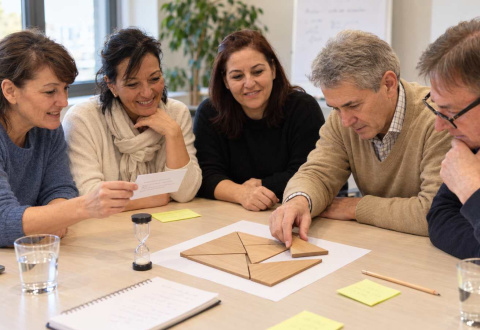
Team Building Without Winners: Why Some Teams Work Better When They Stop Competing
At work, we are used to measuring results, comparing performance, and rewarding those who come first. But what happens when, during a team-building activity, we remove the rankings and replace competition with a shared goal?
Team Building Without Winners offers a different approach: what matters is not who outperforms the others, but what the group can build together. It’s an experience that invites participants to reflect on trust, collaboration, and the ability to put individual skills to work toward a common result.
When success is a collective achievement
Imagine a team tasked with building a structure using limited materials, solving a puzzle, or completing a mission in which each participant has only part of the information. There are no opponents to defeat, but a goal that no one can achieve alone.
In this context, group dynamics also change. The more competitive members can learn to make room for others; those who tend not to speak much can find an opportunity to contribute; and those with different skills can become a decisive resource.
The outcome depends not on individual performance, but on the ability to share ideas, assign tasks, and deal with unexpected challenges without losing sight of the goal.
Three experiences to try
Team building without winners can take different forms, depending on the group’s characteristics and the company’s goals:
-
Collaborative construction: Each subgroup creates one part of a project that only takes shape when everyone’s contributions are assembled.
-
Cooperative mission: Participants share clues and information to solve a common problem, with no individual rankings.
-
Community challenge: The group takes part in a practical activity that benefits a community or social project, turning collaboration into a tangible result.
Less rivalry, more trust
Competition is not necessarily negative: it can boost energy, creativity, and motivation. However, when it becomes the only measure of success, it risks reducing people’s willingness to share information, ask for help, or recognize the value of others’ ideas.
A cooperative activity offers a chance to experience a different possibility: you can do your best without having to prove that you are better than others.
This is also an important principle in day-to-day work, especially in teams where departments, roles, or individual goals can come into conflict. Team building thus becomes a safe space to try new ways of relating, strengthen trust, and discover that differences can complement one another rather than clash.
The most important question comes at the end
The true value of the experience emerges when the group takes a moment to reflect. Did we listen to all the suggestions? Did we share information, or did we hold it back? Did we recognize everyone’s contribution?
These questions help transfer what was learned through the activity into professional life.
Team Building Without Winners does not eliminate ambitious goals: it changes how they are achieved. Because a truly effective team is not one in which one person beats everyone else, but one in which everyone can contribute to shared success.
Want to try designing something new? Share your ideas with us:
Request a quote and let’s design your team-building experience together
FAQ – Frequently asked questions
What is Team Building Without Winners?
It’s an activity where success depends on everyone working together, rather than on rankings or one team beating the others.
What benefits does it offer companies?
It can promote trust, active listening, information sharing, and a sense of collective responsibility.
Is it also suitable for competitive groups?
Yes. It can help people discover how to turn competitive energy into collaboration and shared goals.
How is the success of the activity measured?
By whether the group achieves its common goal and through a final reflection on participation, communication, and group dynamics.