Deaf Awareness Team Building: Turning Communication Diversity into an Asset
In a team, everyone communicates. But not everyone does so in the same way. Some rely on their voice, some observe facial expressions, some use Italian Sign Language (LIS), and others understand a message better through images, gestures, and practical demonstrations. Yet in everyday working life, we are often used to considering verbal communication the primary mode, if not the only one.
Deaf Awareness Team Building was created precisely to challenge this habit and turn communication diversity into an opportunity for collective growth. It is not simply about involving deaf people in a company activity, but about helping the whole group recognize communication barriers, try out new ways of collaborating, and discover that listening also means observing, waiting, and understanding.
When communicating means learning to look at one another
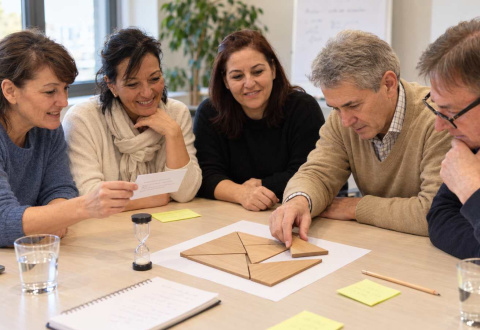
Imagine a team that has to solve a riddle without using their voices, build a structure by following visual instructions only, or complete a challenge in which every participant has essential information needed to achieve the goal.
In situations like these, habits that usually go unnoticed come to the surface: interrupting, talking over one another, taking for granted that everyone has understood, or addressing just one person while ignoring the rest of the group. When these shortcuts no longer work, the team is forced to find new strategies.
The value of the experience does not lie in simulating deafness through improvised exercises, but in understanding how to make communication truly accessible. To do this, it is important to involve deaf people, qualified professionals, and, where appropriate, experts in inclusive team building activities.
Activities that bring out new skills
A Deaf Awareness Team Building program can include visual challenges, coordination games, collaborative construction activities, storytelling through images, and introductory LIS activities led by qualified instructors.
Each exercise should have a specific goal: learning to check that a message has been understood, using shared signals, making important information visible, and distributing responsibilities without leaving anyone behind.
Italian Sign Language is not simply a collection of gestures, but a language with its own linguistic structure. For this reason, an introductory workshop can introduce participants to LIS, while more in-depth learning requires appropriate courses and specific expertise.
From games to workplace life
Once the challenge is over, the most important moment begins: reflecting on what happened. Who was able to follow the information? Who was left out of a decision? Which behaviors made the work easier, and which got in the way?
These questions make it possible to connect the experience to meetings, briefings, shared projects, and the day-to-day management of information. Communicating inclusively means, for example, supplementing explanations with visual aids, making information available in writing, respecting turn-taking, and ensuring that the face of the person communicating is clearly visible.
Of course, the needs of deaf people are not all the same: some use LIS, while others prefer written or spoken language, technological devices, or a combination of tools. The best approach is to ask directly which methods are most effective, rather than relying on assumptions.
A more aware team is a stronger team
Deaf Awareness Team Building invites companies to see inclusion not as a formal requirement, but as a shared responsibility. When people learn to recognize different communication needs, everyone has a better chance to contribute their skills, ideas, and perspectives.
The most meaningful outcome is not just having completed a challenge, but discovering that the problem is often not the differences between people: it is the unspoken rules that prevent them from working together as equals.
A well-designed experience can thus become the starting point for building a more accessible, attentive workplace that knows how to value every voice, even when it is not expressed through words.
Want to try designing something new? Share your ideas with us:
Request a free quote and tell us about your Team Building idea.
Deaf Awareness Team Building FAQ
What is Deaf Awareness Team Building?
It is a workplace experience that helps participants understand communication barriers and try out more inclusive ways of collaborating.
Are the activities suitable for people who do not know LIS?
Yes. The activities can be designed for everyone, gradually introducing visual tools and activities led by qualified professionals.
How can you avoid trivializing the experiences of deaf people?
By involving deaf people in the design process, respecting different identities and communication methods, and avoiding stereotypical simulations of deafness.