Scents, Sounds and Textures: Team Building that Breaks Down Sensory Barriers
What if, to collaborate better, we tried to experience the world through senses other than those we use every day? Multisensory team building is based on precisely this idea: turning scents, sounds, textures and perceptions into tools for communicating, building trust and discovering new team strengths.
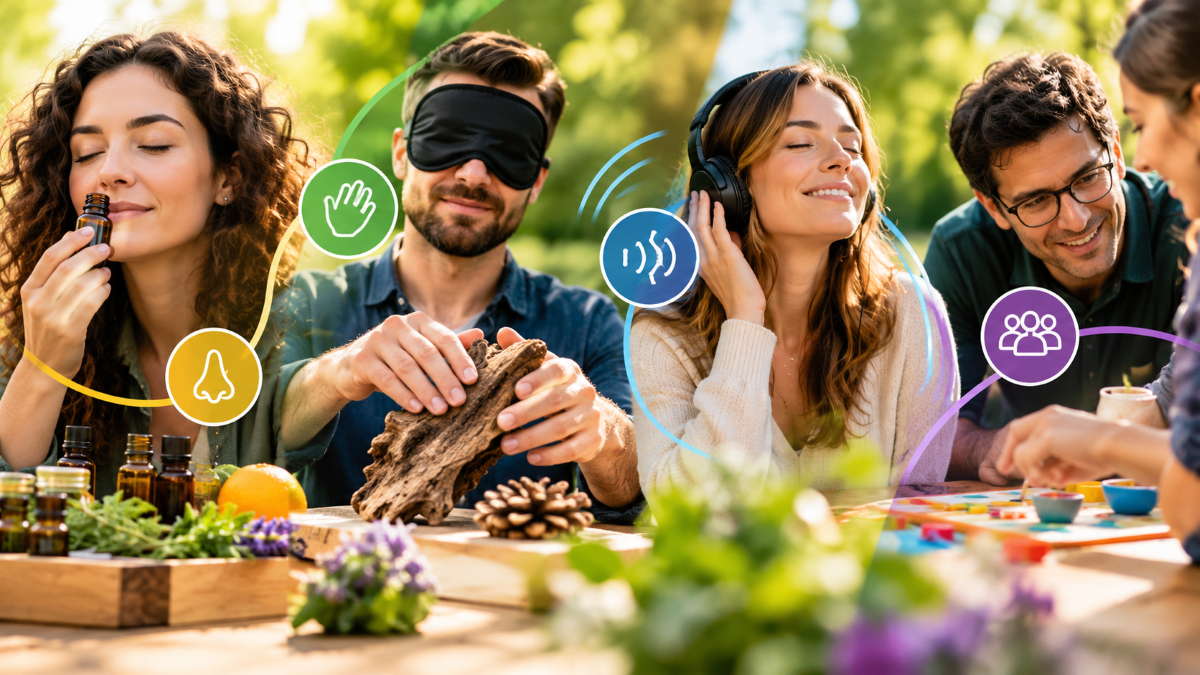
In a Scents, Sounds and Textures activity, participants are invited to explore sensory stimuli, solve small challenges and compare their perceptions. An original experience that challenges habits and teaches us how important it is to listen to what is not expressed in words, too.
When the senses become a team
A scent can evoke a memory, a sound can suggest a direction, and a surface can tell us something without being seen. During a multisensory experience, these sensations become clues to interpret together.
For example, participants can identify scents with their eyes closed, recognize objects by touch, associate sounds with images or follow shared directions to build a route. Every challenge requires attention, curiosity and the ability to compare different points of view.
There isn't necessarily an immediate answer, or one that is the same for everyone. And that's precisely where the opportunity for growth lies: learning to value differences instead of seeing them as an obstacle.
Breaking down barriers through listening
In our daily work, we are used to prioritizing words, images and explicit information. And yet, an important part of communication depends on our ability to observe, listen and understand how others interpret a situation.
A sensory activity can help the team recognize certain automatic responses: taking for granted that everyone perceives things in the same way, judging an answer too quickly or overlooking a contribution because it is expressed differently from our own.
This experience is also connected to the principles of inclusive team building, where activities are designed to encourage participation, respect different needs and create genuine opportunities for collaboration.
To be truly inclusive, the activity must provide accessible alternatives, without forcing participants to touch materials or encounter scents or sounds that could cause discomfort. Participation should be voluntary, and everyone should be able to choose how to contribute.
What stays with you after the experience?
The value of multisensory team building goes beyond the game itself. The most meaningful moment comes when the team reflects on what happened: who listened well? What information was overlooked? How were differences in perception addressed?
These are questions that can also be explored in professional life, improving communication, the handling of unexpected situations and mutual trust.
Scents, Sounds and Textures shows that collaboration doesn't necessarily mean seeing things in the same way, but finding common ground to tackle them together. Sometimes, breaking down a barrier simply takes a change in perspective and a willingness to pay attention to what we hadn't noticed before.
Would you like to try designing something new? Share your ideas with us:
Request a quote and let's design your team-building experience together
FAQ – Frequently asked questions about multisensory team building
How does multisensory team building work?
Participants take on challenges based on scents, sounds and textures, working together to interpret stimuli and achieve shared goals.
What skills does it help develop?
It encourages listening, communication, attentiveness, creativity and the ability to collaborate while valuing different points of view.
Is it suitable for all work teams?
Yes, as long as the activities are adapted to participants' needs, with accessible alternatives and no mandatory sensory stimuli.
Can it be organized at the workplace?
Yes. The format can be delivered at the workplace or at a dedicated venue, with activities, duration and goals tailored to your needs.