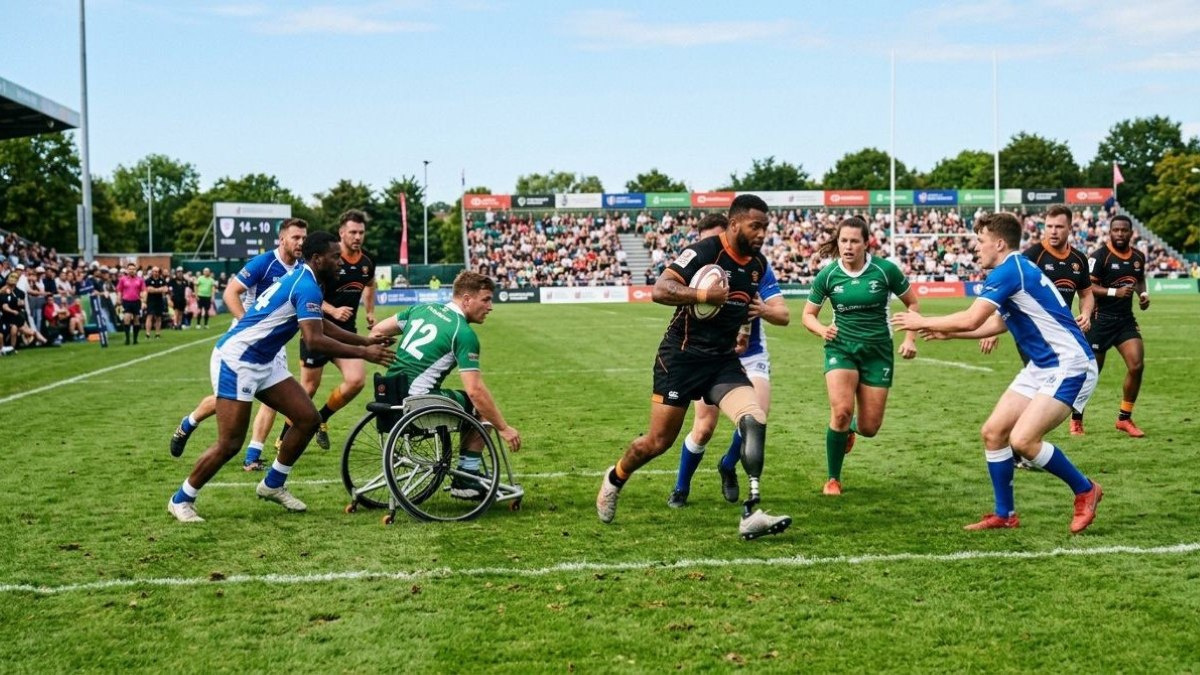
Wheelchair Rugby and Team Building: energy, strategy, and collaboration beyond barriers
There are team-building activities that require people to work together.
And then there are some that make collaboration’s meaning come alive physically.
Wheelchair Rugby belongs to this second category.
The sound of wheels on the court floor, an unexpected trajectory, a teammate who changes direction, a door to defend, and only a few seconds to decide what to do.
In this sport, speed matters—but alone it isn’t enough.
You need strategy, communication, trust, and the ability to continuously read what’s happening around you.
It is exactly this combination that makes Wheelchair Rugby a particularly interesting experience for corporate Team Building, especially when the goal is to address inclusion, collaboration, and valuing different abilities.
What is Wheelchair Rugby
Wheelchair Rugby is a Paralympic sport born from the meeting of wheelchair basketball characteristics and hockey, and it became an official Paralympic discipline starting from Sydney 2000. Paralympic matches are played indoors on a basketball court and feature four players per team on the court at the same time; men and women can compete in the same team. (Paralympic Games)
Unlike traditional rugby, there is no oval ball: Wheelchair Rugby uses a round, soft ball.
Contact between wheelchairs is an integral part of the game, while physical tackling is not allowed. The goal is to carry the ball over the opponent’s try line. (Paralympic Games)
One of the most interesting elements is the sports classification system.
Athletes are divided into seven classes, from 0.5 to 3.5, based on the functional impact of their disability on the sport’s specific activities. Teams must therefore combine different functional profiles, turning individual characteristics into elements of collective strategy. (worldwheelchair.rugby)
And it is exactly here that the link with the business world begins.
From the court to the company: when strategy becomes collaboration
Let’s imagine a group of colleagues walking into the gym.
At first, someone watches with curiosity.
Someone is used to sports and immediately thinks about competition.
Someone else is less sporty and doesn’t know quite what to expect.
Then the sports wheelchairs arrive.
People take their places, try to push themselves, and must learn how to turn, stop, accelerate, and control direction.
In just a few minutes, your perspective changes.
A simple action that seemed obvious becomes something that requires attention.
And it is at that moment that the group starts communicating differently.
"Go!"
"Stop!"
"Pass!"
"Cover!"
"Follow me!"
Communication becomes immediate.
Strategy becomes visible.
Individual success depends on the decisions of others.
Why Wheelchair Rugby is interesting for Team Building
The value of the activity does not lie in putting participants in front of a difficulty.
The goal is rather to create a sporting experience in which the group can concretely experience collaboration dynamics.
Wheelchair Rugby makes it possible to work—through adapted exercises and guided activities—on several key elements.
Communication
When the game is fast, information has to be simple and timely.
There is no room for confusing or too-long messages.
The group quickly learns that good information, at the right moment, can change the action.
Strategy
Moving quickly isn’t enough.
You need to understand where to go, who to support, what space to occupy, and how to react to opponents’ decisions.
Strategy comes from observing the entire court.
Trust
Passing the ball means entrusting another person with the continuation of the play.
The player who receives must be ready.
The passer has to trust.
So the result comes from the ability to rely on others.
Coordination
Four people on the court must move like a system.
One person can create space.
Another can protect.
One can receive.
Another can look for the path toward the try line.
The concept is very close to what happens in a business organization.
Not everyone has to perform the same role.
But they must understand how their role contributes to the overall result.
Adaptability
The situation can change in just a few seconds.
A strategy that worked before can become ineffective.
The team must therefore be ready to modify its behavior.
It’s also a fundamental skill in professional contexts characterized by change, new priorities, and unexpected situations.
Inclusion: not a word, but an experience
The topic of inclusion is often addressed through conferences, workshops, and training moments.
The value of a sports experience like this, however, is to bring the topic into practice.
You don’t simply talk about differences.
You experience how people with different characteristics can have different roles within the same system.
World Wheelchair Rugby highlights the role of classification in allowing athletes with different functional abilities to compete together through a balanced team composition. (worldwheelchair.rugby)
For a company, this can become a very powerful starting point.
The question isn’t:
"Who’s the strongest?"
The question becomes:
"How can we best use each person’s abilities?"
Wheelchair Rugby and corporate Team Building in Rome
Rome offers a particularly interesting setting for building a sports experience dedicated to inclusion.
The Flaminio district is one of the city’s main sports and cultural hubs.
Here you’ll find the PalaTiziano – Sports Palace, the MAXXI – National Museum of the 21st Century Arts, the Auditorium Parco della Musica Ennio Morricone, Foro Italico, and the Stadio Olimpico. (Turismo Roma)
The PalaTiziano is especially significant from a storytelling perspective: designed by Annibale Vitellozzi and Pier Luigi Nervi and built between 1956 and 1957 for the 1960 Rome Olympics, it is today a multifunctional venue hosting sports activities and able to host corporate events as well, subject to project evaluation. (Turismo Roma)
This doesn’t mean that every Wheelchair Rugby experience must necessarily take place in this facility: the venue is selected based on the group’s characteristics, the activity, the equipment needed, and availability.
But the Flaminio area allows you to build a particularly effective narrative:
sport → inclusion → architecture → Olympic history → Team Building.
An experiential format designed for the corporate world
For a company, it isn’t necessary to replicate an official competition.
The format can be built as a progressive, guided experience, with exercises adapted to the participants’ level and led by competent professionals.
1. Introduction
The group gets to know Wheelchair Rugby, the sports wheelchairs, and the core principles of the game.
We talk about sport—but also about safety, respect, and collaboration.
2. Getting to know the wheelchair
Before thinking about competition, you need to learn how to control the equipment.
Accelerate.
Brake.
Turn.
Change direction.
This first phase is often enough to reveal an important trait: skills we take for granted can become much more complex when we change our perspective.
3. The challenge of communication
The group is divided into small teams.
People must move in the space following instructions and shared objectives.
Communication becomes an integral part of the test.
4. Passes and strategy
The ball is introduced gradually.
It doesn’t only matter who has it.
What matters most is who creates the conditions for the action to continue.
This is the moment when one of the most important concepts of the experience emerges:
no one reaches the try line alone.
5. The experiential match
After the drills, the group can take on a series of mini-challenges adapted to the participants’ characteristics.
This is not an official Wheelchair Rugby competition, but a team-building-focused experiential simulation.
The goal is to put into practice what has just been learned.
6. Debriefing
This is the moment when sport meets work.
Who was communicating?
Who took the initiative?
Who stayed in waiting mode?
How were roles distributed?
How did the group react when the strategy didn’t work?
The answers can become a snapshot of the dynamics that, in different forms, also show up within the organization.
From individual performance to collective performance
One of the most interesting lessons that can emerge from a Wheelchair Rugby experience is that performance is not simply the sum of individual abilities.
One player can be very effective at controlling the ball.
Another can be especially useful in protecting space.
Another may have a greater ability to read the situation.
The result comes when these abilities are coordinated.
It’s the same principle we find in corporate teams.
A marketing department doesn’t work in isolation from sales.
A project manager depends on the skills of their own group.
A leader can’t replace all the professionals present in the team.
An effective team doesn’t eliminate differences.
It organizes them.
Wheelchair Rugby and corporate culture
An activity like this can be included within broader programs dedicated to:
-
Diversity & Inclusion;
-
Disability Inclusion;
-
Corporate Social Responsibility;
-
leadership;
-
communication;
-
teamwork;
-
onboarding;
-
corporate conventions;
-
welfare programs;
-
experiential training;
-
days dedicated to people;
-
ESG initiatives.
It can also be paired with other inclusive sports experiences, such as an Inclusive Rugby Team Building path, or integrated with other activities from the catalog dedicated to sport and inclusion.
Design can change based on the company’s goals.
A group that needs to improve communication will have a different structure than a team facing a phase of organizational change.
An experience that can start before you even get on the court
Team Building doesn’t necessarily have to start when the wheelchairs arrive.
It can begin already during the transfer to the venue.
A possible program could be:
Morning – Rome and sport
A short cultural experience in the Flaminio district, with references to the 1960 Rome Olympics and the sports history of the area.
Afternoon – Wheelchair Rugby
Experiential activities, drills, team challenges, and adapted mini-matches.
Debriefing – From sport to work
A guided moment to turn what happened on the court into reflections useful for everyday professional life.
Evening – Social time
The day can end with a group dinner or a Roman food experience.
In this way, sport becomes the heart of a broader day dedicated to people, collaboration, and the city.
The value of perspective
Maybe the most interesting moment isn’t when the match begins.
It’s a few minutes earlier.
When everyone realizes they need to learn something new.
The coordinates change.
Movements change.
Habits change.
And the way you observe your teammate changes too.
This is the real potential of Wheelchair Rugby as a Team Building experience.
Not “putting yourself in someone else’s shoes” through a simple simulation, but meeting a real sport discipline, understanding its complexity, and experiencing a different way to collaborate.
It’s an important difference.
Because inclusion isn’t about making everyone the same.
It’s about creating conditions in which different people can contribute to the same goal.
FAQ – Wheelchair Rugby and Team Building
What is Wheelchair Rugby?
It is a Paralympic team sport played on an indoor court, with four players per team on the court in Paralympic competitions. It is characterized by speed, contact between wheelchairs, strategy, and collaboration. (Paralympic Games)
Is Wheelchair Rugby the same as traditional rugby?
No. It has specific rules, equipment, and features. It is played on a basketball court and uses a round ball; contact between wheelchairs is allowed, while physical tackling is not. (Paralympic Games)
Can people without disabilities participate in a Team Building experience?
Yes. It’s possible to design experiential and training activities open to different participants, as long as they are structured with qualified professionals and appropriate methods. The IPC also notes that people without disabilities can play Wheelchair Rugby, although they cannot take part in official Paralympic competitions as athletes without disabilities. (Paralympic Games)
What business skills can it develop?
The experience can be used to work on communication, coordination, trust, strategy, adaptability, leadership, and collaboration.
Is Wheelchair Rugby suitable for a company day dedicated to Diversity & Inclusion?
Yes, it can be included in a broader program dedicated to inclusion, corporate culture, and valuing different abilities—especially when the activity is supported by a briefing and debriefing phase.
Where can it be organized in Rome?
The venue must be chosen based on the project and the group’s needs. The Flaminio district, with facilities such as PalaTiziano and the nearby Foro Italico complex, offers a context particularly connected to the city’s sporting culture. The PalaTiziano also has an indoor court and accessibility services indicated in Turismo Roma’s official information sheet. (Turismo Roma)
Conclusion: a team isn’t built by eliminating differences
Wheelchair Rugby brings a lesson onto the court that goes far beyond sport.
A team doesn’t work because everyone does the same thing.
It works when each person understands their role, recognizes the roles of others, and can adapt their behavior based on the shared goal.
That’s why energy, strategy, and collaboration become the three key words.
Energy, because the game is intense and engaging.
Strategy, because every move must have meaning.
Collaboration, because no one can build the next play on their own.
And it is precisely this perspective that makes Wheelchair Rugby particularly interesting for contemporary Team Building: not an activity built around disability, but a sports experience capable of putting people, abilities, roles, and collaboration at the center.
If you want to live this experience—or similar ones—click here to find our proposals:
Request a free quote and get all the information about your Team Building experience.
You can also request a quote to build a customized experience based on the number of participants, company goals, the venue, and the level of inclusion desired.