Coffee Cupping & Blind Tasting: training sensory awareness and reciprocal feedback
Some teams get to know each other through a challenge, others through cooking, sport or creativity. And then there are experiences where collaboration grows out of something seemingly simple: a cup of coffee.
Coffee Cupping & Blind Tasting turns coffee into an original Team Building tool, engaging attention, memory, perception and listening skills. Participants don’t simply have to recognize an aroma or distinguish one blend from another: they must learn to describe what they perceive, compare their sensations with those of others and build an evaluation together.
This is the heart of the experience: discovering that the same sensation can be interpreted in different ways and that discussion can make our perception more precise.
What is Coffee Cupping?
Coffee cupping is a method used in the professional coffee industry to evaluate and compare different sensory characteristics. Fragrance, aroma, acidity, body, sweetness, finish and aftertaste become the elements used to analyze a cup.
In a Team Building activity, the method can be turned into an accessible and engaging challenge. You don’t need to be a coffee expert: the real goal isn’t to find the right answer straight away, but to train the ability to observe, listen and communicate your perceptions.
Tastings can be organized using different origins, roasts or brewing methods. This allows each group to identify similarities and differences, formulate hypotheses and explain their choices.
From taster to team: what changes?
When tasting individually, attention is focused primarily on your own sensations. During a group activity, however, a second dimension comes into play: discussion.
One person may perceive notes of chocolate, another dried fruit, and yet another a spicy sensation. None of these perceptions necessarily has to be considered wrong. Discussion thus becomes an exercise in understanding that reality can be viewed from multiple perspectives.
This is also a fundamental principle in professional life: feedback that differs from our own is not necessarily incorrect.
Blind Tasting: when coffee becomes a challenge
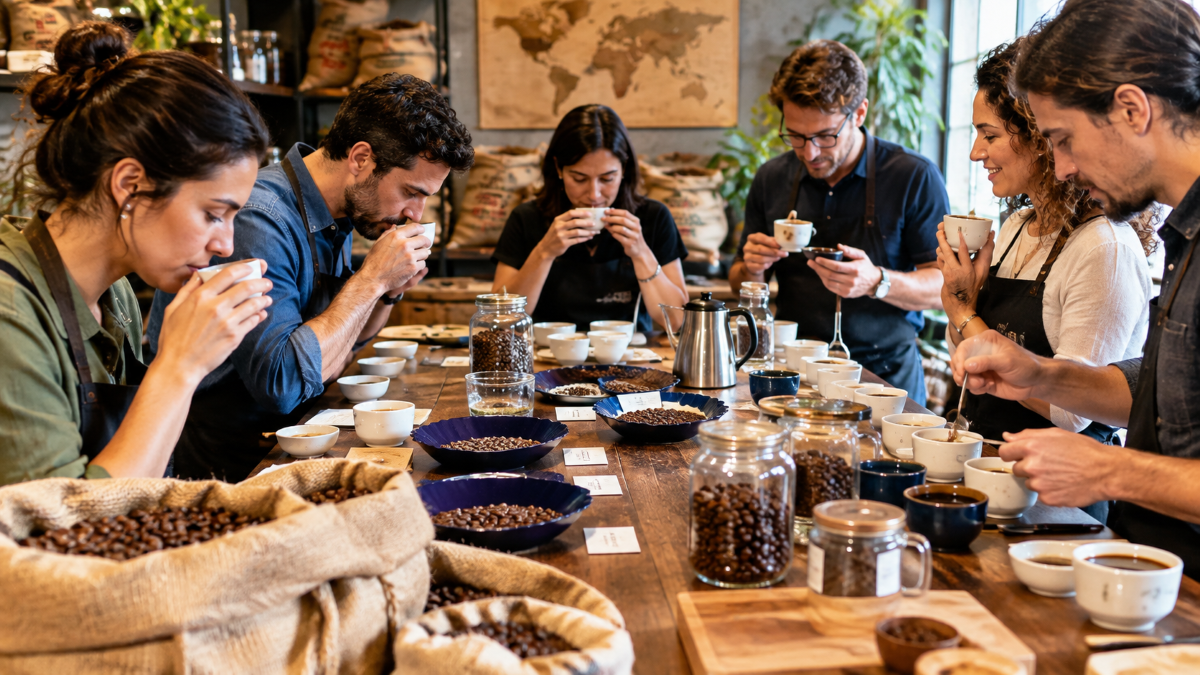
Blind Tasting adds an element of play to the experience. The most obvious information is hidden, and participants have to rely on their senses.
In front of them, for example, there may be three or four different coffees. The labels don’t reveal their origin, variety or characteristics. The task is to taste, observe, smell and compare.
And so a genuine sensory exploration begins.
The group can be invited to answer simple questions:
- Which coffee has the most intense aroma?
- Which tastes sweeter?
- Which has greater acidity?
- Which has a fuller body?
- Which might come from a particular geographical area?
- Which brewing method seems to have brought out the coffee’s characteristics best?
The answers are then shared. And this is precisely when individual tasting turns into a collective experience of listening and collaboration.
Sensory awareness as a metaphor for teamwork
A good team is not necessarily made up of people who think alike. Often, it’s the opposite: a group’s strength comes from its ability to bring together different skills, experiences and points of view.
Blind Tasting makes this concept immediately tangible.
One person may be more sensitive to aromas, another may more easily remember the characteristics they tasted earlier, while yet another may be particularly good at organizing the information gathered by the group.
There is therefore no single essential talent. Every participant can contribute to the final solution.
The value of differences in perception
During the tasting, it may happen that two colleagues describe the same coffee in completely different ways. One talks about cocoa, another about fruit, and a third about spices.
Rather than turning the difference into a disagreement, the activity can use it to prompt a much more interesting question: what can we learn from someone else’s perception?
This step is particularly useful in business settings, where feedback is often associated with performance evaluation. In cupping, however, feedback can become a process of shared discovery.
Reciprocal feedback: learning to listen before responding
One of the most interesting aspects of Coffee Cupping & Blind Tasting is the opportunity to work on the quality of reciprocal feedback.
During a tasting, it’s not enough to say “I like it” or “I don’t like it.” To be useful to the group, an impression must be turned into a description.
Saying “I find it more intense” is different from saying “I don’t like it.” Saying “I perceive more acidity” helps the other participants better understand the point of view being expressed.
This dynamic introduces an important skill for professional communication too: moving from judgment to description.
Describe, explain, listen
A possible outline for the activity can be very simple:
- Perceive: each participant observes and tastes individually.
- Describe: each person identifies aromas, sensations and characteristics.
- Share: perceptions are presented to the group.
- Listen: the other participants compare their own sensations.
- Discuss: the group identifies similarities and differences.
- Decide: a shared evaluation is reached.
The sequence is simple, but it mirrors many of the dynamics that characterize everyday work: gathering information, discussion, managing differences, summarizing and making decisions.
A multisensory Team Building experience in the heart of Rome
Rome offers a particularly interesting setting for creating coffee-themed experiences. The historic center, with its squares, historic cafés and coffee-break tradition, can become an integral part of the activity’s storytelling.
An experience can also be organized near some of the city’s best-known sights, creating an itinerary in which the tasting becomes a sensory interlude during a day devoted to discovering Rome.
At Turismo Roma, you can explore the capital’s many cultural and tourist attractions, while the National Roman Museum is one of the most important cultural landmarks for anyone wishing to combine an experiential activity with a discovery of the city’s historical heritage.
The Team Building activity can also be included in an itinerary that takes in iconic places such as Piazza Navona, the Pantheon or the Trastevere neighborhood.
Coffee Team Building: more than just tasting
Coffee Cupping can be enhanced with a range of challenges to create a more comprehensive experience.
Memory of Flavours
Participants can taste several samples and then try to recognize the characteristics they perceived. The goal is to work on sensory memory and the ability to associate a sensation with a description.
Blind Coffee Challenge
In this version, the group has to identify different coffees without knowing their origin in advance. Each team assigns a score to its guesses, and the answers are compared at the end.
Aroma Detective
Small containers can be used to present different aromas. Participants must identify them and match them to the characteristics they perceive in the coffee.
Team Coffee Blend
Another option is to create an ideal blend. Each team must decide which characteristics to highlight and how to combine different profiles, explaining the reasoning behind their choices.
In this case, the final result becomes a true metaphor for teamwork: every element contributes to the overall balance.
From bean to connection: what does the group take away?
The value of this experience goes beyond the tasting itself.
A well-designed activity can leave the group with a range of skills that can be applied to everyday working life:
- greater attentiveness when listening;
- the ability to describe one’s perceptions more precisely;
- openness to different points of view;
- the ability to give and receive feedback;
- collaboration in finding a shared solution;
- attention to detail;
- awareness of the value of individual skills.
The most interesting outcome, however, may be another one: discovering that you don’t have to perceive things in the same way to reach the same conclusion.
Why choose Coffee Cupping for a corporate activity?
Coffee Cupping & Blind Tasting is particularly well suited to companies looking for an experience that differs from more traditional formats. It doesn’t require any particular level of fitness, can be adapted to groups with different needs and allows for a strong narrative component.
It’s also a flexible activity: it can be a short Team Building session during a corporate event or become a more complete experience, paired with a tour, dinner, aperitif or other experiential activities.
Companies wishing to organize a customized activity in Rome can request a quote and put together a proposal based on the number of participants, the time available and the group’s objectives.
The true aroma of Team Building is collaboration
At the end of the tasting, when the labels are finally revealed, the most intriguing moment arrives: comparing your guesses with reality.
Some will have recognized the coffee. Some will have been completely wrong. Others will have picked up on a detail the rest of the group didn’t notice.
But the real victory won’t necessarily belong to the person who guessed the most samples correctly.
It will be the group’s ability to turn individual sensations into shared knowledge.
Because, just as with a cup of coffee, in teamwork too, we don’t always see, hear or interpret things in the same way. Learning to recognize these differences, talk about them and appreciate them can turn them from an obstacle into a resource.
And perhaps that is the most interesting lesson of Coffee Cupping & Blind Tasting: a good team isn’t one that perceives everything in the same way, but one that knows how to bring different perceptions together to go further.