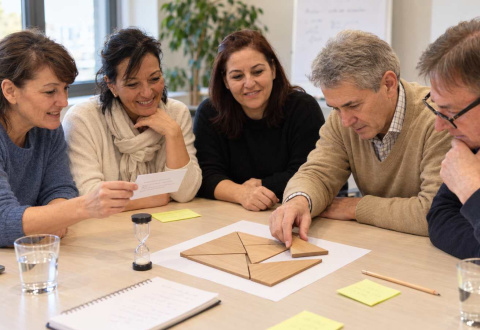



Team Building and Shared Leadership: what happens when the leader changes with every challenge
What if, during a team-building activity, the leader wasn’t always the same person? Imagine a team tasked with taking on a series of challenges, with a different person leading the group each time. Someone who is used to making decisions must learn to listen, while someone who usually stays in the background is called on to speak up, suggest solutions, and take responsibility.
This is the idea behind shared leadership, a collaborative model that helps bring out the strengths of every team member. Through hands-on experiences, team building can become a practical opportunity to discover that leading doesn’t necessarily mean giving orders, and that everyone’s contribution can make a difference.
When leadership becomes a team effort
In organizations, leadership is often associated with a hierarchical role. Someone makes decisions, someone coordinates, and someone carries them out. But what happens when a situation calls for different skills and the traditional leader doesn’t have all the answers?
Shared leadership starts with this very question. It doesn’t remove individual responsibilities or the need for people to look to for guidance, but invites us to recognize that the ability to lead can emerge in different people, depending on the context and the objective.
A team-building activity can make this principle immediately clear: each challenge gives a different participant the lead, and they must organize the group, gather ideas, and make decisions within a set time.
What do you discover when the leader changes?
People who are used to leading may discover how difficult it is to give others space without constantly stepping in. Those who tend to follow other people’s directions, on the other hand, may realize they have insights and decision-making abilities they have never had the chance to express.
A change of role challenges familiar habits, but above all helps people recognize the value of different perspectives. One person may be particularly effective at organizing a strategy, another at motivating the group, and another at finding a creative solution to an unexpected problem.
There isn’t necessarily one ideal leader: it’s about giving the person best suited to the challenge at hand the opportunity to step up.
Team-building activities that put leadership to the test
To experience shared leadership, you can design activities in which success depends on the ability to alternate between leading, listening, and collaborating.
Rotating challenges
The group takes on a series of challenges, such as a treasure hunt, an urban game, or a problem-solving challenge. At each stage, a different person is responsible for the team and must choose a strategy and coordinate their teammates.
The difficulty isn’t just reaching the goal, but managing to lead without centralizing every decision.
Missions with distributed information
Each participant has clues or information the others don’t. The leader for that round must learn to ask questions, listen, and build a shared solution without relying exclusively on their own knowledge.
This dynamic highlights how the quality of decisions depends on the ability to draw on the skills within the group.
Creative and decision-making challenges
From building an object to completing a project within a limited time, creative activities make it possible to observe different leadership styles. Some participants will be good at organizing the work, while others will know how to manage unexpected situations or spark innovative ideas.
The goal isn’t to identify who gives orders best, but to understand how different approaches to leadership can complement one another.
From the challenge to everyday life at work
The value of the experience doesn’t end when the challenges are over. The final debrief helps participants connect what happened during the activity to the dynamics they experience at work every day.
Did those who struggled to delegate learn something about how they manage responsibilities? Did those who led for the first time feel heard? Was the group able to accept an approach different from the usual one?
These questions can spark reflection on how decisions are made, responsibilities are distributed, and skills are recognized within the organization.
A carefully designed corporate team-building program can help develop mutual trust, autonomy, and adaptability. To achieve lasting results, however, it’s important to turn the insights gained into concrete behaviors after the experience, too.
A stronger team when the leader isn’t always the same
Shared leadership doesn’t mean that everyone has to decide everything, or that the manager’s role becomes less important. It means creating the conditions for people to take responsibility, contribute to decisions, and lead when their skills are most useful.
Team building makes this concept tangible: when the leader changes with every challenge, the group learns that following doesn’t mean being passive and leading doesn’t mean always being right.
The question to take back to the workplace is simple: are we making the most of everyone who could help lead the team, or do we keep relying on the same people?
Sometimes, all it takes to discover new forms of leadership is to change the rules of the game.
Want to try designing something new? Share your ideas with us:
Request a free quote and get all the information about your Team Building experience.
FAQ – Questions about shared leadership
What is shared leadership?
It’s an approach in which different people can take the lead based on their skills and the needs of the situation.
Why change leaders during a team-building activity?
To help participants try out new roles, develop autonomy, and better understand the challenges faced by both leaders and collaborators.
Does shared leadership eliminate the role of the company manager?
No. The manager retains their responsibilities, but can encourage greater participation and make the most of the group’s abilities.
How can you bring the experience into everyday working life?
By identifying behaviors to maintain, distributing some responsibilities more effectively, and creating opportunities to hear the ideas of different team members.