













































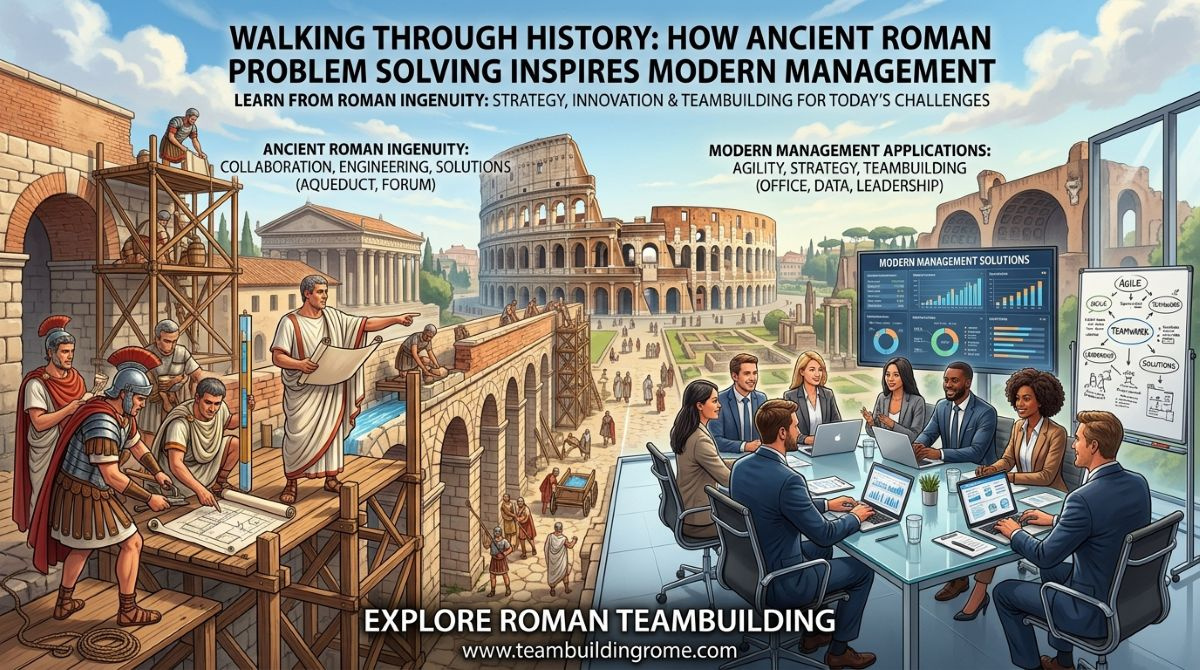
Strolling through History: how Problem Solving in Ancient Rome can inspire modern Management
Rome is not just a city to visit. It is an open-air laboratory where, even today, it is possible to observe traces of decisions, strategies, mistakes, insights, and solutions that helped shape one of the most influential civilizations in history.
Walking through the Roman Forum, the Imperial Fora, the Capitoline Hill, and the Palatine, you enter a scenario in which problem solving was not a skill to be added to a resume, but a daily necessity.
How do you organize a city that is constantly expanding? How do you manage infrastructure, trade, armies, and resources? How do you make decisions when the information available is incomplete? How do you coordinate people with different roles, skills, and interests?
Questions that are surprisingly up to date.
For this reason, Rome can become much more than a venue for a corporate event: it can turn into a true metaphor for modern management, where history becomes a tool to reflect on leadership, strategy, collaboration, and the ability to find solutions.
Ancient Rome as a Problem Solving practice ground
Let’s imagine we are in the heart of Ancient Rome.
The group walks along the Via Sacra. In front of their eyes appear columns, arches, basilicas, and the remains of buildings that once represented the city’s political and religious center.
At first glance, it seems like nothing more than a walk through history.
Then a question arrives:
“You have three minutes to find the solution.”
The group stops.
Someone observes. Someone looks for a detail. Another person suggests a hypothesis. A colleague challenges the first solution. Another tries to reconstruct the problem starting from information that seems apparently secondary.
In just a few seconds, the dynamics change.
There are no longer simply visitors in Rome.
There is a team that needs to think together.
And it is precisely here that historical heritage can meet team building.
From the monument to the problem
The value of an experience like this is not only in learning about a monument.
The real goal is to use the historical context to create situations in which the group must:
-
analyze information;
-
distinguish what is important from what is secondary;
-
formulate hypotheses;
-
listen to different points of view;
-
make decisions;
-
manage time;
-
adjust a strategy when it doesn’t work;
-
turn an individual problem into a collective challenge.
These are exactly some of the skills required every day by management.
The Roman Forum: when every decision had consequences
The Roman Forum is one of the most interesting places to tell this parallel.
For centuries, it was the center of the city’s political, religious, economic, and social life. It wasn’t simply a monumental space: it was a place where decisions were made that could influence the life of an entire society.
Today, while going through it during a team building activity, you can use this context to build a completely contemporary narrative.
Each team receives a mission.
There are information, constraints, objectives, and limited time.
There is not necessarily only one path to reach the solution.
And that’s the key point.
Problem Solving doesn’t mean finding the answer right away
In modern management, there is often an implicit belief: a great professional should know the solution immediately.
In reality, effective problem solving works differently.
A good team is not the one that always has the answer.
It’s the one that knows how to build it together.
During a challenge set in the Roman Forum, for example, one team might decide to follow a clue right away, while another might prefer to gather all the available information first.
Both strategies can be valid.
The difference lies in the ability to quickly assess risks, opportunities, and consequences.
It’s a dynamic very similar to what happens every day in companies.
The Capitoline Hill and the importance of perspective
From the Roman Forum, your gaze can shift toward the Capitoline Hill, one of the most significant points for understanding Rome and its urban evolution.
Here, another essential management skill emerges: changing perspective.
When we are immersed in a problem, we often see only part of the situation.
A team might focus on a single detail and lose sight of the overall objective.
For this reason, in problem solving, it’s essential to learn how to take a step back.
Look at the problem from above.
Reframe it.
Ask yourself:
“Are we trying to solve the right problem?”
Strategic thinking and the big-picture view
The ability to move from details to the overall vision is one of the most important competencies for a manager.
A team member may focus on execution.
A team leader, however, must be able to understand:
-
where the group is;
-
where it needs to get;
-
which resources are available;
-
which obstacles may appear;
-
which decisions must be made immediately;
-
which ones can be postponed.
A route through Rome can turn this dynamic into a concrete and memorable experience.
The Palatine: building a strategy before acting
Continuing toward the Palatine, the story changes again.
Here, team building can introduce another essential question:
Is it better to act right away or stop to plan?
It’s one of the most frequent dilemmas in business management.
Speed matters, but speed without direction can generate errors.
At the same time, overly long planning can make you miss opportunities.
So effective problem solving comes from the balance between analysis and action.
Strategy, time, and resources
Let’s imagine a test in which each team has a limited number of attempts and a set amount of time.
The team must decide:
who gathers the information?
Who coordinates?
Who checks?
Who makes the final decision?
Who controls the time?
What seems like a simple game actually reveals a lot about the group’s structure.
Leadership, organizational ability, communication, and priority management emerge naturally.
And that observation is exactly what makes team building interesting even from a managerial perspective.
What can Ancient Rome teach modern Management?
History doesn’t offer magic formulas.
But it can offer something just as important: perspectives.
Rome makes it possible to tell some management dynamics through real experiences.
1. The solution grows out of discussion
A group made up of people with different skills can arrive at a better solution than a single person working in isolation.
During a challenge, each participant can bring a different way of reading the situation.
So the skill isn’t about getting everyone to speak at the same time, but about creating the conditions for information to circulate.
Listen before deciding
One of the most common difficulties in teams is confusing decision speed with impulsive decision-making.
Listening doesn’t mean wasting time.
It means increasing the quality of the information available before choosing.
2. Mistakes can become information
A team that makes mistakes during a test doesn’t necessarily fail.
It has acquired information.
The strategy used didn’t work.
So it must be changed.
This simple step represents one of the most important principles of problem solving:
don’t defend a solution just because it was our first idea.
In management, this ability is crucial.
A market changes, a project takes an unexpected direction, a customer modifies their needs.
The initial strategy can suddenly become unsuitable.
An effective team doesn’t get stuck.
It adapts.
3. Leadership can be shared
During a team building activity in Rome, something interesting can happen.
The person who normally coordinates the group in the office might not be the one who stands out during a logical test.
A colleague who is usually quieter could identify the decisive clue.
Another person might prove particularly effective at coordinating time.
Another might stay calm during moments of higher pressure.
Every problem can bring out a different talent
This is one of the most interesting features of experiential problem solving.
There is no single form of leadership.
Depending on the situation, the following may be needed:
-
decision-making leadership;
-
organizational leadership;
-
creative leadership;
-
relational leadership;
-
technical leadership.
The value of the team lies precisely in its ability to activate the right talent at the right moment.
Rome becomes a big outdoor meeting room
The big advantage of using Rome as the setting for a corporate activity is that the context isn’t artificial.
The group moves through the space for real.
It has to orient itself.
Observe.
Interpret.
Compare.
Decide.
And in the meantime, it discovers the city.
A route can touch the Roman Forum, the Imperial Fora, the Capitoline Hill, and the Palatine, or be built in the historic center by including other symbolic places such as the Pantheon, Piazza Navona, Campo de' Fiori, Piazza Venezia, or the Jewish Ghetto, depending on the event objectives. The site already offers experiences in which monuments become an integral part of the game through riddles, missions, observation, and strategic decisions. (Teambuilding Rome)
So the city isn’t simply the backdrop.
It becomes part of the challenge.
From Team Building to Management: the true value of the experience
A well-designed problem solving activity shouldn’t end with the announcement of the winning team.
The most interesting moment comes afterward.
When the group stops and reflects on what has just happened.
Who made the first decision?
Did we listen to all opinions?
Did we change strategy when needed?
Who took on leadership?
Did we use the time well?
Did we share all the information?
And above all:
“Does what happened during the game resemble what happens every day in the company?”
That’s the question that turns a fun experience into a real learning moment.
Debriefing: when the game becomes training
Debriefing allows you to connect the experience to professional everyday life.
The team doesn’t analyze only who won.
It analyzes the process.
This makes it possible to identify behaviors that, when transferred to the workplace, can have a real impact:
-
how decisions are made;
-
how information is shared;
-
how mistakes are handled;
-
how conflicts are addressed;
-
how leadership is distributed;
-
how priorities are set;
-
how well the group manages to adapt to changes.
This is where team building stops being just entertainment and becomes a tool for organizational development.
Why choose a historical Team Building in Rome
A team building activity set in Ancient Rome makes it possible to combine culture, experience, play, and management skills.
It is especially interesting for:
-
companies organizing conventions and meetings in Rome;
-
international groups;
-
teams that need to improve collaboration and communication;
-
companies interested in developing problem solving and decision making;
-
corporate incentives;
-
groups that want to discover Rome through an active experience;
-
teams that want to work on leadership and strategy.
The advantage is twofold: on one hand, participants live an engaging experience; on the other, they can concretely observe the dynamics of their own group.
Indeed, the team building experiences proposed in Rome can combine history, urban games, treasure hunts, riddles, and strategic challenges, turning the city’s heritage into a setting for play and collaboration.
What Rome really teaches about Problem Solving
Perhaps the most interesting lesson isn’t about a specific technique.
It’s about an attitude.
Rome survived, grew, and transformed by going through crises, changes, conflicts, and new needs.
Every era required new solutions.
And that’s exactly what happens in companies too.
Problems change.
People change.
Markets change.
Technologies change.
A strategy that works today might not be enough tomorrow.
That’s why the real problem solver isn’t the one who knows all the answers.
It’s the one who knows how to ask the right questions, involve the right people, and modify the path when reality requires it.
In Rome, this philosophy takes on a special dimension.
Walking among the ruins of the Forum, observing the Capitoline Hill, or crossing the Palatine can make you feel like you are stepping into a story already written.
In reality, each group can rewrite it in its own way.
Because the true journey through history isn’t only about looking at what happened.
It consists of understanding how people dealt with the problems of their time.
And discovering that, two thousand years later, some of the most important questions are still the same.
Conclusion: from the Roman Forum to the meeting room
A good team building doesn’t simply take people out of the office.
It takes them out of their usual patterns.
And Rome, with its historical heritage and extraordinary concentration of POIs, provides an ideal setting to do that.
Here, a column can become a clue.
A square can become a map.
A monument can become a problem to solve.
A choice can become a strategy lesson.
And a simple walk through history can turn into a reflection on how a team communicates, decides, collaborates, and deals with uncertainty.
Because modern management can learn a lot from the past. You just have to change the way you look at it.





