




























Mixology & Team Chemistry: the art of cocktails to develop negotiation and precision in teamwork
When a cocktail becomes a Team Building lesson
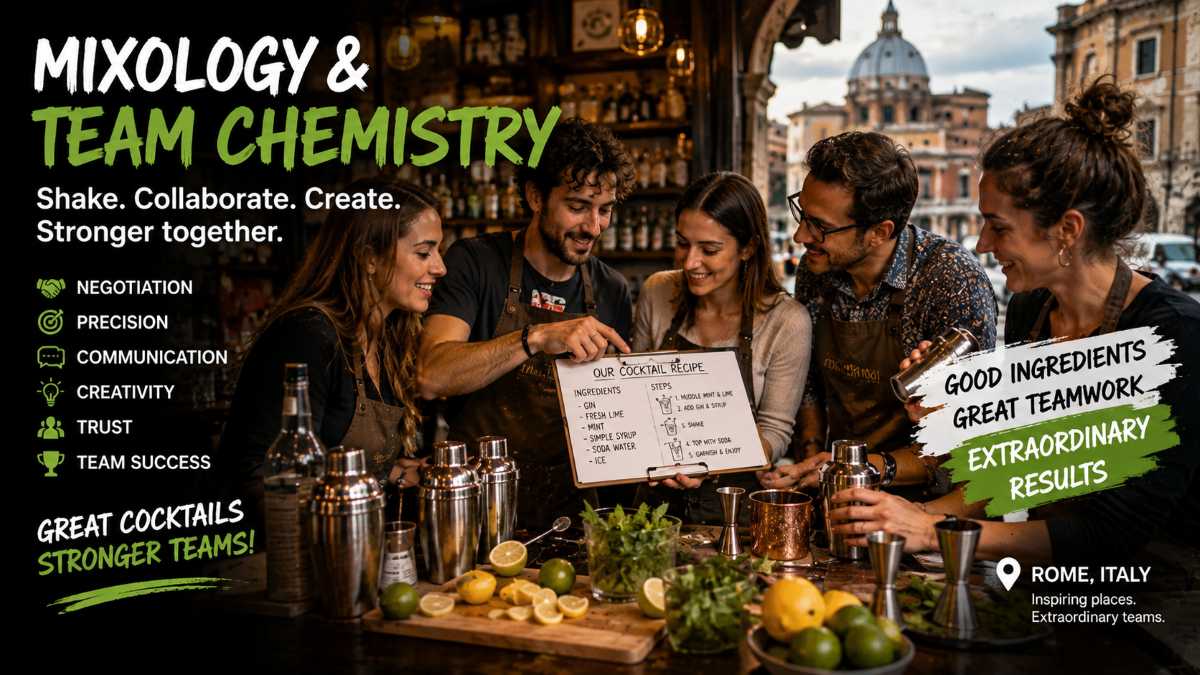
A bar counter.
Some shakers.
Glasses lined up.
Different ingredients, each with its own character.
And a team tasked with creating something that works.
It might seem like it’s simply the beginning of a Mixology Team Building in Rome experience.
In reality, behind the preparation of a cocktail lies a dynamic surprisingly similar to what characterizes a team’s work every day.
Because a good cocktail doesn’t come from putting ingredients together at random.
You need to choose.
Measure.
Listen.
Respect a sequence.
Coordinate.
Make decisions.
And, most importantly, understand that even a small variation can completely change the outcome.
Exactly like what happens in a work group.
Mixology thus becomes an experiential workshop where you can practice essential skills for the professional world: negotiation, precision, communication, listening, time management, problem solving, and collaboration.
And Rome, with its culture of hospitality and its extraordinary gastronomic tradition, provides the ideal setting to turn a simple aperitif into an original team-building experience.
The perfect metaphor: a team is like a cocktail
Let’s imagine a cocktail made with five ingredients.
Each one is indispensable.
But no one ingredient alone can produce the final result.
It’s a very effective metaphor for talking about business organization.
In a team, we can have:
-
a creative person;
-
an analytical person;
-
a result-oriented person;
-
a person who can mediate;
-
a person who is particularly attentive to details.
Different skills.
Different personalities.
Different work styles.
Just like the ingredients in a cocktail.
The challenge isn’t to make everyone the same.
It’s about finding the right balance among differences.
And that’s where Team Chemistry comes into play.
Team Chemistry: the alchemy that turns a group into a team
The so-called team chemistry isn’t simply the friendliness between coworkers.
It’s the ability of different people to coordinate in order to achieve a common result.
During a Mixology activity, this concept becomes immediately visible.
One participant might handle choosing the ingredients.
Another checks the quantities.
A third prepares the glass.
A fourth manages the presentation.
But who decides?
And what happens when two people have completely different ideas?
That’s exactly the moment when the activity becomes interesting.
The cocktail isn’t just something to produce anymore.
It becomes an exercise in collaboration.
Negotiation: finding the shared recipe
One of the most interesting aspects of Mixology Team Building is the need to make collective decisions.
Each team can receive a challenge:
create an original cocktail that represents a company value.
At this point, discussions begin.
What base should we use?
Which ingredient should be the main character?
Better something classic or innovative?
Sweet or dry?
Elegant or surprising?
Each choice represents a position.
And each position can be supported by a different person.
The point isn’t to win the discussion
Effective negotiation isn’t about convincing others to accept your idea.
It’s about finding a solution that allows the group to move forward.
During the preparation of a cocktail, this dynamic can be tested right away.
The team has to reach a decision.
Time is limited.
The ingredients are defined.
The result must be presented.
There’s no room for endless debates.
You need to listen, argue, and decide.
This is an extremely important skill for everyday work as well.
Precision: when a few milliliters make the difference
Mixology is also an extraordinary training ground for precision.
An ingredient can be great.
But if it’s used in the wrong amount, it can throw off the balance of the entire preparation.
It’s a perfect metaphor for the business world.
A small piece of information communicated badly.
A deadline not met.
A step skipped.
A neglected detail.
A task assigned without clarity.
Taken individually, these can seem like minor elements.
But together, they can influence the final outcome.
Precision doesn’t mean rigidity
Being precise doesn’t mean working without flexibility.
It means knowing the process well enough to know when to follow the rules and when to adapt.
Even the bartender works with a recipe.
But they have to be able to read the result.
If something isn’t balanced, they need to step in.
Likewise, an effective team doesn’t apply procedures automatically.
It uses them as a reference point and knows how to correct the route when necessary.
The time factor: working under pressure
During a Mixology Team Building activity, a time limit can also be introduced.
The team, for example, has only a few minutes to:
-
analyze the challenge;
-
choose the recipe;
-
distribute the tasks;
-
prepare the ingredients;
-
make the cocktail;
-
present it.
Time thus becomes a strategic element.
It’s not enough to know what to do.
You must decide in what order to do it.
Who does what?
This simple question can reveal a lot about a group’s internal structure.
A well-organized team tends to spontaneously distribute responsibilities.
A less coordinated group, on the other hand, risks concentrating too many activities on a single person.
Someone might take charge.
Someone else might wait for instructions.
One participant may try to do everything.
Another might stay in the background.
These are dynamics that often exist in everyday business life as well, but during a hands-on experience they become much easier to observe.
Rome: the cocktail meets the city
Mixology can become even more interesting when it’s included within a broader experience dedicated to discovering Rome.
In fact, the Capital offers plenty of inspiration for building a path where culture, conviviality, and teamwork speak to each other.
The setting can start with a location in the historic center or develop through some of the city’s symbolic places.
Piazza Navona: creativity and discussion
Piazza Navona is one of the most recognizable places in Rome.
Its history, the presence of the fountains, and Baroque architecture can become a narrative starting point for a creative challenge.
The team could be asked to design a cocktail inspired by an element of the square.
Not only in flavor.
Also in the name, the presentation, and the story to tell.
So preparation becomes an exercise in business storytelling.
Campo de' Fiori: ingredients, identity, and choice
Another POI particularly consistent with the theme is Campo de' Fiori, a place historically linked to commerce and the presence of the market.
Here, the theme of ingredients takes on a special meaning.
Each ingredient has its own characteristics.
The team must understand which ones to use and how to combine them.
It’s the same logic we find in an organization:
what skills do we have available, and how can we combine them in the most effective way?
Mixology and communication: speaking less, understanding better
A cocktail can also become an exercise in non-verbal communication.
Let’s think of a team where only one person knows the recipe.
The others have to follow their instructions.
Communication should be:
-
clear;
-
concise;
-
organized;
-
timely.
Saying “add a bit of this” isn’t particularly useful.
Saying “add 30 ml” is much more precise.
The difference can seem trivial.
At work, however, it can be enormous.
From the recipe to operational instructions
Good business communication should reduce ambiguity.
Anyone receiving a task must understand:
what to do, why to do it, by when, and with what expected result.
Mixology makes it possible to experience this principle in a concrete and fun way.
When communication is unclear, the cocktail suffers.
When communication is effective, the work flows.
Problem Solving: what if the recipe doesn’t work?
It’s probably the most interesting moment of the entire experience.
The cocktail is ready.
The team tastes it.
And something’s wrong.
Too sweet.
Too bitter.
Too strong.
Not balanced enough.
What do we do?
The team can freeze.
Or it can look for a solution.
This is the real essence of problem solving.
Don’t look for the culprit—look for the solution
In a real work situation, it can happen that a project doesn’t produce the expected result.
The spontaneous reaction can be:
“Who made the mistake?”
A more evolved approach starts instead from another question:
“What can we do now to improve the result?”
During a Mixology challenge, this difference becomes clear in just a few seconds.
You don’t need to find someone to blame.
You need to save the cocktail.
And it’s an extremely practical lesson.
Leadership behind the counter
Mixology can also be an interesting training ground for leadership.
Not necessarily the leader who speaks the loudest will stand out.
It could be the one who:
-
distributes the tasks;
-
listens to others’ opinions;
-
keeps the group focused;
-
manages time;
-
steps in when something isn’t working;
-
enhances the other people’s skills.
Leadership and delegation
A common mistake in teams is thinking the leader has to do everything.
During a Mixology challenge, this approach quickly becomes counterproductive.
If one person tries to choose the recipe, prepare the ingredients, use the shaker, manage the timing, and present the cocktail, the group loses efficiency.
Delegating, on the other hand, makes it possible to use the available skills.
Leadership therefore becomes the ability to orchestrate, not to replace others.
The cocktail as a metaphor for corporate culture
Another particularly interesting dimension concerns organizational culture.
Every company has its own “recipe.”
There are values that form the foundation.
Skills that make up the ingredients.
Processes that define the preparation.
People who contribute to the realization.
And a final result that should be recognizable.
During a Mixology experience, the team can be invited to create “the cocktail of its company”.
Which ingredients represent our team?
This question can spark a surprisingly rich discussion.
Is creativity an ingredient?
Trust?
Innovation?
Precision?
Speed?
Irony?
The ability to listen?
And above all:
which ingredient absolutely cannot be missing?
The answer can become a reflection tool on the group’s real identity.
Why Mixology works as corporate Team Building
An effective experience shouldn’t just entertain.
It should create situations where people can try behaviors different from those of everyday routine.
Mixology has exactly this quality.
It is:
Experiential
You learn through action, not just through theory.
Collaborative
The result depends on the contribution of multiple people.
Measurable
The final cocktail makes the effectiveness of collaboration immediately evident.
Creative
Each team can develop its own interpretation.
Engaging
The sensory dimension makes the experience memorable.
Adapted to different corporate roles
Managers, employees, and international teams can take part in the same challenge.
Mixology Team Building in Rome: who is it for?
This format may be especially interesting for:
-
companies that want to improve collaboration;
-
sales teams working on negotiation;
-
management teams;
-
international companies;
-
teams that are facing a phase of change;
-
new work groups;
-
companies looking for a social activity with training content;
-
groups that want to develop creativity and problem solving.
It can also be integrated with other team-building activities in Rome, creating a more structured program that alternates experience, culture, games, and training.
From the shaker to the team: what remains after the experience
At the end of the challenge, the tasting moment arrives.
Each team observes its own cocktail.
And often the result tells far more than the recipe.
It shows who took initiative.
Who listened.
Who mediated.
Who controlled the details.
Who managed pressure.
Who found a solution when something didn’t work.
In other words, it tells how the group worked together.
And that’s exactly the value of experiential Team Building.
It isn’t just about getting out of the office.
It’s about creating a situation where group dynamics can emerge in a new, informal, and stimulating setting.
The real teamwork recipe
If we had to turn the experience into a recipe, we could imagine it like this:
30% collaboration
20% communication
20% precision
15% negotiation
10% creativity
5% ability to improvise
Of course, there’s no universal formula.
And that’s the point.
As happens in Mixology, in teamwork too, balance is never completely static.
A team may need more creativity in one phase.
More precision in another.
More negotiation ability during a complex decision.
More speed when a deadline approaches.
The real competence lies in understanding which ingredient is needed, when it’s needed, and in what quantity.
Mixology & Team Chemistry: when the result comes from balance
A well-built cocktail isn’t the random sum of its ingredients.
It’s the result of balance.
The same applies to a team.
You don’t need identical people.
You need people who can bring different skills to the table and find a common language.
That’s why Mixology can become much more than just a fun activity.
It can turn into a concrete metaphor for collaboration:
choosing together, measuring skills, communicating precisely, negotiating differences, and correcting course when necessary.
In the end, the question won’t be only:
“How is the cocktail?”
But above all:
“How did we manage to create it together?”
And it’s in the answer to this second question that the real value of Team Building lies.