













































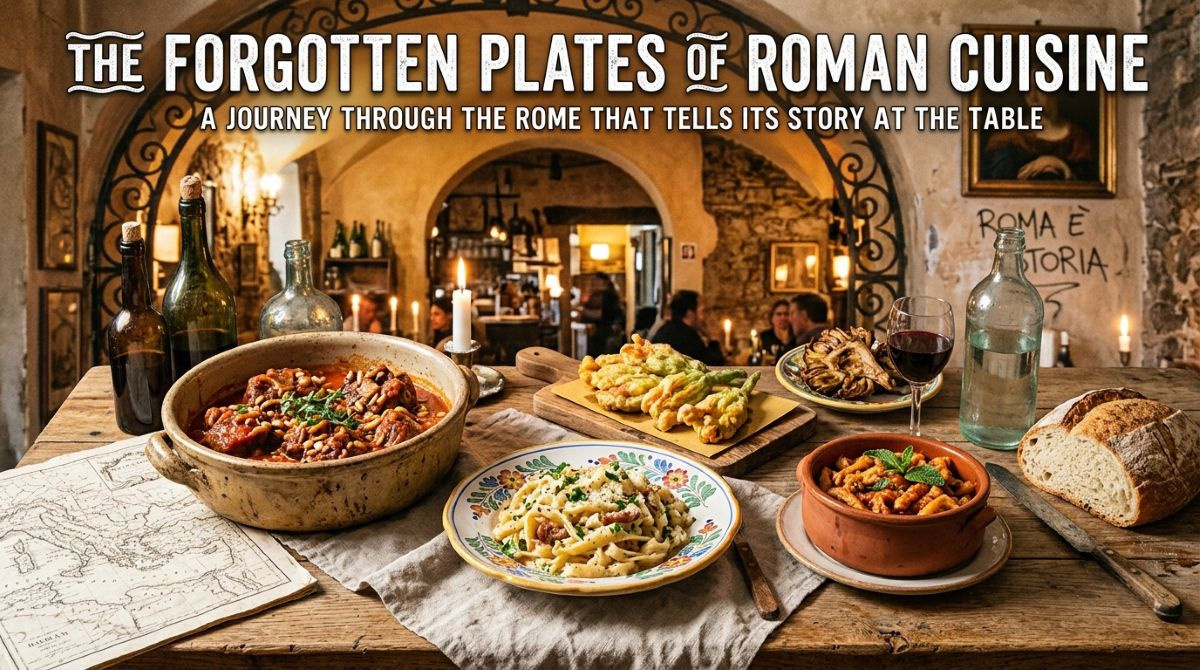
The forgotten dishes of Roman cuisine: a journey through Rome told at the table
Rome has a cuisine famous around the world.
Carbonara, amatriciana, cacio e pepe, gricia, saltimbocca, and oxtail alla vaccinara have now become ambassadors of Roman gastronomy far beyond the borders of the capital.
But just step away for a moment from the best-known dishes to discover another Rome.
A Rome made of poor man’s soups, offal, seasonal vegetables, underappreciated fish, broths, leftovers turned into recipes, and preparations that once belonged to everyday cooking in families.
These are the dishes of memory.
Recipes that tell a city in which nothing was supposed to be wasted—and in which cooking often began with the need to turn simple ingredients into something delicious.
Some are still found in trattorias that are most attentive to tradition. Others appear only occasionally. And others still survive mainly in the memories of those who ate them as children.
And it’s precisely this lesser-known gastronomic heritage that’s worth rediscovering.
Because knowing Rome doesn’t mean only visiting the Colosseum.
It also means sitting down at the table and listening to what a recipe has to say.
Roman cuisine before carbonara
When we talk about Roman cuisine, the temptation is to think immediately of the great classics.
But Roman gastronomy is much broader.
Popular Roman cuisine was born from the meeting of countryside, markets, butchers, vegetable gardens, the river, seasonality, and above all from the need to use every possible ingredient.
A fundamental role was played by the fifth quarter, that is, parts of the animal that did not belong to the noble cuts and were recovered and turned into tasty dishes.
Tripe, pajata, oxtail’s lower organs, sweetbreads, brain, and oxtail are some of the stars of this tradition. The story is also closely linked to the ancient slaughterhouse of Testaccio and the vaccinari, who helped spread this popular cuisine. (Gambero Rosso)
But the fifth quarter is only part of the story.
Alongside meat, there are soups, vegetables, fish, legumes, and very simple preparations.
A cuisine in which poverty of ingredients did not mean poverty of flavor.
10 Roman dishes to rediscover
1. Broccoli soup with arzilla
Perhaps it’s one of the dishes that best represents the lesser-known Roman food scene.
The arzilla, the Roman name for the breed, is used to prepare a broth in which broccoli and pasta are then cooked, often also using leftover bits of pasta.
The result is a flavorful soup, deeply tied to popular cooking and seasonality.
Turismo Roma recalls how this preparation was traditionally associated with Christmas Eve, the days of abstinence, and Lent. (Turismo Roma)
A recipe that tells the art of not wasting
The pasta could be made from small leftovers of different shapes.
Nothing was thrown away.
Every ingredient could find a second life.
It’s a principle we call sustainability today, but in Roman popular cuisine it already existed for generations.
2. Stracciatella alla romana
Today, the word "stracciatella" may immediately bring to mind ice cream.
In Rome, however, there is a completely different stracciatella.
It’s a soup made with meat broth, eggs, Parmigiano, nutmeg, and lemon zest.
The eggs are poured into the boiling broth and turn into small curds.
That’s where the name comes from: the eggs get "stracciated" (torn) during cooking.
Turismo Roma describes it as a preparation deeply linked to Roman family tradition and the recovery of leftover broth. (Turismo Roma)
A simple, almost home-style cuisine
It’s not a dish built to impress.
It’s a recipe that evokes the idea of family cooking.
A pot on the stove.
A good broth.
Few ingredients.
And a preparation capable of turning them into something deeply comforting.
3. Garofolato di manzo
Garofolato belongs to that category of preparations that tells of a Roman cuisine very far from contemporary trends.
It’s beef flavored with cloves and cooked slowly until it becomes tender and tasty.
The very name refers to the use of cloves as a flavoring element.
It’s a preparation that belongs to the repertoire of traditional Roman cuisine and the gastronomic culture in which slow cooking and simple aromas turned less noble cuts into important dishes.
Time as an ingredient
Today we’re used to quick recipes.
Garofolato, instead, tells another philosophy.
The meat must cook.
The sauce must concentrate.
The aromas must slowly infuse.
It’s almost the opposite of contemporary cooking based on speed.
4. Coratella with artichokes
Coratella is made from the inner organs of the milk-fed lamb (abbacchio) and is one of the most characteristic dishes of the Roman fifth-quarter tradition.
Traditionally, it’s associated mainly with the Easter period and can be prepared with artichokes, another major presence in Roman cuisine. Even today, the recipe is considered a classic of Roman Easter. (Gambero Rosso)
A dish that divides
It’s probably precisely this that’s its strength.
Coratella isn’t a neutral dish.
It has a strong character.
It requires curiosity.
And it perfectly tells a cuisine in which the idea of "scrap" did not match the idea of "useless."
The principle was very simple:
If an ingredient can be cooked well, it can become a dish.
5. Mixed fried Roman style
Before the term "street food" became international, Rome already had a long tradition of fried foods.
Mixed fried Roman style could include very different elements, from vegetables to offal, passing through preparations tied to everyday cooking.
Turismo Roma highlights in particular the traditional version with artichokes, spine marrow, and brains, to which other ingredients could be added. (Turismo Roma)
The secret is contrast
Crisp outside.
Tender inside.
Hot.
Fragrant.
To be eaten as soon as it’s made.
It’s, by definition, a convivial cuisine.
And precisely for that reason, it can also become an interesting starting point to tell Roman gastronomic culture during a corporate experience.
6. Meatball made from boiled beef leftovers
What to do with the meat left over after preparing boiled beef (bollito)?
The answer from Roman cuisine is simple:
transform it.
Meatballs made from boiled beef represent one of the great examples of the “recovery” cuisine.
The meat is worked again and becomes a completely different dish.
The philosophy of traditional Roman cuisine is indeed strongly tied to using few ingredients and the ability to turn them into different preparations. (Turismo Roma)
The second life of ingredients
Perhaps this is one of the most fascinating aspects of Roman cuisine.
A preparation didn’t necessarily end when it was served.
Leftovers could become the starting point for a new recipe.
Today, the concept of food recovery is associated with sustainability.
In traditional cooking, it was simply common sense.
7. Roman pajata: the dish that tells the fifth quarter
Pajata is probably one of the most identity-defining dishes of Roman fifth-quarter cuisine.
It’s the small intestine of milk-fed veal, traditionally prepared in the characteristic Roman way and served also with the sauce along with rigatoni.
Its story is closely linked to the gastronomic culture of Testaccio and the ancient slaughterhouse. Gambero Rosso includes pajata among the symbolic preparations of the Roman fifth quarter. (Gambero Rosso)
From poor food to gastronomic heritage
Pajata perfectly tells the relationship between Rome and recovery cooking.
What elsewhere could be considered scrap became a specialty.
And even today, it represents one of the most divisive and identity-based preparations of Roman street-level cuisine.
It doesn’t have to please everyone.
It’s enough that it helps people understand how deep the history hidden behind a dish can be.
8. Abbaccchio alla cacciatora
When we talk about Roman abbacchio, people often think right away of the "alla scottadito" version.
But tradition includes different preparations.
Abbaccchio alla cacciatora is a more rustic recipe, in which the meat is cooked slowly with aromas and seasonings that bring out its character.
The Abbacchio Romano IGP tradition includes numerous historic preparations and specifically identifies abbaccchio alla cacciatora among those that contributed to Roman culinary culture. (abbacchioromanoigp.it)
Time as an ingredient
Slow cooking is a fundamental part of the recipe.
The meat must become tender.
The aromas must blend together.
The result isn’t born from speed, but from patience.
It’s a culinary philosophy that today may seem almost against the current.
9. Padellotto di piedini e nervetti
Here’s another dish that belongs to the most authentic part of fifth-quarter cuisine.
Foot pieces (piedini) and nerve endings (nervetti) were highlighted through cooking and preparations that enhanced their texture and flavor.
It’s an extreme example of a philosophy that today is surprisingly modern:
use everything.
Contemporary cuisine talks about sustainability, waste reduction, and maximizing the use of raw materials.
Roman popular cuisine did it simply because it was necessary.
The Roman fifth quarter is born precisely from valuing parts of the animal that would otherwise have been considered less noble. (Gambero Rosso)
10. Roman cazzimperio
Let’s close with a completely different preparation.
cazzimperio is the Roman version of pinzimonio: a simple preparation based on raw vegetables seasoned with oil, salt, and pepper.
The tradition calls in particular for fennel and celery, and the dish has also been mentioned in Roman literature. Turismo Roma even links it to the gastronomic tradition of ancient times. (Turismo Roma)
When simplicity becomes identity
No elaborate cooking.
No dozens of ingredients.
No spectacular presentation.
And yet cazzimperio perfectly tells a part of Roman gastronomic culture:
seasonality, conviviality, and simplicity.
Testaccio: where the history of Roman cuisine meets the city
If there’s a neighborhood where the gastronomic history of Rome can be read almost like a book, that’s Testaccio.
Here stood the ancient slaughterhouse, and this place played an important role in the birth and spread of fifth-quarter culture.
So the neighborhood is far more than just an area to go and eat.
It’s a real GASTRONOMIC HUB.
Walking around Monte dei Cocci, the former slaughterhouse, the market, and the neighborhood streets, you can understand how the urban environment, work, and food helped shape Roman cuisine.
The history of the fifth quarter is indeed directly connected to the slaughterhouse workers of Testaccio—the so-called "vaccinari"—who contributed to the creation of this gastronomic tradition. (Gambero Rosso)
Monte dei Cocci and the city’s memory
Even Monte Testaccio is an extraordinary presence.
The artificial hill made from fragments of amphorae tells an ancient Rome connected to trade, goods, and consumption.
It’s a perfect example of how in Rome even a place that seems far from gastronomy can become a gateway to the history of food.
Trastevere: the Rome of trattorias and memory
If Testaccio tells mainly the relationship between market, slaughterhouse, and fifth quarter, then Trastevere tells a more convivial dimension of Roman cuisine.
Here, the trattoria becomes an integral part of the experience.
Close tables.
Voices.
Dishes in the middle.
Passed-down recipes.
Food isn’t simply nourishment.
It’s socializing.
And that’s exactly what makes Roman gastronomy especially interesting even for corporate team building.
From the Pantheon to Campo de’ Fiori: when Rome becomes a cooking classroom
Let’s picture an international group of colleagues.
In the morning, visit the Pantheon.
Then cross Piazza Navona.
Pass through Campo de’ Fiori.
Finally reach a kitchen where they find ingredients, utensils, and a forgotten Roman recipe.
The mission?
Discover the history of the dish, recognize the ingredients, and prepare it together.
This wouldn’t be just a cooking team-building activity.
It would be a journey through gastronomic Rome.
Every ingredient could become a clue.
Every recipe, a story.
Every dish, a test of collaboration.
Roman cuisine as Team Building
Rediscovering forgotten dishes can become a surprisingly effective corporate activity.
Because cooking together means:
-
assigning roles;
-
communicating;
-
respecting timing;
-
listening;
-
making decisions;
-
managing surprises;
-
sharing the result.
From recipe to team
Let’s think of a team that needs to prepare a traditional recipe.
One person weighs the ingredients.
Another prepares the vegetables.
A third monitors the cooking.
Another still reads the recipe.
Someone has to coordinate everything.
If one person works without communicating with the others, the result can be compromised.
It’s a perfect metaphor for corporate work.
A good recipe, like a good project, requires coordination.
The value of forgotten cuisine in international Team Building
For an international company, there’s also an additional advantage to a Roman gastronomic experience.
It allows you to tell the story of Rome without relying exclusively on the most photographed monuments.
The Colosseum is extraordinary.
The Pantheon is extraordinary.
Piazza Navona is extraordinary.
But a city’s true identity also lies in its everyday gestures.
In a recipe.
At a market.
In a trattoria.
In a preparation passed down from a grandmother.
A different Rome for those coming from far away
An international group might arrive in Rome knowing carbonara and pizza.
And set off again having discovered:
arzilla, stracciatella, the fifth quarter, garofolato, coratella, and cazzimperio.
That’s exactly the difference between seeing a city and living it.
The future is rediscovering what we risk losing
Roman cuisine doesn’t need to constantly invent new recipes.
Sometimes it just needs to remember the ones that risk disappearing from the table.
Contemporary gastronomy talks more and more about:
-
sustainability;
-
zero waste;
-
seasonality;
-
valuing raw materials;
-
short supply chains;
-
recovery;
-
tradition.
These are principles that Roman popular cuisine has known for centuries.
The fifth quarter made valuable what was not considered noble.
Broccoli soup with arzilla used simple ingredients.
Meatballs made from leftovers turned leftover meat into something new.
Cazzimperio highlighted raw vegetables.
Family recipes transformed a few ingredients into dishes capable of feeding many people.
The modernity hidden in tradition
And perhaps this is the most interesting message.
Some dishes seem "old."
But the ideas they represent are extremely modern.
Less waste.
More seasonality.
More creativity.
More sharing.
More respect for raw materials.
You can taste Rome also through its stories
So the next time we cross Rome, we can try to look at it with different eyes.
In front of the Colosseum, think of imperial Rome.
At the Pantheon, the history of the city.
At Campo de’ Fiori, the relationship between Rome and its markets.
Trastevere, the culture of trattorias.
Testaccio, the history of the slaughterhouse and the fifth quarter.
And in front of a bowl of broccoli soup with arzilla, a plate of coratella, or a simple Roman stracciatella, we can remember that food is also a form of memory.
Because a city isn’t made only of monuments.
It’s made of people.
Of habits.
Of words.
Of fragrances.
And of recipes.
The true richness of Roman cuisine is what we don’t yet know
Carbonara is known worldwide.
Cacio e pepe needs no introduction.
Amatriciana has gone international.
But precisely for that reason, perhaps, it’s time to go further.
Discovering the forgotten dishes of Roman cuisine means entering a more authentic Rome: made of less famous recipes yet able to tell everyday life, poverty turned into creativity, the value of recovery, and the pleasure of being together.
And it can also become an extraordinary idea for a gastronomic team-building experience in Rome.
Because when a group of people prepares an ancient dish together, they aren’t just cooking.
They’re recovering a story.
They’re learning something about the city.
They’re collaborating.
And in the end, they sit around the same table.
Just as it has always happened in Rome.
Because some recipes shouldn’t just be preserved. They must be lived again.





