

































Reverse Mentoring Games: when Gen Z teaches seniors and seniors surprise Gen Z
Imagine this scene.
A 23-year-old junior team member sits down in front of a manager with twenty-five years of experience.
Usually, in a company, we already know how things should go.
The senior speaks.
The junior listens.
The manager teaches.
The young person learns.
But this time, something changes.
There are no slides to follow or a lecture-style lesson on the table.
There’s a challenge.
The young person must explain how to use a new digital tool, interpret a trend, build an effective prompt for artificial intelligence, or talk about how language on social networks is changing.
Then comes the second round.
The positions are reversed.
The manager explains how they handled a business crisis, how they managed a difficult negotiation, why a professional relationship can take years to build and only a few minutes to damage.
The young man listens.
And suddenly, something becomes clear.
Experience doesn’t belong to just one generation.
And neither does innovation.
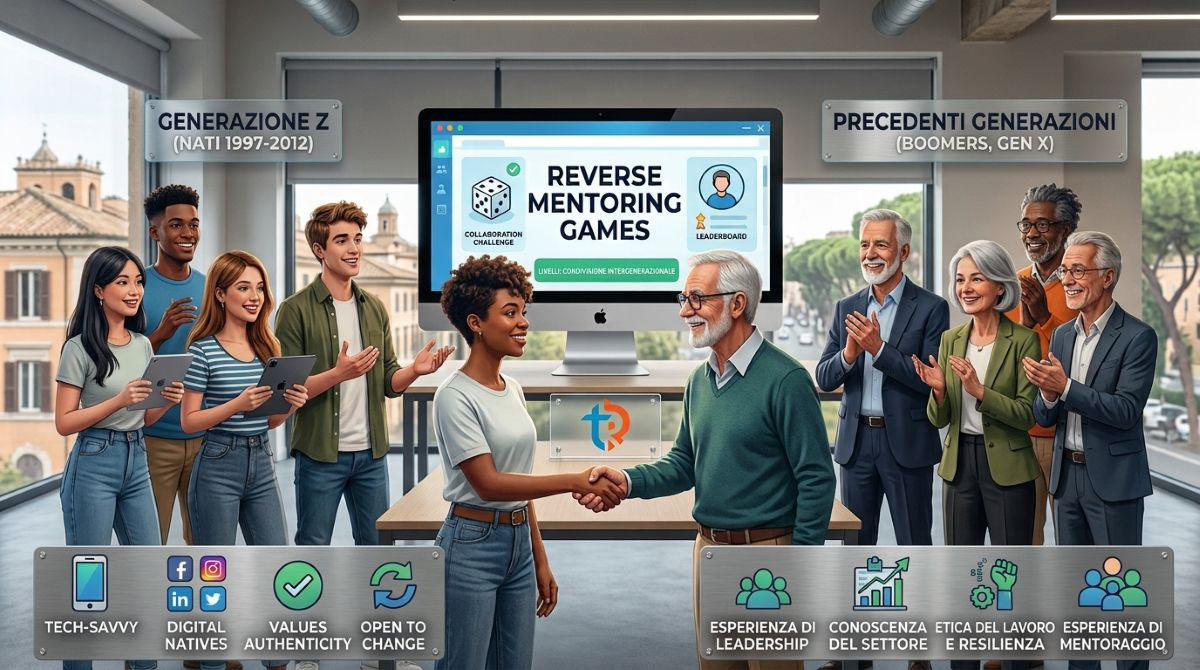
It’s exactly from this idea that Reverse Mentoring was born: an approach that temporarily flips the traditional mentor-mentee relationship and values the mutual exchange between people of different ages, experiences, and skills. In recent years, reverse mentoring has become increasingly common in discussions about the future of work and the relationship between young professionals and corporate leadership. (Indeed)
But what happens when Reverse Mentoring meets Team Building?
Something even more interesting happens.
Reverse Mentoring Games are created.
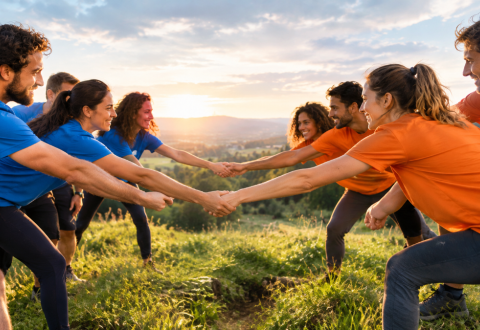
Games, challenges, and collaborative activities in which Gen Z, Millennials, and senior professionals aren’t separated into categories.
They’re put into teams.
And, above all, they learn to switch roles.
What is Reverse Mentoring and why it can transform Team Building
Reverse Mentoring is a process of mutual learning.
In an initial phase, often, younger employees share with senior colleagues skills and perspectives related to:
-
new technologies;
-
artificial intelligence;
-
social media;
-
digital languages;
-
new trends;
-
new communication methods;
-
culture of the new generations.
But the real value of Reverse Mentoring shouldn’t be one-way.
A senior professional can share equally valuable expertise:
-
decision-making experience;
-
relationship management;
-
leadership;
-
negotiation;
-
crisis management;
-
industry knowledge;
-
company historical memory.
The most important principle: everyone can teach something
In a Reverse Mentoring Game, the question isn’t:
“Who knows more?”
The question becomes:
“What can I teach you that you don’t know yet?”
And that’s a huge difference.
Because it turns generational diversity from a potential obstacle into a resource.
Why turn Reverse Mentoring into a game?
A traditional mentoring session can be useful.
But a game has an advantage.
It reduces pressure.
Breaking a company hierarchy isn’t always easy.
A young team member might feel intimidated when having to explain something to an executive.
A manager might be reluctant to admit they don’t know a digital tool.
The game creates a different space.
For a few hours, roles aren’t the only thing that exists.
There are teams.
There are missions.
There are points.
There are challenges.
There are shared goals.
Recent research on gamification applied to intergenerational reverse mentoring also suggests that combining playful learning with interaction between generations can increase engagement, motivation, and the transfer of skills. (MDPI)
Rome as a big laboratory for Reverse Mentoring
And which city is better than Rome to talk about generations?
Rome is, after all, a giant meeting between past and future.
In front of the Pantheon, a young person can photograph and share, in just a few seconds, a monument built nearly two thousand years ago.
At MAXXI, contemporary architecture speaks with innovation.
At EUR, the city of the twentieth century meets new companies, coworking spaces, and technologies.
At Cinecittà, the history of cinema can become the starting point for talking about new digital languages and content.
And among the streets of Trastevere, tradition continues to coexist with new generations, new habits, and new ways of living the city.
So Rome can become a perfect metaphor for Reverse Mentoring:
You don’t have to choose between the past and the future. You have to learn to make them talk to each other.
The Top Ten Best Reverse Mentoring Games
1. Digital Swap Challenge
Round 1: the digital challenge
The first game is simple only at first glance.
Participants are divided into intergenerational pairs.
Each person must teach the other a skill.
The younger participant can explain:
-
a new app;
-
an AI tool;
-
a digital feature;
-
an online trend;
-
a new communication method.
Round 2: the experience challenge
The senior must teach something that isn’t easily found in a tutorial:
-
how to handle a negotiation;
-
how to deal with a difficult client;
-
how to read a meeting;
-
how to make a complex decision.
What it develops
-
listening;
-
trust;
-
curiosity;
-
mutual respect.
The value of the game
In the end, every participant discovers that they are simultaneously a mentor and a mentee.
2. Generation Quiz Battle
A big intergenerational quiz.
But watch out.
It isn’t about deciding which generation is better.
The questions are divided into categories.
Gen Z category
-
digital languages;
-
social media;
-
AI;
-
new trends;
-
online culture.
Senior category
-
company history;
-
industry evolution;
-
major market changes;
-
professional experience;
-
real cases.
Teams must be mixed.
A young person alone can’t win.
A senior alone can’t either.
What it develops
-
collaboration;
-
sharing knowledge;
-
listening;
-
valuing differences.
Where to set it in Rome
A venue in the EUR area can be particularly interesting for building a game dedicated to the meeting between company history and the future of work.
3. Trend Radar Challenge
Each team receives a set of images, words, trends, and technologies.
The task is to build a real Future Radar.
The young people must explain which trends are emerging.
The seniors must assess which ones could truly impact the business.
At the end, a map is created with three areas:
To ignore
Trends that will likely be short-lived.
To watch
Interesting trends, but still to be understood.
To experiment with
Innovations that could be useful for the company.
The value of the game
Gen Z brings the ability to spot change.
Seniors add perspective and evaluation skills.
4. AI Prompt Relay
One of the most current games for Team Building 2026.
The teams receive a business problem.
For example:
“How can we improve internal communication?”
The first participant writes a prompt.
The second improves it.
The third adds context.
The fourth evaluates the result.
The team continues until it gets an answer that’s genuinely useful.
Younger participants can share familiarity with new tools and digital languages, while seniors can add experience, context, and critical thinking.
What it develops
-
AI literacy;
-
collaboration;
-
critical thinking;
-
the ability to formulate effective requests.
Microsoft resources dedicated to prompting emphasize the importance of clearly defining the goal, context, and expectations when building prompts. (Support Microsoft)
5. One Truth, Two Generations
An intergenerational reinterpretation of the famous game “one truth and two lies.”
Each participant shares three statements.
But they must relate to their generation or their professional journey.
For example:
-
“When I started working, email didn’t exist.”
-
“I learned how to use AI before my kids.”
-
“I’ve never had a social media profile.”
The others must guess which statement is true.
Then comes the most interesting part.
Each statement becomes the starting point for a conversation.
The result
The game breaks stereotypes.
Because you quickly discover that:
-
not all young people are digital experts;
-
not all seniors reject technology;
-
each person has a different story.
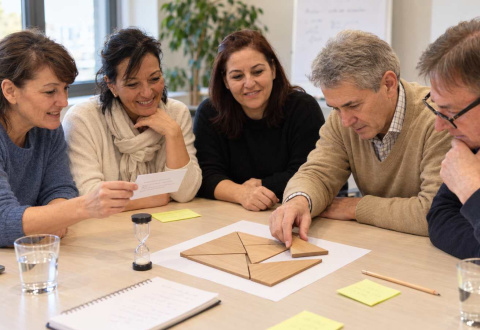
6. The Big Picture Puzzle
A large puzzle represents a perfect metaphor for Reverse Mentoring.
Each participant holds a piece.
No one has the complete picture.
Teams must rebuild the puzzle by collaborating.
The young person might have a skill.
The senior has another.
But the final result only comes when information is shared.
Miro’s template dedicated to the “Big Picture Puzzle” is designed specifically to work on collaboration, communication, shared vision, and teamwork. (miro.com)
The final debrief
The question is:
“Which part of our organization can we see only because of people who are different from us?”
7. Social Media Time Machine
A journey through generations.
Teams must build a timeline of communication.
From letters.
To fax machines.
From email.
To early websites.
From blogs.
To social media.
Up to AI-generated content.
Each generation explains how it experienced the change.
The young person explains
How trends are created and disappear today.
The senior explains
How professional relationships changed before permanent digital communication.
The result
A real Time Machine of corporate communication.
8. Reverse Elevator Pitch
Each participant receives a challenge.
They must present an idea from the other generation’s world.
A young person must defend a traditional approach.
A senior must present a futuristic innovation.
For example:
Gen Z must sell
A work method without smartphones.
The senior must sell
A business project fully supported by artificial intelligence.
The result is often fun.
But above all, it forces everyone to step into the other person’s perspective.
What it develops
-
empathy;
-
communication;
-
public speaking;
-
the ability to change perspective.
9. The Experience Exchange
This game can become one of the most emotional moments of the entire experience.
Each participant must complete two sentences.
“I’d like to learn…”
And then:
“I can teach…”
Responses are collected on a large digital wall.
Hidden skills suddenly emerge.
Someone knows how to use a new software.
Someone else knows an industry perfectly.
One person can speak in public.
Another has international experience.
A young person can teach a technology.
A senior can teach how to handle a difficult situation.
So Team Building becomes a real map of internal skills.
10. The Generation Innovation Lab
The grand finale.
Teams receive a real company challenge.
For example:
-
improving onboarding;
-
making meetings more effective;
-
improving internal communication;
-
creating a new service;
-
using AI more intelligently.
Each team must propose a solution.
But with one fundamental rule:
each generation must contribute at least one idea.
At the end, an internal jury evaluates the projects.
Criteria
-
innovation;
-
feasibility;
-
creativity;
-
collaboration;
-
the ability to integrate different perspectives.
The game can end with an award ceremony.
But the most interesting prize is something else.
Bringing a few ideas for real into the company.
Reverse Mentoring Games and POI of Rome: a city that teaches dialogue between generations
A Reverse Mentoring Team Building can become even more original if it’s set in symbolic places around the city.
MAXXI: the future meets the present
The MAXXI can inspire activities dedicated to innovation, creativity, and new forms of expression.
Here, the theme could be:
“What will the workplace look like tomorrow?”
Cinecittà: from big screens to new digital content
At Cinecittà, the discussion can focus on the evolution of communication.
From traditional cinema.
To television.
From social media.
To short-form content.
Up to generative artificial intelligence.
EUR: the architecture of the future imagined yesterday
The EUR is an extraordinary metaphor.
A district designed to represent an idea of the future that, in the meantime, has become history.
Perfect for asking:
“How do we imagine our company’s future today?”
Trastevere: tradition and new generations
At Trastevere, tradition and modernity coexist every day.
It can become the ideal setting for a challenge dedicated to communication, storytelling, and cultural differences.
For which companies is Reverse Mentoring Team Building ideal?
This format is particularly interesting for companies with teams made up of different generations.
Companies in digital transformation
When technology changes rapidly, exchanging skills can become essential.
Companies with young talent
Reverse Mentoring allows young people to feel more engaged and valued.
Companies with a strong presence of seniors
The experience built over time can be shared and turned into company assets.
International companies
The format can be adapted to multicultural and multigenerational teams.
Companies that want to improve internal culture
Because temporarily breaking hierarchies can help build more open relationships.
Skills developed by Reverse Mentoring Games
A well-designed Reverse Mentoring Game can work on many skills at the same time.
Communication
To teach something, you first need to learn how to explain it.
Listening
Each participant must be willing to learn from others.
Distributed leadership
Leadership moves from one person to another based on the required skill.
Curiosity
The group learns to ask questions instead of giving immediate answers.
Digital mindset
New technologies become a tool to understand together.
Intergenerational respect
Stereotypes make room for direct knowledge of people.
The real goal isn’t to teach: it’s to change perspective
Reverse Mentoring works for real when we stop thinking:
“Young people must learn from seniors.”
And we also stop thinking:
“Seniors must update themselves thanks to young people.”
The reality is more interesting.
Everyone has something to learn.
Everyone has something to teach.
Gen Z can help an organization look ahead.
Senior professionals can help the organization not to forget what it learned along the way.
One brings speed.
The other brings depth.
One spots change.
The other recognizes consequences.
And when these two energies meet, Team Building stops being just an activity.
It becomes a lab for the company’s future.
FAQ – Reverse Mentoring Games and intergenerational Team Building
What is Reverse Mentoring?
Reverse Mentoring is a learning model in which people with less professional seniority can share skills, knowledge, and new perspectives with more senior colleagues, within a exchange that can become truly mutual.
Can Gen Z really teach managers?
Yes. Young professionals can bring new skills and viewpoints related, for example, to technology, new digital languages, and cultural changes. At the same time, seniors can share experience, decision-making capability, and industry knowledge.
What are the best Reverse Mentoring games?
Among the most effective activities are Digital Swap Challenge, Generation Quiz Battle, Trend Radar Challenge, AI Prompt Relay, games based on storytelling, and challenges dedicated to solving business problems.
Can Reverse Mentoring be used in a Team Building?
Yes. Gamification makes it easier to break down hierarchical barriers and encourages a more spontaneous exchange between people from different generations.
How many participants can take part in a Reverse Mentoring Game?
The format can be adapted for small groups, company teams, and large corporate events by organizing intergenerational pairs, tables, or teams.
What’s the most important outcome of a Reverse Mentoring Team Building?
The most important outcome is to build a company culture in which people aren’t valued only for the role they hold, but also for what they can teach others.