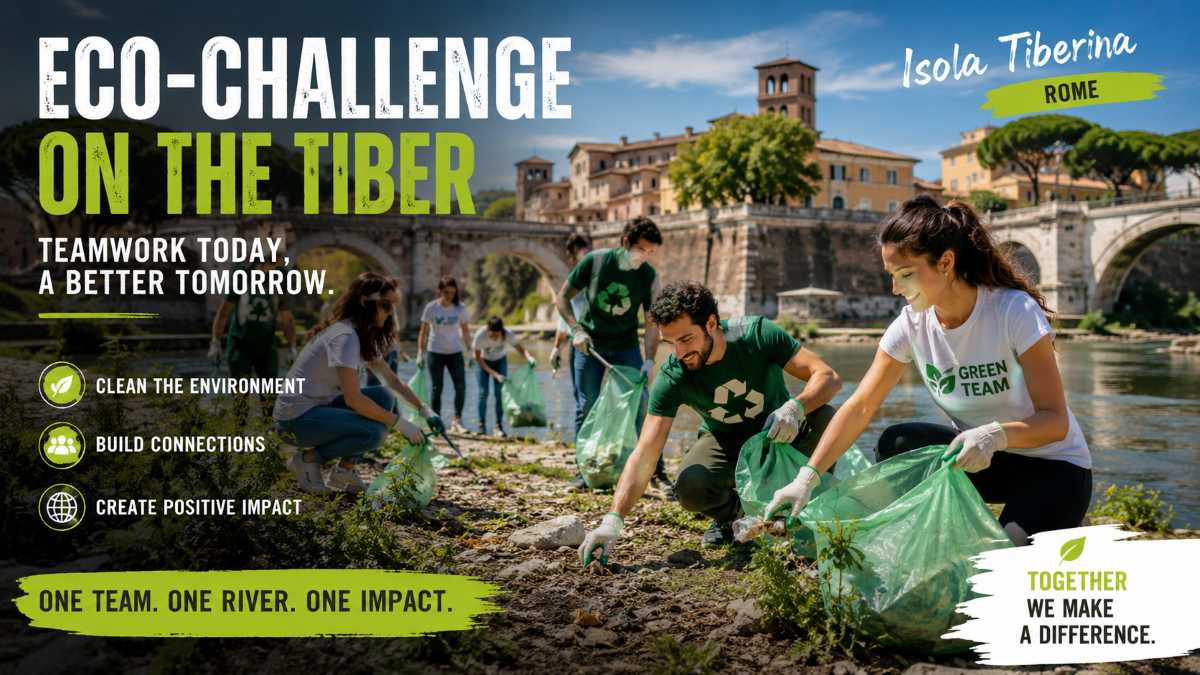
Eco-Challenge on the Tiber: Green Activities and Participatory Cleanup for a Real Social Impact
Rome has a special kind of noise.
It’s the sound of scooters, conversations in the squares, footsteps on the cobblestones, and trams crossing the city.
But there is a place where that noise changes.
It’s the Tiber.
Rome’s great river runs through the city, connecting neighborhoods, monuments, bridges, and landscapes that are very different from one another. Following its course, you encounter extraordinary places like the Tiber Island, Ponte Fabricio, Ponte Sant’Angelo, Castel Sant’Angelo, and Ponte Milvio. A historical and environmental heritage that makes the river far more than just a scenic backdrop: the Tiber is a living part of Roman identity.
But too often we only observe it from above.
From a bridge.
From a terrace.
From the window of a car.
Eco-Challenge on the Tiber proposes a change in perspective.
Don’t just watch Rome.
Try to take care of it.
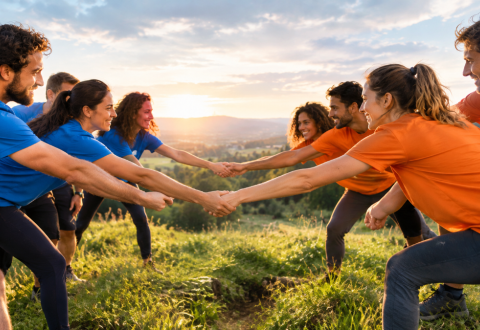
An experience of Green Team Building in Rome that brings together collaboration, gamification, outdoor activities, environmental education, and active participation—turning the energy of a corporate group into a concrete gesture for the local area.
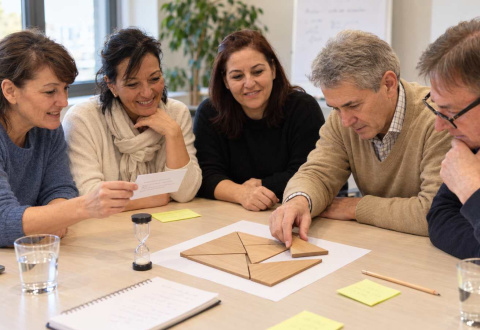
Gloves, missions, sustainability quizzes, challenges between teams, orientation, and shared objectives.
But above all, one question:
What can a team do when it decides to leave a positive impact, rather than simply living an experience together?
The answer can begin right along the Tiber.
When Team Building meets sustainability, CSR, and ESG
For many years, Team Building has been associated mainly with fun.
A treasure hunt.
A sports challenge.
A competition.
A team game.
Today, though, many companies are looking for something more.
They want to engage people, but also convey values.
They want to build relationships, but they also want to strengthen their connection with the local area and with social and environmental themes.
This is where activities dedicated to sustainability, Corporate Social Responsibility, and ESG principles come into play.
ESG stands for Environmental, Social, and Governance, and it represents an approach that leads organizations to increasingly consider the environmental, social, and organizational impacts of their activities.
Corporate sustainability is now also central in the European framework: the European Commission is deepening the topic of Corporate Sustainability Reporting and the relationship between business activities, people, and the environment.
But there is a big difference between talking about sustainability and actually living it.
A document can describe an objective.
An experience can turn it into a memory.
And that’s exactly the value of an Eco-Challenge for companies: turning concepts like responsibility, collaboration, and sustainability into a shared action.
The Tiber: a great story that runs through Rome
For centuries, the Tiber has been one of the city’s major arteries.
It has served as a route for communication, an economic resource, a boundary, and a fundamental element in Rome’s everyday life.
Even today, as also described in the in-depth piece dedicated to the Tiber on Rome’s official tourism portal, following the river’s course means moving through eras, neighborhoods, and landscapes that are completely different from one another.
From the bridges of ancient Rome to contemporary architecture.
From Trastevere and Testaccio to the more natural areas that accompany the river on its way toward Ostia.
An Eco-Challenge route can use this richness as a narrative element.
Each stop becomes a mission.
Each place tells something.
Each team is called not only to solve a challenge, but also to observe the local area with greater attention.
In this way, the Tiber becomes a perfect metaphor for teamwork.
Because a river isn’t made of just one element.
It’s the result of connections, territories, ecosystems, and tributaries.
Just like a team.
Eco-Challenge: the mission isn’t only about winning
The day can begin with a briefing.
Participants arrive, are divided into teams, and receive a mission.
This time, there isn’t just a hidden treasure to find.
The value of the experience is right in front of them.
Taking care of a shared space.
Naturally, a participatory cleanup along the Tiber cannot be improvised.
The areas must be selected appropriately, and the activity must be designed in compliance with permits, safety conditions, and the guidance of the competent authorities.
Rome’s city administration (Roma Capitale) also has structures dedicated to protecting and enhancing the river: the Tiber Enhancement Office (Ufficio Valorizzazione del Tevere) handles monitoring, protection, enhancement, and project planning dedicated to river areas.
This is a key point.
Authentic ESG activity doesn’t simply mean handing out a bag and asking people to pick up litter.
It means building a responsible project.
It means knowing:
-
where to intervene;
-
how to intervene;
-
which materials to use;
-
how to correctly manage what is collected;
-
which parties to involve;
-
how to measure the result.
For sustainability to be credible, it must be organized.
A possible format: Tiber Eco-Challenge
Phase 1 – Green Welcome & ESG Mission
The experience begins with a welcome moment.
A facilitator presents the mission of the day and introduces the group to the topic of sustainability.
The teams receive the information they need to face the experience in an organized and safe way.
The briefing may include:
-
an introduction to ESG principles;
-
an explanation of the missions;
-
guidance about the area;
-
safety rules;
-
team division;
-
presentation of the scoring system.
The first challenge: understanding before acting
Even before the outdoor activity, teams can tackle quizzes and challenges dedicated to:
-
circular economy;
-
waste reduction;
-
responsible consumption;
-
biodiversity;
-
Agenda 2030;
-
environmental responsibility;
-
daily behaviors.
The message is simple:
before solving a problem, you need to learn to recognize it.
Phase 2 – Green Orienteering along the Tiber
Then the game really gets going.
The teams receive a map or a digital system of missions and must navigate along a pre-set route.
Each stop proposes a challenge.
The fastest team doesn’t necessarily win.
Winning means combining best:
-
organization;
-
strategy;
-
collaboration;
-
attention;
-
precision;
-
decision-making ability.
Because sustainability too requires a strategy.
In addition, the Eco-Challenge can take inspiration from the dynamics of outdoor Team Building and gamification activities already included among Team Building Rome’s proposals—this time integrating an environmental and social mission.
POIs of the Tiber: Rome becomes a big sustainability map
Tiber Island: the heart of the river in the heart of the city
Tiber Island is one of the most fascinating places that can be told about along a route dedicated to the Tiber.
It’s the only urban island in the river and represents an extraordinary meeting point between history, legend, and contemporary life.
Its position between the two sides of the city also makes it a perfect metaphor for connection.
A team, just like a bridge, connects people, skills, and different perspectives.
During the Eco-Challenge, this stop can offer reflection on the concept of ecosystem.
No one works completely alone.
Every choice has consequences.
Every behavior can influence others.
And it’s precisely this interdependence that is one of the fundamental principles of sustainability.
Ponte Fabricio: resilience built over time
Tiber Island is connected to the banks of the Tiber also through the famous Ponte Fabricio, built in 62 B.C.
As mentioned in the in-depth piece dedicated to the bridge system on the Tiber, many of these crossings still represent extraordinary examples of Roman history.
A stop dedicated to Ponte Fabricio can become a challenge about resilience.
The question for the teams could be:
What are the elements that allow a project to last over time?
The answers can include:
-
quality;
-
maintenance;
-
long-term vision;
-
adaptability;
-
shared responsibility.
Exactly the same elements needed to build a sustainable corporate strategy.
Ponte Sant’Angelo and Castel Sant’Angelo: the value of transformation
Following the course of the Tiber, you come across some of the city’s most iconic views.
Ponte Sant’Angelo leads to the majestic Castel Sant’Angelo, creating one of Rome’s most recognizable panoramas.
This area can become a stop dedicated to the concept of transformation.
Because places change function over time too.
And companies must learn to do the same.
Transform without losing your identity.
Innovate without forgetting responsibility.
Look to the future without ignoring the territory where you operate.
Ponte Milvio: the river as a meeting point
Further north, Ponte Milvio is another important landmark along the Tiber.
Today it’s known as one of the city’s meeting places, but its history goes back to ancient Rome.
In a corporate format, it can become the ideal stop for a mission dedicated to connection.
An effective team isn’t made only of competent people.
It’s made of people who are able to create connections.
Between departments.
Across generations.
Between ideas.
Between different goals.
Phase 3 – The green mission and participatory cleanup
Then comes the most concrete moment of the day.
The teams take on the environmental mission planned by the project.
The activity can be organized with the support of associations, institutions, or specialized partners in environmental protection and in managing volunteer initiatives.
A useful reference for understanding how environmental volunteer days are organized is the platform dedicated to Legambiente volunteering, where initiatives are presented, including environmental cleanups, excursions, and other activities dedicated to caring for the area.
The principle is important:
it’s not an individual gesture, but a collective action.
Someone observes.
Someone coordinates.
Someone records data.
Someone supports the team.
Someone documents the result.
And slowly something interesting happens.
Hierarchies become smaller.
People start collaborating spontaneously.
Those who normally work behind a screen may end up organizing a team.
Those who speak little during meetings may become the best observers.
Those who don’t like competition can become the group’s balance point.
This is one of the most interesting features of experiential Team Building.
People can show skills that, in everyday routine, remain invisible.
From gesture to data: how to measure an ESG impact
A sustainable activity becomes even more valuable when the outcome can be communicated in a concrete way.
At the end of the Eco-Challenge, teams can take part in an impact measurement moment.
Of course, the indicators must be defined realistically and consistently with the activity actually carried out.
Among the data that can be collected:
-
number of participants involved;
-
duration of the activity;
-
participation hours;
-
missions completed;
-
amount and type of materials collected, when planned and correctly managed;
-
results of the challenges;
-
contribution to any projects or associations;
-
level of team participation.
The day’s Impact Report
A short Impact Report can become the concluding document of the experience.
Not necessarily a complex sustainability report.
Rather, a transparent summary of the day.
A way to tell:
What we did.
How many people we involved.
Which missions we completed.
What concrete result we achieved.
What we can do next.
And it’s precisely the word “next” that makes the difference.
Sustainability shouldn’t be just an event.
An experience can become the starting point for a broader project.
Corporate volunteering: when the company meets the local area
More and more organizations look for experiences that engage people also in terms of values.
Corporate volunteering can be an opportunity to build a more direct relationship between the company, employees, and the local area.
The experience becomes especially meaningful when it isn’t perceived as an obligation.
But as a shared choice.
A moment when the company says:
“Today our team can do something together for a place that belongs to everyone.”
Legambiente’s environmental volunteering initiatives are an example of how participation can turn into concrete action to protect territories and ecosystems.
Even the Tiber is now at the center of enhancement projects and strategies.
Through its work dedicated to protecting river areas, Roma Capitale considers the river an environmental resource and an important element for the quality of urban life.
The city is also working on redevelopment and enhancement programs for the river system, as shown by projects dedicated to regenerating the urban stretch of the Tiber and creating new spaces to enjoy along the river.
For a company, getting involved in this discussion means understanding that the territory isn’t simply the location of an event.
It’s part of the experience.
Eco-Challenge and ESG: be mindful of greenwashing
Talking about sustainability is important.
Acting is even more important.
But there is a fundamental difference between an activity truly designed to generate impact and a simple promotional message.
That’s why a good ESG format should avoid excessive promises.
A single day can’t “save the Tiber.”
A Team Building event can’t solve complex environmental problems on its own.
But it can do something equally important:
build awareness and turn a group of people into active participants.
It can create attention.
It can produce a concrete, measurable result.
It can support a project.
It can involve associations.
It can inspire different behaviors.
It can help a company reflect on its own impact.
Credible sustainability starts right from here.
From the ability to recognize what we can truly do.
And then do it well.
The skills developed by a corporate Eco-Challenge
Collaboration
Each team must distribute roles and responsibilities.
Leadership
In new situations, different leaders may emerge compared to the normal work routine.
Problem Solving
Teams must interpret information, take on missions, and find solutions.
Communication
Good organization requires clear guidance and mutual listening.
Responsibility
Each participant understands that their actions have consequences for the collective outcome.
Systems thinking
The activity allows reflection on the relationship between individual behaviors, organizations, communities, and the environment.
Why choose the Tiber for Green Team Building in Rome?
Because the Tiber is an extraordinary metaphor.
It brings people together.
It runs through.
It transforms.
It receives.
It gives back.
It’s history and nature at the same time.
Organizing an Eco-Challenge along the river also means remembering that Rome isn’t made only of monuments.
Rome is an ecosystem.
And ecosystems work when every element is respected.
The theme of enhancing river areas is also central in Roma Capitale’s activities, which—through the dedicated office for Tiber enhancement—promotes protection, monitoring, and redevelopment projects for areas connected to the river.
So, the Tiber isn’t just a backdrop.
It can become the protagonist of a new idea of Team Building.
A customizable format for companies and international groups
The Eco-Challenge on the Tiber can be designed according to the company’s needs.
Number of participants
The format can be structured for small teams or larger corporate groups, with parallel teams and missions.
Duration
It can turn into an activity lasting a few hours or become part of a full corporate day.
Objectives
The company can choose to give more space to:
-
environmental sustainability;
-
collaboration;
-
corporate volunteering;
-
gamification;
-
CSR;
-
ESG training;
-
knowledge of Rome.
Partners and associations
When the activity involves concrete interventions on the territory, it’s possible to evaluate collaborations with associations and competent organizations.
The end of the experience
The day can end with:
-
ESG debrief;
-
aperitivo;
-
lunch or dinner;
-
symbolic awards;
-
presentation of the Impact Report;
-
support for an environmental project;
-
corporate follow-up activities.
For companies looking for other experiences dedicated to social impact and sustainability, it may be worth exploring the proposals in the Team Building Socials, Sustainability, and ESG section of Team Building Rome.
From the Tiber, a lesson for the future of Team Building
At the end of the day, the teams come together.
The missions are finished.
The results are collected.
People share what happened.
Someone looks at the river.
Maybe for the first time they don’t see it only as part of the Roman panorama.
They see it as something closer.
Something that concerns everyone.
And that’s precisely the most important result of an Eco-Challenge.
Not just the score.
Not just the leaderboard.
Not just the final photo.
But the awareness that a group can do a lot when it decides to move in the same direction.
A company is made of people.
People make choices.
And those choices—even the ones that seem small—shape how an organization relates to the world.
Maybe the future of Team Building will not only be about asking:
“How much did we have fun?”
But also:
“What positive thing have we left behind?”
On the Tiber, this question takes on a special meaning.
Because a river always continues its journey.
And every gesture we choose to make today can help make tomorrow’s path better.
FAQ – Eco-Challenge on the Tiber and ESG Team Building
1. What is a corporate Eco-Challenge?
It’s a Team Building activity dedicated to sustainability that can combine games, collaborative missions, orienteering, environmental training, and concrete actions designed with partners and competent organizations.
2. Can a participatory cleanup be organized along the Tiber?
Yes, but it must be planned exclusively in areas and with methods permitted, respecting permits, safety, and procedures established by the competent authorities.
3. What skills does this activity develop?
Collaboration, communication, leadership, problem solving, organization, individual responsibility, and systems thinking.
4. Why is the activity connected to ESG principles?
Because it allows environmental and social topics to be addressed concretely by involving people in an experience dedicated to responsibility, participation, and the relationship with the local area.
5. Is it possible to measure the result of the Eco-Challenge?
Yes. It’s possible to define indicators related to participation, activity hours, missions completed, and—when planned and correctly managed—the concrete outcomes of the initiative.
6. Is the Eco-Challenge suitable for international groups too?
Yes. The format can also be delivered in English or as a multilingual version, and it can integrate storytelling dedicated to the history of the Tiber and the main POIs in Rome.