













































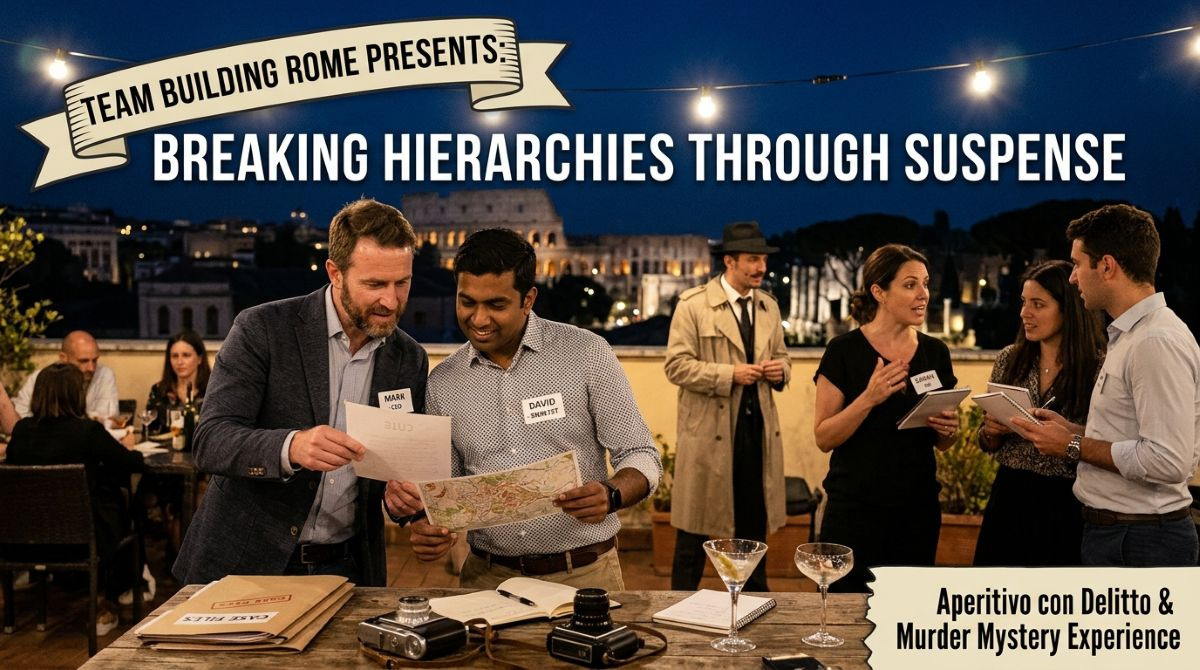
Aperitivo with a Murder Mystery and Murder Mystery: how suspense breaks down hierarchical barriers in Team Building
In the modern landscape of Human Resources and Corporate Welfare strategies, employees’ emotional engagement and overcoming organizational rigidity are among the toughest challenges for high-performance companies. Between the historic alleyways and noble palaces of the Capital, a particular experiential format is changing the way businesses build cohesion: Aperitivo with a Murder and the investigative dynamics of the Murder Mystery.
But what are the psychological, social, and narrative mechanisms that allow a police-style riddle to turn into a powerful catalyst for trust—capable of connecting a CEO with the most recent intern?
1. The Psychology of Suspense: Disassembling Corporate Routine
In conventional workplace settings, communication flows inevitably follow the structure of the organizational chart: leadership sets the guidelines, middle managers coordinate, and operational collaborators carry them out. While this model is necessary for day-to-day efficiency, it often risks creating psychological barriers, shyness toward leadership, and reduced circulation of cross-functional ideas.
Investigation-based formats built on role play and suspense introduce a phenomenon known in psychology as the suspension of disbelief. When the team is immersed in an emergency narrative scenario (a crime to be uncovered, a clue to interpret, or an alibi to dismantle), the perception of corporate roles makes way for achieving the common goal.
The Investigation Paradox: When Logic Beats the Org Chart
During a clue hunt or a guided interrogation, formal competencies temporarily lose their central role in favor of soft skills and individual intuition:
-
Breaking Down Information Silos: A cryptic clue requires instant sharing of ideas. Keeping information to yourself means losing your team.
-
Democratizing Input: The authority at the investigation table does not come from your job title, but from analytical sharpness, active listening, and lateral thinking (out-of-the-box thinking).
-
Distributed Leadership: It’s not rare to see usually reserved figures take the lead in the discussion thanks to strong deductive logic or synthesis skills.
According to numerous studies on the psychology of game-based learning applied to work published in Harvard Business Review, game-based learning (game-based learning) stimulates neural plasticity, increases stress tolerance, and significantly reduces communication inhibitions between different hierarchical levels.
2. Narrative Storytelling and Genius Loci: Rome as a Theater of the Enigma
Unlike traditional activities carried out in anonymous conference rooms, a Murder Mystery in Rome draws its disruptive power from the city’s extraordinary historical and monumental heritage. The architectural setting of Rome isn’t just a backdrop—it becomes a true co-protagonist in the plot.
+-------------------------------------------------------------------------+
|                  THE FLOW OF THE INVESTIGATIVE EXPERIENCE                  |
+-------------------------------------------------------------------------+
|  1. BRIEFING & STORYTELLING  -->  2. CLUE HUNT IN THEN THEN           |
|     The riddle is presented       Dynamic exploration of historic places    |
|     by professional actors.        (Pantheon, Trastevere).     |
|                                                                         |
|  3. DECODING & DEBATE   -->  4. APERITIVO & FINAL ACCUSATION          |
|     Teamwork to connect           Conviviality on rooftops,            |
|     the evidence collected.    uncovering the culprit and toasting.|
+-------------------------------------------------------------------------+
From the Shadows of the Pantheon to the Secrets of Roman Neighborhoods
Integrating Points of Interest (POI) into game dynamics makes it possible to combine teambuilding with experiential cultural tourism:
-
The Renaissance Mystery at the Pantheon: Among the majestic columns of one of antiquity’s best-preserved monuments (curated by Ministry of Culture - MiC), teams decipher symbols and riddles linked to ancient secret codes.
-
Spy Story through Trastevere’s Lanes: The neighborhood’s bohemian atmosphere lends itself perfectly to simulated tailing, the exchange of confidential information, and meetings with professional actors hidden among the historic corners.
-
Dinner with a Murder in a Noble Palace: Near Piazza di Spagna, the drama is dressed in elegance, catapulting the team into a period atmosphere where every guest is potentially a suspect.
-
Investigations with a View: From rooftops overlooking the Colosseum or in the secret courtyards of the Monti neighborhood, the city’s visual beauty acts as a natural relaxant, encouraging participants to engage in open discussion.
3. The Informal Aperitivo: Conviviality as a Catalyst for Trust
If the investigative phase fuels positive competition and analytical reasoning, the transition to the Aperitivo is the moment when the experience takes hold on a human level.
The combination of dopamine (generated by the game and the resolution of the riddle) and oxytocin (triggered by the conviviality of food and wine) fosters an atmosphere of deep empathy. When the culprit is revealed and the curtain falls on the Murder Mystery, the discussion naturally shifts to the investigation’s details. The CEO and the employee end up laughing about the mistakes made or celebrating the brilliant insight that led the team to victory—strengthening interpersonal relationships that will last well beyond the event.
4. Frequently Asked Questions (FAQ) about Murder Mystery and Aperitivo with a Murder
To support HR Managers and Decision Makers in organizing the perfect corporate event, we’ve gathered answers to the most common questions:
How do you adapt an Aperitivo with a Murder for very large groups?
Our formats are scalable and modular. For large groups (over 50–100 participants), the group is split into independent “investigative teams” that compete in parallel, interacting with the same actors or solving interconnected subplots.
Is it also suitable for international participants?
Absolutely yes. Our investigation formats can be managed entirely in English or in a multilingual setup (up to 6 languages) thanks to a team of native-speaking actors and moderators.
What happens in case of bad weather if the activity includes outdoor stops?
All of our experiences include an Plan B indoors. The investigation phases can be moved inside historic residences, reserved rooms, or directly to the chosen location for the aperitivo or corporate dinner.
What is the ideal duration for an event like this?
The average duration ranges between 2 and 3 total hours, split between the staged introduction, the clue hunt/interrogations (about 90 minutes), and the final resolution followed by a convivial aperitivo.




