

























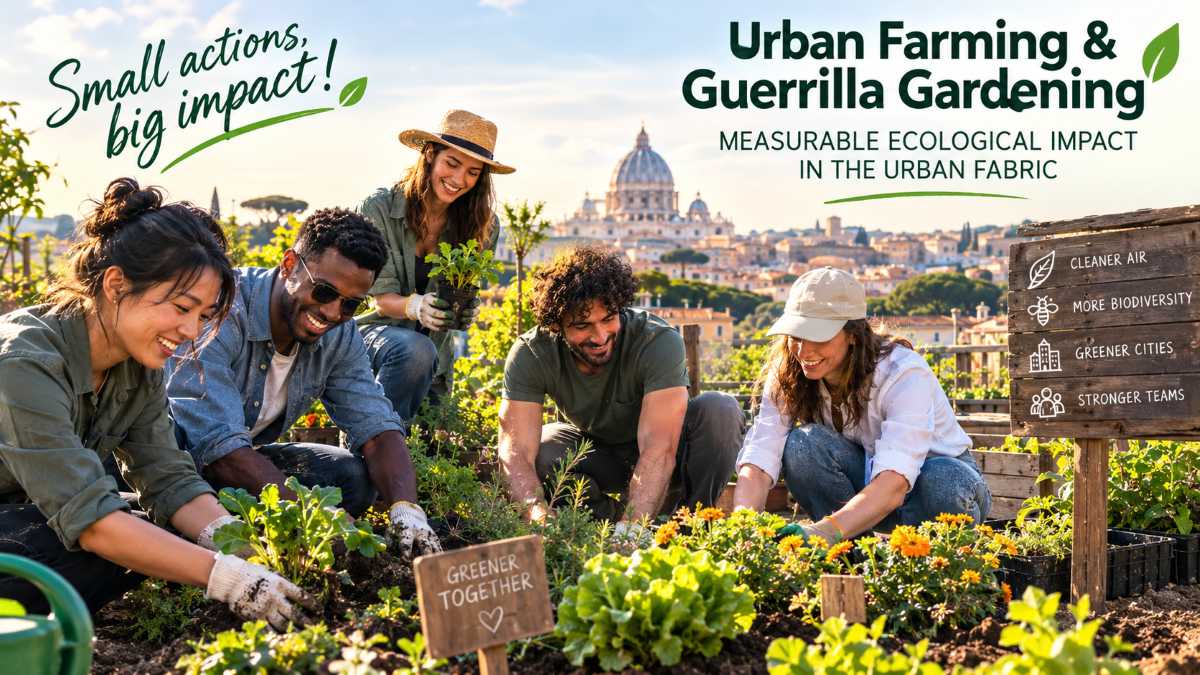
Urban Farming & Guerrilla Gardening: measurable ecological impact in the urban fabric
There comes a moment, during some team-building sessions, when the noise of conversations gives way to the sound of earth.
Someone plunges their hands into the soil. Someone else sets up a seedling, prepares a small nursery, measures an area, or observes a space that only a few minutes earlier seemed like just an anonymous urban patch.
Then the question arrives: "What can we leave here?"
It’s from this question that a new way of thinking about sustainable team building in Rome takes shape.
No longer just a symbolic activity dedicated to the environment, but an experience in which the group actively contributes to the regeneration of a green space, the care of an urban garden, or the creation of biodiversity interventions that are designed and authorized.
The concept Urban Farming & Guerrilla Gardening therefore turns sustainability into a participatory experience: the team gets their hands dirty, learns to understand the territory, and contributes to a project whose results can be observed, documented, and—when the project allows—measured over time.
In Rome, this philosophy meets a particularly interesting context. The Capital has large parks, green areas, community gardens, nature trails, and civic participation initiatives.
The new regulation of Rome Capital on Community Urban Gardens, approved with Resolution of the Capitoline Assembly no. 117/2024, considers the garden not only as a space where crops can be grown, but as a common good linked to the territory, the community, social life, and the enhancement of the urban landscape. (Comune di Roma)
It is right here that team building meets urban regeneration.
Why Urban Farming and Team Building can become one single experience
A traditional corporate social responsibility activity may leave a memory.
An urban farming experience can leave something more concrete: a transformed place.
The difference is important.
When a group takes part in caring for an urban garden, it’s not simply “doing volunteering for a few hours.” They can work toward a shared goal, distribute responsibilities, make decisions, deal with unexpected issues, and immediately see the consequences of their actions.
It’s a powerful metaphor also for the business world.
A team functions like an ecosystem: each element influences the others.
If someone doesn’t collaborate, the result changes. If a phase is organized poorly, the next one suffers. If skills are shared, the project grows faster.
Earth makes all of this visible.
From symbolic team building to team building with impact
The key shift is therefore from:
"let’s do something green"
to:
"we build a green project with a verifiable result."
This approach makes it possible to link team building to the company’s ESG goals, without turning the activity into a mere communication exercise.
Urban Farming in Rome: the team enters the territory
Rome has an ideal feature for this kind of experience: an extraordinary amount of greenery woven into an extremely complex urban fabric.
Green isn’t confined to the edges of the city.
You find it within major historic parks, along green corridors, in gardens, in leftover agricultural areas, and in spaces managed through active citizenship initiatives.
The Regulation for the establishment and management of Community Urban Gardens of Rome Capital identifies, among its objectives, the enhancement of green areas and the urban landscape, responsible use of resources, the recovery and reuse of land and water, and the promotion of an agro-ecological approach. (Comune di Roma)
In addition, among the objectives listed by the Municipality is also the protection of native plant species and the landscape. (Comune di Roma)
This creates an ideal foundation for designing corporate activities that bring together nature, collaboration, and environmental responsibility.
A possible scenario: from soil to results
Let’s imagine a group of twenty managers.
They arrive on a Roman morning in a previously identified and authorized green area.
There are no conference tables.
There are gloves, tools, crates, potting mix, seeds, plants, and a map of the area.
The first task is not yet planting.
It’s observing.
What’s the condition of the area?
Where does the light reach?
Which zones are already vegetated?
Which species are present?
Where could a small corridor for pollinators be created?
Where can biodiversity be improved without compromising the existing balance?
That’s how the team begins thinking like a small environmental design group.
Only afterwards comes the manual work.
Guerrilla Gardening: reinterpreting it responsibly
The term guerrilla gardening traditionally evokes the idea of spontaneously transforming abandoned small urban spaces through plants and seeds.
In a corporate context, however, it’s essential to reinterpret the concept responsibly.
The goal isn’t to intervene arbitrarily in a public area.
The goal is to use the philosophy of spontaneous and participatory regeneration within spaces identified, authorized, and designed together with the responsible stakeholders in the territory.
Rome Capital uses collaboration agreements (Patti di collaborazione) precisely as a tool through which citizens and public entities can define objectives, responsibilities, duration, and the ways to care for common goods. (Comune di Roma)
From “guerrilla” to collaboration
It’s an interesting transformation also from the storytelling point of view.
The real challenge is no longer planting a seed where nobody has ever done it before.
The real challenge is creating a green intervention that makes sense for that place.
That means choosing appropriate species, avoiding invasive plants, respecting the area’s characteristics, and working together with those who know the territory.
The Roman regulation on Community Urban Gardens explicitly provides for excluding invasive exotic species and promotes an agro-ecological approach. (Comune di Roma)
Seed Bomb: when a small sphere becomes a message
One of the most visually striking activities to include in this format is the creation of seed bombs, small spheres of substrate and seeds designed to support germination in suitable contexts.
But even here, the concept can be turned into a true team activity.
Each group can receive:
-
a selection of seeds compatible with the project;
-
natural materials;
-
a sheet on the species;
-
a map of the area;
-
an ecological goal;
-
a system for identifying the activities.
The challenge isn’t simply about producing the highest number of pellets.
The team must understand what it is helping to create.
The principle of native species
Choosing the species is a fundamental part of the experience.
Not all plants are suitable for every environment, and not everything that looks “green” is automatically positive for an ecosystem.
That’s why the project should be built with experts, associations, or responsible stakeholders for the area—prioritizing species that fit the context and the biodiversity objectives.
The result becomes more serious and more credible: not just a simple green marketing activity, but a lab of applied urban ecology.
Urban biodiversity: team building becomes an ecosystem
One of the most interesting evolutions of contemporary team building concerns the relationship between people and biodiversity.
The city isn’t only concrete.
It’s an ecosystem where plants, pollinating insects, birds, microorganisms, water, soil, and human activities coexist.
The European regulation on Nature Restoration Law has introduced specific goals for restoring urban ecosystems, including—among other things—the absence of net loss of urban green space and tree cover by 2030 compared to 2021, as well as targets for increasing green areas in the following years. The regulation also includes combating the decline in pollinator populations. (EUR-Lex)
This makes the topic extremely current also for companies.
From generic greenery to measurable biodiversity
A team building project can therefore be structured around simple and understandable indicators.
For example:
square meters regenerated
number of plants planted
number of species used
percentage of native species
number of elements created to support pollinators
amount of materials recovered or reused
hours of corporate volunteering
number of participants involved
Not all of these indicators will apply to every project, but the principle is important: impact must be explainable through data, not only through photographs.
Rome’s green POIs become part of the story
An Urban Farming Team Building doesn’t necessarily have to be separated from the tourism experience.
In fact, one of its strengths can be precisely the ability to connect sustainability to the Capital’s major green places.
Botanical Garden of Rome
In the heart of Trastevere, the Botanical Garden of Rome is one of the most interesting places to tell the story of plant biodiversity.
Located between Via della Lungara and the Gianicolo, it covers about 12 hectares and preserves botanical collections from different parts of the world. (Turismo Roma)
Its value for team building doesn’t necessarily lie in organizing the activity directly within the collections, but in being able to use this POI as a narrative and scientific inspiration for a biodiversity-focused program.
The group can, for example, start with a visit or an introductory moment, then continue in an authorized space set aside for hands-on activities.
Villa Borghese: greenery in the heart of the Capital
Villa Borghese also offers an extraordinary setting to discuss the relationship between city and nature.
The large park hosts centuries-old trees, gardens, ponds, fountains, monuments, and wide green spaces in the heart of Rome. (Turismo Roma)
Its narrative strength is clear: the team can begin by observing a major urban park to understand how nature can coexist with a metropolis.
From there, a challenge focused on designing a small urban ecosystem can be created.
Villa Ada: biodiversity and landscape
Even more immersive is the natural dimension of Villa Ada Savoia, one of the Capital’s large urban parks.
The park spans about 160 hectares and preserves woodland areas, green spaces, and a significant presence of urban wildlife. (Turismo Roma)
The place is well suited for a story centered on biodiversity, observing the territory, and the relationship between the natural environment and the city.
Parco degli Acquedotti: landscape, history, and nature
Another option is to build the storytelling around the Parco degli Acquedotti, part of the wider system of the Parco Regionale dell’Appia Antica.
Here the team can engage with an extremely distinctive backdrop: ancient infrastructure, Roman countryside, and contemporary urban landscape coexist in the same space.
The park also offers nature trails and a cycle path. (Turismo Roma)
It’s a perfect place to communicate an important concept:
regenerating also means restoring a relationship between what existed, what exists today, and what we want to leave tomorrow.
The challenge: designing a micro-urban ecosystem
To turn the activity into a real team building experience, you can introduce a competitive component.
The teams receive the same problem:
"How can we improve this space with a sustainable green intervention?"
Each group must design its own solution.
Phase 1 – Observation
The area is analyzed.
Phase 2 – Design
Species, materials, functions, and objectives are defined.
Phase 3 – Implementation
The team gets to work.
Phase 4 – Measurement
The activities carried out and the initial indicators are recorded.
Phase 5 – Storytelling
Each team presents its intervention.
The winning team can be awarded not only to the most beautiful solution, but to the one that best combines:
environmental impact + feasibility + biodiversity + collaboration + creativity.
An ESG Team Building that leaves a trace
For a company, this type of experience can become particularly interesting when it’s connected to internal sustainability programs.
The activity can, in fact, produce a small final Impact Report.
A simple document in which to report:
-
where the project was carried out;
-
how many people took part;
-
how many hours were dedicated;
-
which interventions were implemented;
-
which species were used;
-
what area was involved;
-
which materials were recovered;
-
which environmental goals were defined;
-
how the project can be monitored over time.
Before, during, and after
The real difference from a normal corporate event is precisely this.
Team building doesn’t end when people take off their gloves.
A second phase can begin:
monitoring.
A photo taken after three months.
An update after six months.
A new visit.
A comparison between the initial and subsequent conditions.
In this way, the experience becomes a story that continues even after the event.
The human value: getting dirty together
There’s also a dimension that no ESG indicator can fully capture.
It’s the gesture.
A manager and a young employee planting together.
Two colleagues who normally work in different countries and have to decide where to place a plant.
A person who has never gardened before and discovers they’re surprisingly good at it.
A group that, after an hour working the soil, looks at each other and laughs because everyone has dirty hands.
These are simple moments.
But it’s precisely these moments that make a team building memorable.
Why Urban Farming is the future of sustainable Team Building
Corporate team building is changing.
Companies no longer seek only fun activities.
They look for experiences consistent with their values.
They seek activities that engage people, build connections, and produce a result that makes sense even beyond the company.
The Urban Farming Team Building meets this need exactly.
It is:
experiential, because you learn by doing;
collaborative, because the result depends on the group;
sustainable, because it puts resources and biodiversity at the center;
territorial, because it works on the urban context;
measurable, because it can be linked to impact indicators;
memorable, because it leaves a visible trace;
replicable, because the model can be applied in other contexts.
Rome becomes the company’s green laboratory
At the end of the day, the group returns to the hotel or heads to dinner.
Rome continues to live around them.
But something has changed.
Maybe a small space has been regenerated.
Maybe new species have been planted.
Maybe an habitat more welcoming to pollinators has been created.
Or maybe a new awareness has simply emerged.
The important thing is that the team can say:
"Today, we left something behind."
That’s the heart of Urban Farming & Guerrilla Gardening as a team-building experience.
Not just building a team.
Building a team to leave a positive trace in the place that hosts us.
And in a city like Rome, where history, nature, archaeology, and contemporary life continuously coexist, turning the territory into a sustainability laboratory means giving team building a new dimension: real impact.