
























Concrete solidarity: build to give back—team building that turns teamwork into a real gesture
There is a substantial difference between talking about solidarity and doing something concrete for someone.
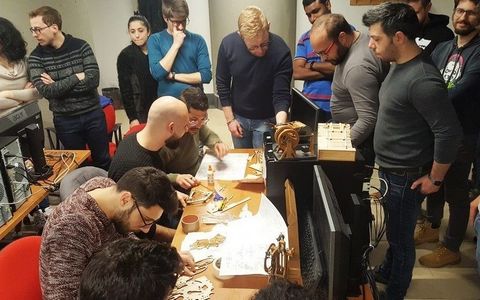
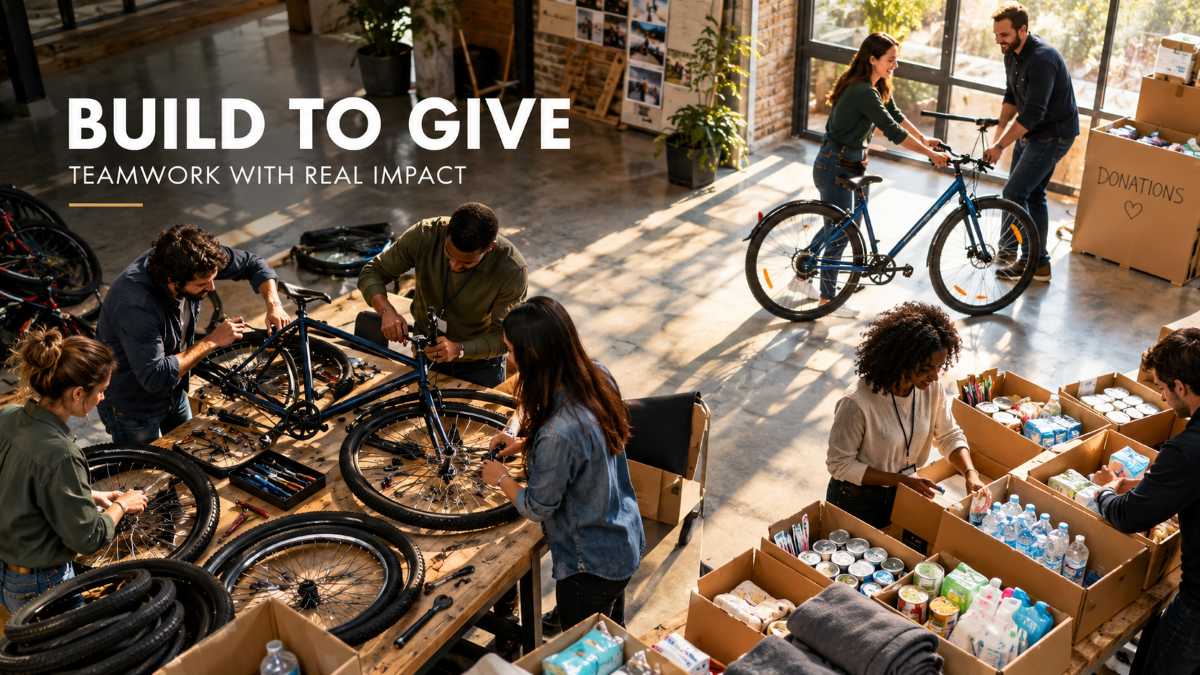
Let’s imagine a room set up for a corporate event. On the table, there are not only markers, creative materials, or gadgets, but frames, wheels, tools, boxes, hygiene products, blankets, and materials meant to become something useful. Participants split up the tasks, discuss, try, make mistakes, and start again.
At the end of the day, it’s not only the memory of a fun activity that remains.
A real object built together and meant for someone who needs it remains.
This is the philosophy behind a charitable team building based on building and donating: turning corporate collaboration into a tangible outcome through activities such as assembling bicycles, building devices or components for social projects, preparing essential-needs kits, and organized collections of essential goods.
In Rome, this approach can fit into a particularly interesting context, thanks to the presence of associations, institutions, and organizations that are committed every day to supporting vulnerable people.
The Italian Red Cross – Metropolitan Area Committee of Rome, for example, carries out assistance activities for people experiencing homelessness and lists among the needed support items blankets, food supplies, and hygiene kits. (CRIROMA.ORG)
So, team building can become a workshop where collaboration is not only simulated through a game, but produces a small tangible result within a solidarity chain.
From team to community: when collaboration produces a concrete result
Many team-building exercises use metaphors: building a tower means learning how to collaborate, overcoming a course means facing a challenge, solving a riddle means improving communication.
In a charitable team-building experience, however, the metaphor can become reality.
If a group builds a bicycle, that bicycle can actually be assigned to a social project.
If they prepare an essential-needs kit, the contents can be directed to a reality that supports people in situations of vulnerability.
If they create materials through a hands-on workshop, the final product can be delivered to an association or a partner organization.
The difference matters because it introduces into the team a very simple question:
“Who are we doing this for?”
This question completely changes the dynamics of the experience.
The result doesn’t belong exclusively to the company or to the participants. It’s meant to go beyond the group, to a final beneficiary.
Bike Building: building bicycles to turn collaboration into mobility
One of the most immediate formulas is that of the charitable Bike Building.
Participants receive components, tools, and instructions, and are divided into teams. Each group must organize the work and distribute responsibilities: who handles the frame, who handles the wheels, who handles the drivetrain, and who handles the final assembly.
In this way, the bicycle becomes a true collective project.
It’s not enough to be fast.
Communication is necessary.
It’s not enough to have someone with technical skills.
The group must work in a coordinated way.
And above all, it’s not enough to complete the assembly: the vehicle must be tested and checked before it’s delivered for its final destination.
A bicycle can become a tool for inclusion
Mobility is closely connected to personal autonomy.
In 2026, right here in Rome, an initiative connected to the Giro d’Italia provided the donation of 35 bicycles to children, families, and people living in situations of vulnerability, as part of a project promoted by RCS Sport, Rome City Hall (Roma Capitale), and ACLI. (Giro d'Italia 2026)
It’s an interesting example of how a bicycle can take on a meaning that goes beyond the object itself: mobility, autonomy, inclusion, and the possibility of living your territory more easily.
The Italian Red Cross “CRI in Bici” also uses bicycles as an operational tool to help volunteers move quickly through parks, pedestrian areas, and events, providing assistance where traditional vehicles may have more difficulty. (Croce Rossa Rome)
The concept is therefore particularly suited to a corporate experience: build something that keeps serving a purpose even after the event ends.
Not only bicycles: building for a social cause
The formula can be adapted to other projects as well.
The principle is always the same: turn a day of collaboration into a product or service aimed at a social purpose.
Essential-needs kits
A particularly effective activity consists of assembling kits intended for people facing difficulties.
Each team receives a list of materials and must organize the composition of the parcels.
Depending on the project, they may include:
-
hygiene kits;
-
personal hygiene products;
-
food supplies;
-
school materials;
-
blankets and essential items;
-
small kits dedicated to specific social needs;
-
parcels for structures and associations.
The Red Cross of Rome – activities supporting people experiencing homelessness highlights exactly the need for blankets, food supplies, and hygiene kits for assistance activities in the area. (CRIROMA.ORG)
In this case, team building takes on an almost logistical structure.
The group must plan, count, distribute, check, and prepare.
A small “assembly line” of solidarity where each mistake can mean an incomplete kit.
Building aids and projects for inclusion
Another option is to create, with the supervision of professionals and specialized organizations, components or materials intended for inclusion projects.
Here it’s essential to make a distinction: when talking about prosthetics, medical aids, or devices for people with disabilities, this is not a normal DIY workshop.
The design and creation of medical or prosthetic devices require technical expertise, verification, and qualified parties.
Therefore, team building can focus on activities compatible with the level of competence of the participants, leaving the technical and certification parts to professionals and specialized organizations.
In this way, solidarity doesn’t become just a backdrop, but is embedded in a serious, verifiable project.
From symbolic action to measurable project
This approach also allows companies to link the experience to their ESG, CSR, and Corporate Social Responsibility paths.
Not only the number of participants is measured.
You can report, when data is available and verifiable:
-
number of bicycles assembled;
-
number of kits prepared;
-
quantity of materials collected;
-
number of beneficiaries;
-
hours of corporate volunteering;
-
quantity of products intended for donation;
-
organizations involved.
The result therefore becomes more easily documentable in a sustainability report or an internal communication.
Rome as an open-air lab for solidarity
Rome offers a particularly interesting feature: it allows you to alternate lab moments and outdoor activities without losing the connection to the territory.
An experience can be organized, for example, near neighborhoods characterized by a strong urban identity, or combined with a sustainable mobility route.
Among the POIs that can become settings or reference points for an activity, we find Villa Borghese, one of the city’s large parks in the heart of Rome, characterized by wide green spaces, avenues, monuments, and areas that can be used for experiential activities. (Turismo Roma)
Another particularly evocative location is the Centrale Montemartini, along Via Ostiense: a former power plant turned into a museum, where industrial archaeology and Roman art coexist in a decidedly original setting. The museum also offers various accessibility services, including a route for wheelchairs and services dedicated to people who are blind or visually impaired. (Turismo Roma)
For an event with a stronger outdoor and storytelling component, even the area of the Baths of Caracalla can provide a scenic context, in the heart of the archaeological area between Aventine and Circus Maximus. (Turismo Roma)
In this case, the value of the POI isn’t only aesthetic.
Rome becomes part of the story.
How a charitable concrete team-building works
A day can be built as a real corporate mission.
1. The mission
The group receives a challenge:
“Today we’ll build something that won’t stay with us.”
It’s a simple but effective introduction because it immediately clarifies the purpose.
2. Team division
Participants are divided into small groups.
Each team can have different responsibilities:
-
procurement;
-
assembly;
-
quality control;
-
logistics;
-
communication;
-
customization;
-
final verification.
In this way, different skills are involved.
3. The build
The operational part begins.
In the case of bicycles, for example, teams receive components and tools and must reach the finished product through a sequence of activities.
In the case of kits, instead, the issue may be to correctly organize materials and quantities while respecting a predetermined list.
4. The check
Before delivery, a fundamental phase comes: the inspection.
A bicycle must be verified.
A kit must be complete.
A parcel must be properly organized.
Solidarity requires precision.
5. The delivery
This is the moment when the activity changes meaning.
What, only a few minutes earlier, was a simple component on the table becomes something meant for a person, a family, an association, or a social project.
It’s the passage from “us” to “us for someone”.
Charitable team building and business skills
This type of activity doesn’t eliminate the traditional objectives of team building.
It simply makes them more concrete.
Communication
Components must be coordinated and information must circulate quickly.
Leadership
Each team must identify priorities and distribute responsibilities.
Problem Solving
Instructions are not always applied perfectly on the first try.
Project Management
Timing, resources, and quality must be managed simultaneously.
Collaboration
The final result belongs to the group and not to any single participant.
Accountability
The work has a final recipient, and this increases focus on the result.
Empathy
The final beneficiary makes visible the reason why the group is working.
Why concrete solidarity can leave a stronger memory
There’s one feature that distinguishes this format from many other corporate activities: the result remains.
After a race, a photograph, or a game, the memory mainly stays in the participants’ minds.
After a day of charitable Bike Building, though, a bicycle can also remain.
After a workshop assembling charitable kits, ready-to-distribute parcels remain.
After an organized collection, goods remain intended for a reality that needs them.
This is the true value of “Human Impact Team Building”: bringing together people, skills, and time to produce something that has a use beyond the event.
A customizable format for companies, multinationals, and international groups
Concrete solidarity can be adapted to teams of very different sizes.
For small groups, it can become an extremely participatory hands-on workshop.
For larger companies, it can turn into a real Social Impact Challenge, with multiple operational stations at the same time.
For multinationals, it can also be developed in a multilingual format by dividing participants into international teams and assigning each group a part of the project.
The challenge can also be linked to the company’s ESG goals, sustainability week, a convention, a Kick-Off, or a day dedicated to corporate volunteering.
The same structure can be replicated with different recipients and different products.
The key is that the project has a real beneficiary, a stated purpose, and a verifiable outcome.
The new frontier of team building: building a team to do good
Charitable team building doesn’t ask participants to be a team only.
It asks them to understand why it’s worth being one.
Building a bicycle, preparing a kit, organizing materials, or contributing to a social project means putting into practice one of the simplest and most powerful ideas of teamwork:
by ourselves we can do something; together we can make it go further.
And this is exactly where the corporate experience meets social responsibility.
Not a symbolic gesture.
Not a simple photo-op activity.
But a day in which people’s time, energy, and skills are turned into something concrete.
In Rome, a city where history, culture, mobility, and community live side by side every day, this type of experience can find a particularly effective context: from the greenery of Villa Borghese to the spaces of Ostiense, from urban routes to accessible cultural places, the Capital can become the setting for a corporate mission with an impact that continues even after the event ends.
FAQ – Charitable team building and donation activities
Do you need technical skills to build a bicycle?
No. The format can be designed for participants with no mechanical experience, with appropriate instructions, materials, and technical supervision.
Are the bicycles built actually donated?
The project may include donating to organizations or associations identified before the event. Recipients, methods, and checks must be agreed in advance with the involved parties.
H3: Is it possible to organize a team building with essential-needs kits?
Yes. It’s possible to plan assembly activities for food, hygiene, or other types of kits, based on the needs indicated by the beneficiary organization.
Can disability-related projects be created?
Yes, but in the case of prosthetics, aids, and medical devices it’s essential to involve professionals and qualified organizations. Participants can contribute to parts of the project that are compatible with their skills.
Can charitable team building be linked to ESG goals?
Yes. The activity can be designed to produce concrete indicators, such as number of kits prepared, bicycles assembled, materials collected, or volunteer hours.
Where can this experience be organized in Rome?
The venue can be chosen based on the number of participants, the season, and the type of activity. It’s possible to plan indoor spaces, outdoor spaces, or itinerant formats connected to different POIs in the city.
If you want to experience this or other similar experiences, click here—you’ll find our proposals:
Request a free quote and get all the information about your team-building experience.
You can also request a quote to design a customized experience.