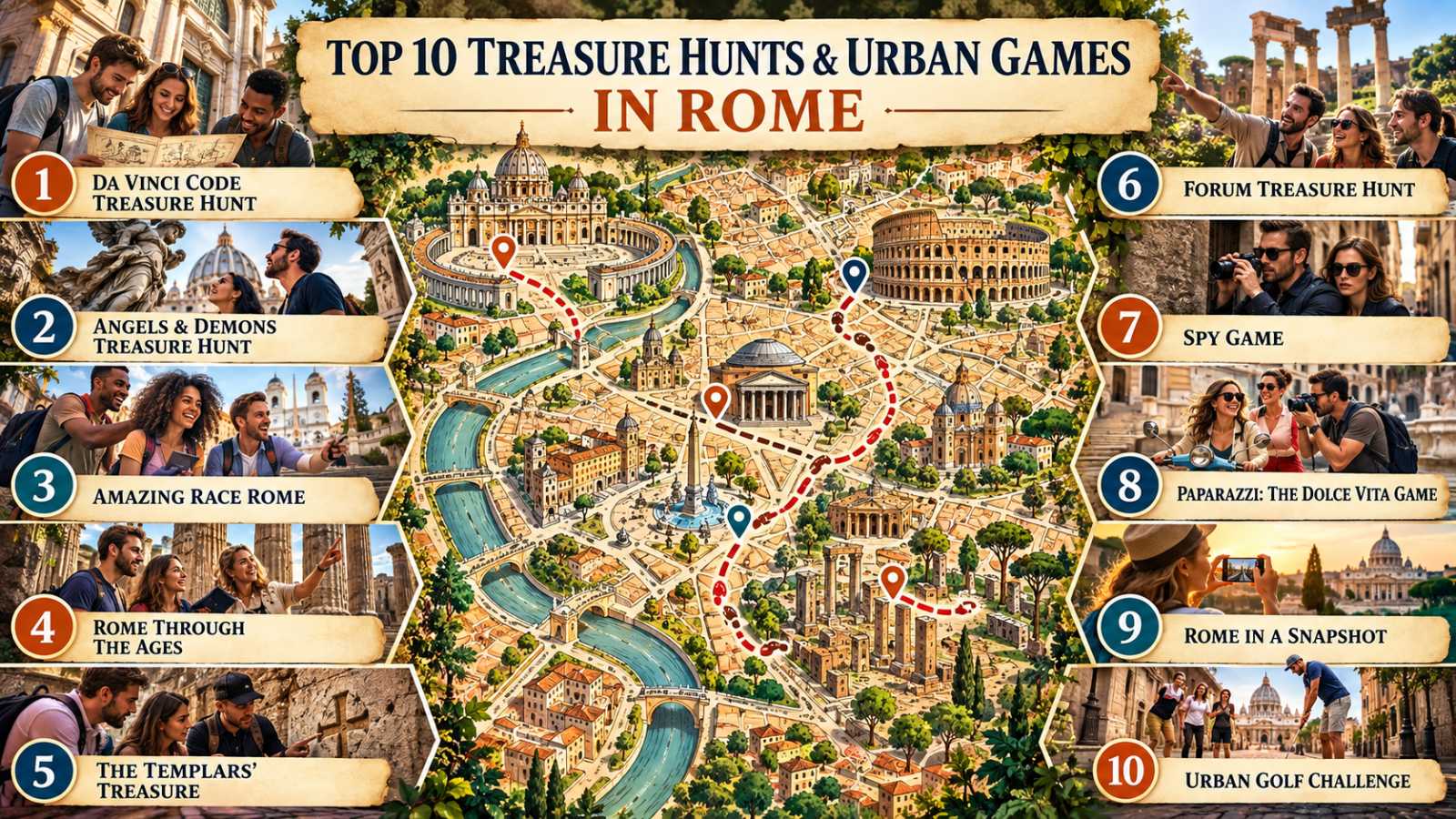
Top 10 Treasure Hunts and Urban Games in the Neighborhoods of Rome
Rome becomes a gigantic map to explore
Rome can be visited by following a guide, traveling along a tourist itinerary, or sitting in front of a monument to take a photograph.
But it can also be played.
All it takes is to turn a square into a stop, an alley into a clue, a fountain into a challenge, a neighborhood into a map, and a monument into a mission segment.
This is where the charm of Treasure Hunts and Urban Games in Rome comes from—Team Building experiences in which the city is not simply the backdrop for the activity, but becomes the true protagonist.
The group walks, observes, searches, photographs, interprets clues, solves riddles, and above all makes decisions.
The shortest road isn’t always the right one.
The most famous monument doesn’t necessarily contain the solution.
And sometimes an apparently insignificant detail can allow a team to score valuable points.
For a company, all of this translates into an experience capable of combining Team Building, culture, movement, strategy, communication, and discovery of Rome.
In this Top 10, we gathered ten formats that allow you to cross very different areas of the Capital: from the Vatican to Villa Borghese, from the Pantheon to the Ghetto, from the Roman Forum to Trastevere, up to the most hidden part of Rome.
1. Angels and Demons: a treasure hunt between the Vatican and Castel Sant’Angelo
The first route takes you into the heart of monumental Rome.
Angels and Demons was created in the Vatican area and leads teams to one of the most captivating places in the city: Castel Sant’Angelo.
The mission structure begins with searching for clues.
Teams must observe the surroundings, interpret the elements found along the way, and arrive at the final solution.
The neighborhood as part of the game
Here, the added value is precisely the area itself.
The route lets you use some of the most recognizable spots of monumental Rome as a backdrop, creating an experience where history and play go hand in hand.
The result is an Urban Game particularly suitable for international groups, because the universal language of riddles allows you to experience the city without turning the experience into a simple guided tour.
2. Paparazzi: Rome becomes a big photographic set
Let’s completely change perspective.
With Paparazzi – Photographic Treasure Hunt, the mission isn’t mainly about finding an answer.
You have to find the right photograph.
Teams cross the center of Rome in search of details, perspectives, situations, and views capable of interpreting the different photographic missions.
You don’t need to be a professional photographer.
You need creativity, observation, and the ability to build an idea together.
From the Pantheon to the streets of the center
The strength of this format is freedom.
A square can become a set.
A monument can be reinterpreted.
A group of colleagues can turn into a small film crew.
In the end, the images become part of the final contest.
So it’s an Urban Game that combines urban exploration, creativity, and collaboration.
3. La Dolce Vita on Apetta: Rome between the Vatican, the Colosseum, and Aventine
Rome is also movement.
With La Dolce Vita su Apetta, the treasure hunt moves on wheels and uses small vehicles to travel through some of the Capital’s most iconic settings.
The route can involve areas such as the Vatican, the Colosseum, Aventine, and Circo Massimo, turning traveling itself into part of the mission.
Tablets, riddles, missions, and challenges accompany the teams.
An Urban Game in motion
Here, Team Building takes on a dynamic dimension.
You don’t just have to solve the riddle.
You must organize the team, manage the route, make decisions, and coordinate during the moves.
And when an unexpected mission arrives, the group must decide quickly how to handle it.
In this case, Rome becomes a large narrative track.
4. Without Brakes: an Urban Game in the greenery of Villa Borghese
For those who want to get out of the streets of the historic center, there is Senza Freni – Urban Games at Villa Borghese.
The setting is Villa Borghese, one of Rome’s great green lungs.
The format uses assisted-pedal vehicles and turns the park’s avenues into a route of challenges, orientation, and collaboration.
Villa Borghese as a playing field
The great thing about an Urban Game inside a park is the change of pace.
After the crowded squares of the center, the team finds itself immersed in greenery.
The route becomes more open.
Decisions can be made by observing the map, choosing the direction, and coordinating the group.
It’s an original way to combine mobility, play, and outdoor Team Building.
5. The Treasure of the Templars: between the Pantheon, the Ghetto, and Aventine
If the team loves mysteries, codes, and historical storytelling, The Treasure of the Templars turns Rome into a great investigative adventure.
The route crosses areas such as the Pantheon, the Jewish Ghetto, and Aventine.
The narrative revolves around the traces of the Knights Templar, the riddles, and the search for the mysterious treasure.
When history becomes a riddle
The charm of this format lies in the narrative.
A team isn’t simply crossing Rome.
It’s following a trail.
A clue leads to the next.
A code can open a new phase.
An architectural detail can become the key to proceed.
It’s the classic treasure-hunt mechanism, but embedded in the city’s historical heritage.
6. The Cacciatona: Pantheon, Piazza Navona, Campo de’ Fiori, and Ghetto
Three hours.
A map.
Numerous missions.
And one essential question:
how much of Rome will your team manage to conquer?
With The Cacciatona, the historic center becomes a real urban race.
The route involves places like the Pantheon, Piazza Navona, Campo de’ Fiori, and the Ghetto, while teams must decide which missions to take on.
Strategy before speed
The most interesting feature is that it’s not enough to run.
A challenge can be very far away but award many points.
Meanwhile, three nearby missions could lead to a better result.
So the group must continuously evaluate:
-
time;
-
distance;
-
score;
-
difficulty;
-
team ability.
It’s a format in which strategy and movement become inseparable.
7. Hunt for the teForo: in search of Caesar’s treasure
To step right into Ancient Rome, one of the most unique experiences is Hunt for the teForo.
The route runs between the Capitoline Hill, the Roman Forum, Via Sacra, and Palatine, within one of the world’s most important archaeological settings.
Here, the Urban Game changes atmosphere completely.
It’s not just modern streets and shops.
There are columns, arches, ruins, and traces of a city that has passed through more than two thousand years of history.
The Roman Forum becomes a map
Every ruin can become part of the storytelling.
Every detail can hold a clue.
So the team must combine knowledge, observation, and reasoning skills.
It’s a way to experience Ancient Rome without limiting yourself to a traditional visit.
8. The Ages of Rome: from the Pantheon to Trastevere
Rome keeps changing its face.
And it’s precisely this transformation that becomes the protagonist of The Ages of Rome.
The route crosses the Pantheon, Campo de’ Fiori, the Jewish Ghetto, and Trastevere, connecting different eras and neighborhoods.
Antiquity, the Middle Ages, the Renaissance, and contemporary Rome become chapters of the same adventure.
Four neighborhoods, one single story
The narrative value of the experience lies in the variety.
A team can start in front of the Pantheon and, after a series of riddles, arrive in the alleys of Trastevere.
The landscape changes.
Architecture, atmospheres, and stories change.
But the group keeps following the same thread.
It’s a particularly interesting format for those looking for cultural Team Building in Rome without giving up the playful side.
9. Spy Game: a spy hides in the center of Rome
Imagine receiving a message.
A spy is in Rome.
They left a series of clues.
Your team must find them before the other teams.
This is the premise of Spy Game, a treasure hunt set in the historic center.
The route can also be enriched by actors, turning the experience into a true urban role-playing game.
When the historic center becomes a cinematic set
The group doesn’t just have to follow a list of instructions.
It must interpret information, observe what’s happening around it, and connect the clues.
So the city becomes a scene.
Squares become possible meeting points.
Alleys become corridors.
People and urban elements become part of the storytelling.
It’s an ideal format for those who love mystery, investigation, and narrative adrenaline.
10. Rome Upside Down: the invisible city
The final experience takes us to the less predictable Rome.
Rome Upside Down was created from the idea of observing the Capital from different perspectives.
Panoramic terraces.
Hidden cloisters.
Churches rich in symbols.
Basements and underground spaces.
Views that can normally even escape those who live in Rome.
Seeing Rome differently
The concept is simple but effective.
The team must learn how to observe.
Not only in front of them.
Also above.
Below.
Behind.
Inside.
The historic center becomes a kind of three-dimensional city.
A specific architectural detail can become a clue.
A terrace can provide the perspective needed to solve a challenge.
A hidden place can become the next stop.
It’s a treasure hunt designed for those who want to discover secret and less conventional Rome.
Why choose a Treasure Hunt as Team Building?
An urban treasure hunt works because it naturally pushes people to collaborate.
It’s not enough to have the brightest colleague.
It’s not enough to have the one who runs the fastest.
It’s not enough to know Rome.
You need to bring together different skills.
Communication
Clues must be shared.
One person may notice a detail that another hasn’t seen.
The solution comes from combining information.
Leadership
During the route, capable figures who can coordinate the group may spontaneously emerge.
But leadership can also change throughout the mission.
Problem solving
Riddles force you to think.
Unexpected missions require modifying the plan.
Time management
In time-limited formats, every decision has a cost.
Stopping too long can mean losing a mission.
Running too much can mean not noticing the decisive clue.
City knowledge
Rome becomes a training ground for observation.
The group learns to read monuments, streets, squares, and architectural details through a different perspective.
The neighborhoods of Rome become protagonists
One of the most interesting features of Urban Games is the ability to build different itineraries.
Vatican City and Prati
Monumentality, history, and great perspectives make the area ideal for narrative treasure hunts like Angels and Demons.
Historic Center
The Pantheon, Piazza Navona, Campo de’ Fiori, and the Ghetto make it possible to create highly structured routes, like The Cacciatona and The Ages of Rome.
Trastevere
Alleys, squares, and a lively local atmosphere offer a perfect setting for experiences that combine history, observation, and storytelling.
Aventine
The hill allows you to include panoramic views, history, and less crowded glimpses in the route.
Villa Borghese
The large Roman park makes it possible to design more dynamic Urban Games, like Without Brakes, alternating movement, orientation, and team challenges.
Central archaeological area
The Roman Forum, Palatine, and the Capitoline Hill turn the treasure hunt into a journey through Ancient Rome, as happens with Hunt for the teForo.
Treasure Hunt or Urban Game: what’s the difference?
The two concepts are often used as synonyms, but they may have different characteristics.
The traditional Treasure Hunt mainly focuses on finding clues and progressively solving riddles.
An Urban Game can be broader instead.
It can include:
-
photographic challenges;
-
missions;
-
orientation;
-
riddles;
-
physical challenges;
-
actors;
-
tablets and apps;
-
storytelling;
-
points collection;
-
interaction with the territory.
In practice, a treasure hunt can become one of the components of a more complex Urban Game.
And it’s precisely this flexibility that makes it possible to build tailored experiences for companies, conventions, incentives, and international groups.
Tablets, apps, and technology: the new treasure hunt
A contemporary treasure hunt doesn’t necessarily have to be built with little notes hidden behind a statue.
Technology makes it possible to use tablets, smartphones, GPS, photographs, and interactive applications.
This allows you to quickly modify missions and collect the teams’ results.
Technology, however, remains just a tool.
The real protagonist continues to be the group.
An app can point to a destination.
But it will be up to people to decide which road to follow.
A tablet can present a riddle.
But it will be the team that has to solve it.
How to choose the right Urban Game for your group?
The choice should start with the type of experience the company wants to build.
For those who love history and culture
Hunt for the teForo, The Ages of Rome, and The Treasure of the Templars.
For those looking for mystery
Angels and Demons and Spy Game.
For those who want creativity
Paparazzi.
For those who want movement
The Cacciatona, La Dolce Vita on Apetta, and Without Brakes.
For those who want to discover a less known Rome
Rome Upside Down.
The choice can also be adapted to the number of participants, duration, language, difficulty level, and business objectives.
A different Rome for every team
There’s a special moment during a treasure hunt.
It’s the moment when a team stops acting like a group of coworkers and starts moving like a real team.
One person observes.
One person reads.
One person runs ahead.
One person checks the map.
Another colleague shares two pieces of information that seemed to have no connection at all.
And suddenly the solution arrives.
Meanwhile, Rome continues to flow around them.
People stroll.
Scooters cross the streets.
Fountains keep running.
Bells ring.
But for that team, at that moment, the historic center has become a huge puzzle.
That’s the strength of Urban Games in Rome.
They don’t just show the city.
They turn it into an experience.
And when the game ends, something has probably changed in the way participants will look at those same streets.
Because after searching for a clue in a square, crossing a neighborhood following a map, or solving a riddle in front of a monument, it’s hard to see Rome exactly the same way again.
FAQ – Treasure Hunts and Urban Games in Rome
1. What’s the difference between a treasure hunt and an Urban Game?
A treasure hunt focuses mainly on clues and riddles; an Urban Game can also include photographic challenges, missions, technology, actors, orientation, and collaborative challenges.
2. Which neighborhoods of Rome can be involved?
It depends on the format. Vatican City, the historic center, the Ghetto, Trastevere, Aventine, Villa Borghese, and the Forum area are some of the possible settings.
3. Are the activities suitable for international corporate groups?
Yes. Many formats can be adapted in English and can use images, maps, technology, and missions that are easy to understand even for international groups.
4. Do you need to know Rome?
No. The riddles and missions are designed specifically to turn discovering the city into an integral part of the experience.
5. Are treasure hunts suitable for large groups?
They can be organized with multiple teams at the same time, by adjusting the route, challenges, and management methods based on the group.
6. Can an Urban Game be customized?
Yes. Route, storytelling, duration, difficulty, language, missions, and objectives can be tailored to the needs of the event.
If you want to live this experience or something similar, click here—you’ll find our proposals:
Request a free quote and get all the information about your Team Building experience.
Request a free quote and get all the information about your Team Building experience.