

























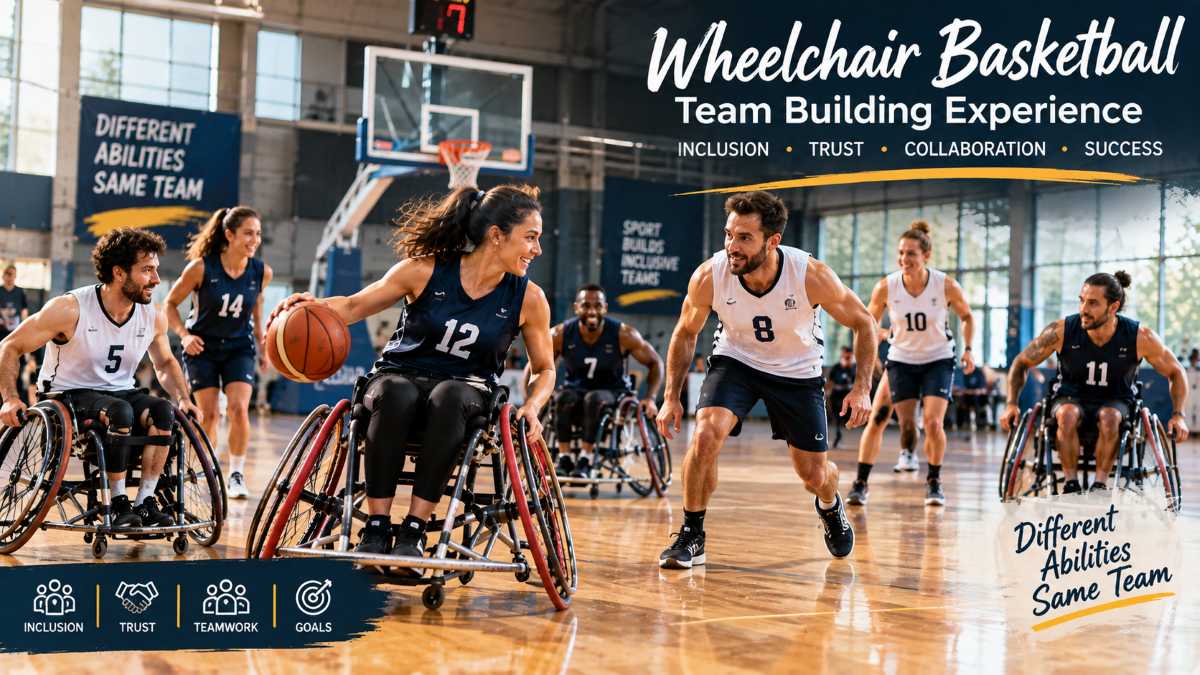
Basket in a Wheelchair: Team Building that turns disability into collaboration
A ball that bounces.
A basket to reach.
Four wheels that quickly change direction.
And around them, a team that must learn to move as one single organism.
The Basket in a Wheelchair as Team Building is an experience that takes people out of their daily professional routine and introduces them to a sporting setting where communication, trust, coordination, and collaboration immediately become concrete.
It’s not simply about “trying to stay in a wheelchair.”
The value of the experience comes from the opportunity to get to know a real sport discipline, understand its rules, practice movement techniques, and play together under the guidance of qualified instructors.
Basketball in a wheelchair is a structured Paralympic discipline, practiced by athletes with different physical disabilities. In Italy, it is managed by the Italian Wheelchair Basketball Federation and recognized by the Italian Paralympic Committee. The IPC also highlights that the functional classification system allows athletes with different disabilities to be integral to team mechanisms. (Italian Paralympic Committee)
And it is precisely here that Team Building finds its starting point.
Not disability as a limitation.
But the team as an opportunity.
From traditional basketball to Basketball in a Wheelchair: changing perspective
Let’s imagine a group of colleagues walking into the gym.
At first, the atmosphere is like any corporate activity.
Someone jokes around.
Someone watches.
Someone thinks they’re not very good at sports.
Then the sports wheelchairs arrive.
The instructor explains how to position yourself.
How to push the wheels.
How to brake.
How to turn.
How to protect the ball.
How to collaborate with your teammate.
After just a few minutes, the perception changes.
The wheelchair is no longer just a tool to use.
It becomes part of the sporting dynamic.
The court takes on a different perspective.
A movement that seemed simple suddenly becomes much more complex.
A pass requires coordination.
A shot requires control.
A defense requires attention to the positions of others.
And above all, an awareness emerges:
no one can truly play alone.
Basket in a Wheelchair as a Team Building Experience
Basketball is a team sport.
The wheelchair version preserves this fundamental characteristic.
The IPC states that the dimensions of the court, the ball, the height of the basket, and many core principles of the game are similar to those of traditional basketball, with specific adaptations related to wheelchair play. (Italian Paralympic Committee)
This makes the discipline especially interesting for a corporate experience.
The group doesn’t simply have to learn a new activity.
They have to learn to collaborate through a completely different “language.”
The first challenge: moving together
The first part of the experience can be dedicated to getting familiar with the sports wheelchair.
Participants progressively learn:
-
pushing and propulsion;
-
braking;
-
changing direction;
-
rotations;
-
distance management;
-
ball control;
-
passing;
-
shooting at the basket.
These are seemingly simple gestures.
But when you try them directly, they require attention and coordination.
This phase is important because it prevents the experience from turning into a simple “simulation.”
The group instead gradually enters the logic of the sport.
The second challenge: communicating without losing the rhythm
On the court, there isn’t much time to explain a decision.
You have to communicate quickly.
“Pass!”
“Go!”
“Cover!”
“Behind!”
“Here I am!”
The voice becomes an operational tool.
But talking isn’t enough.
You also have to listen.
A teammate can communicate a position.
Another can indicate an open space.
A third can suggest a change in strategy.
The team works when information circulates.
And it’s a dynamic very similar to what every day characterizes a professional team.
From the gym to the office
At work, a project can fail not because individual skills are missing, but because information isn’t shared at the right moment.
In Basketball in a Wheelchair, this mechanism becomes visible.
If a player doesn’t communicate, a teammate may find themselves without a solution.
If two people do the same thing, a resource can be wasted.
If someone occupies the wrong space, the collective action can be interrupted.
So sport makes certain dynamics immediately noticeable that, in an office, can remain hidden behind processes, emails, and meetings.
Trust: when a teammate becomes part of your strategy
There’s a particular moment during a game.
The moment when the player has to trust a teammate.
The ball is in motion.
You don’t know exactly what will happen.
But you know someone will be there.
This dynamic makes Basketball in a Wheelchair especially interesting for working on team trust.
Not abstract trust.
Operational trust.
The trust that the colleague:
-
will do their part;
-
will communicate;
-
will respect their role;
-
will be ready to step in;
-
will help the team when necessary.
Trust also means making room
An effective team isn’t made up of people who all try to take control.
On the contrary.
Each player must understand when to intervene and when to leave space.
This principle can become a very powerful metaphor for the corporate world.
A good leader doesn’t necessarily have to do everything.
A good collaborator doesn’t necessarily have to always wait for instructions.
Collaboration comes from the balance between autonomy and coordination.
The role of mistakes
During a first Basketball in a Wheelchair experience, mistakes are inevitable.
You take a curve the wrong way.
A pass arrives too soon.
A shot goes far from the basket.
A position is taken at the wrong moment.
And yet, it is precisely these mistakes that can become an important part of the experience.
The group quickly learns that stopping to criticize doesn’t help.
You need to understand.
Correct.
Try again.
Keep going.
A lesson useful at work too
In the professional world, mistakes are often experienced as something to avoid.
In a well-designed sports experience, however, they can become a source of learning.
It doesn’t mean normalizing mistakes.
It means learning how to respond.
An effective team isn’t necessarily the one that never makes mistakes.
It’s the one that can stay coordinated even when things don’t go as planned.
Basket in a Wheelchair and inclusion: going beyond stereotypes
Talking about inclusive Team Building also means paying attention to how the experience is built.
An activity focused on Basketball in a Wheelchair shouldn’t turn into a spectacular portrayal of disability.
The focus should be on the sport.
Its rules.
Technique.
Competition.
Collaboration.
Talent.
Teamwork.
This approach helps avoid a narrative based on compassion and instead focus on skills and sporting dynamics.
The same discipline is practiced at national and international competitive level and is part of the Paralympic Games program since Rome 1960. (Italian Paralympic Committee)
Rome and the culture of Paralympic sport
Rome has a particularly significant relationship with the history of Paralympic sport.
It’s not a minor detail.
In fact, the 1960 Paralympic Games represented a historic moment for the birth of the international Paralympic movement in its modern form, and wheelchair basketball was already included in the program of that event. (Italian Paralympic Committee)
Today, Rome continues to host activities and facilities dedicated to Paralympic sport.
Among the most important references is the Paralympic Training Center of Rome, in the Tre Fontane area, where the IPC organizes sports activities and initiatives aimed at promoting Paralympic sport. In September 2026, for example, CIP Lazio organized a multidisciplinary campus at the Paralympic Training Center dedicated to young people with intellectual-relational disabilities. (Italian Paralympic Committee)
These places can become important reference points for designing corporate events connected to Paralympic culture.
A Team Building that can start before the game
The experience can be built like a real corporate day.
First phase: briefing
The group meets the instructors and learns about the discipline.
Rules, functional classification, sports wheelchair, and safety are discussed.
Second phase: technique
Participants learn the basic movements.
Push.
Brake.
Rotation.
Pass.
Shot.
Third phase: pair exercises
Simple collaboration exercises are introduced.
Passing while moving.
Routes.
Precision games.
Attack and defense situations.
Fourth phase: mini challenge
Teams can face short technical trials.
Accuracy.
Controlled speed.
Passing.
Shots.
Coordination.
Fifth phase: the game
Finally, it’s time for the competition.
But at this point, the group has already learned something.
They’ve learned how to move.
How to communicate.
How to listen.
How to trust.
The final game: when Team Building comes to life
The court changes completely once the teams start.
The sound of the wheels increases.
The ball moves quickly.
Someone tries to defend.
Someone opens up space.
A teammate calls for the pass.
The improvised audience applauds.
And suddenly the people who, an hour earlier, were working together in front of a computer are communicating through a completely different language.
The result of the game becomes almost secondary.
The interesting part is to observe what happens between one action and the next.
Who encourages?
Who organizes?
Who listens?
Who takes initiative?
Who helps a teammate after a mistake?
Who manages to stay calm?
These are behaviors that can reveal a lot about group dynamics.
From a sporting gesture to corporate collaboration
The real value of Basket in a Wheelchair Team Building isn’t teaching employees to play basketball.
It’s about creating a context where certain relational skills become visible.
Communication
Information must arrive quickly and clearly.
Coordination
Each individual movement must be compatible with everyone else’s.
Trust
The player must be able to rely on teammates.
Leadership
In some situations, someone has to take the initiative.
Listening
A team that communicates but doesn’t listen remains disorganized.
Adaptability
The game changes continuously and requires quick responses.
Resilience
A mistake can’t stop the entire game.
Inclusion
Each participant must find a concrete way to contribute to the team.
The value of the experience for companies and organizations
This type of Team Building can be interesting for companies that want to include themed events such as:
-
diversity & inclusion;
-
collaboration;
-
leadership;
-
trust;
-
empowerment;
-
sport and well-being;
-
inclusion culture;
-
social responsibility;
-
internal communication.
It can also be connected to ESG programs or to corporate initiatives dedicated to raising awareness about accessibility and participation.
However, it’s important to keep a distinction.
A sports experience does not replace a real corporate Diversity & Inclusion strategy.
But it can become an experiential tool to open up a conversation.
Basket in a Wheelchair and Diversity & Inclusion
A company that organizes an experience like this can use the activity as a starting point to address broader topics.
Accessibility
Spaces must be designed to allow real, safe participation.
Language
Even the words used to describe the experience matter.
Participation
The goal shouldn’t be “to make people try disability,” but to let the group get to know a Paralympic discipline through practice.
Awareness
The activity can be accompanied by testimonials from Paralympic athletes, technicians, or professionals.
Continuity
The real value of an inclusive initiative increases when the event becomes part of a larger path.
An example of a program for a corporate day in Rome
Morning – Rome and Paralympic culture
The group can start the day with a session dedicated to the history of Paralympic sport and the relationship between Rome and the movement.
First part – Training
Introduction to Basketball in a Wheelchair and familiarization with sports wheelchairs.
Second part – Team Challenge
Coordination, passing, precision, and communication exercises.
Third part – Tournament
Split into teams and final match.
Debriefing
After the game, the group comes together to reflect on the experience.
What happened?
How did we communicate?
Who took leadership?
When did we trust others?
How did we respond to mistakes?
Casual get-together
The day can end with a corporate lunch or dinner, turning the sporting experience into a moment of sharing.
A format adaptable to different types of event
Basketball in a Wheelchair can be included in:
Corporate conventions
As an experiential activity linked to collaboration themes.
Kick-Off
To introduce, in a metaphorical way, the concept of a team at the start of a new project.
Incentives
As an original experience during a corporate stay in Rome.
Diversity & Inclusion events
To create a practical moment dedicated to learning about Paralympic sport.
CSR and social activities
When the company wants to connect the event to a social responsibility project.
Leadership Training
To observe communication, coordination, and decision-making dynamics.
A discipline that tells a very simple story: no one wins alone
The ball moves from one person to another.
The player who receives has to know what to do.
The teammate has to know where to position themselves.
The team has to occupy spaces.
The coach observes.
The group responds.
Every individual action changes the next action.
This is the power of Basketball in a Wheelchair as a business metaphor.
Not because disability needs to be turned into a “lesson.”
But because sport makes a very simple truth visible:
a team becomes a team when people stop moving only for themselves and start moving also for others.
And Basketball in a Wheelchair makes this visible in just a few minutes.
FAQ – Basketball in a Wheelchair and Team Building
1. What is Basketball in a Wheelchair Team Building?
It’s a corporate experience based on learning about and practicing wheelchair basketball, with technical exercises, collaborative activities, and—when planned—a final game.
2. Do you have to be sporty to participate?
No. The activity can be designed for people without specific experience, with a progressive introduction to movements and rules.
3. Is it suitable even for people without a disability?
Yes. The format can involve participants with and without disabilities, as long as the activity is designed and managed under safe conditions, with qualified instructors.
4. What skills can it foster?
Communication, listening, coordination, trust, leadership, adaptability, and collaboration.
5. Is Basketball in a Wheelchair an official Paralympic sport?
Yes. It’s a Paralympic discipline recognized by the Italian Paralympic Committee and has been part of the Paralympic Games program since Rome 1960. (Italian Paralympic Committee)
6. Can it be organized in Rome?
Yes. The Rome area has facilities and organizations connected to Paralympic sport. CIP Lazio also operates in the area, and the Tre Fontane Paralympic Training Center is one of the key references for Paralympic sport in the Capital. (Italian Paralympic Committee)
Conclusion: you don’t build a team by watching from the sidelines
When the game ends, the wheelchairs stop.
The ball returns to the instructor’s hands.
The court becomes quiet.
But the group isn’t exactly the same as the one that entered the gym a few hours earlier.
Because everyone has experienced a situation where communicating wasn’t a theoretical concept.
It was necessary.
Trust wasn’t a word to include in a presentation.
It was necessary.
Collaboration wasn’t a corporate slogan.
It was necessary.
So Basket in a Wheelchair as Team Building can become an experience that puts sport, competition, collaboration, and inclusion culture at the center.
Not to portray disability as something to overcome.
But to learn a discipline in which different skills, different roles, and different people can become part of the same team.
Because on the court, as at work, the result rarely comes from the performance of a single person.
It comes from how twelve, ten, or five people are able to turn their differences into a shared action.
If you want to experience this or something similar, click here—you’ll find our proposals:
Team Building Rome
Request a free quote and get all the information about your Team Building experience.
Request a free quote and get all the information about your Team Building experience.