


























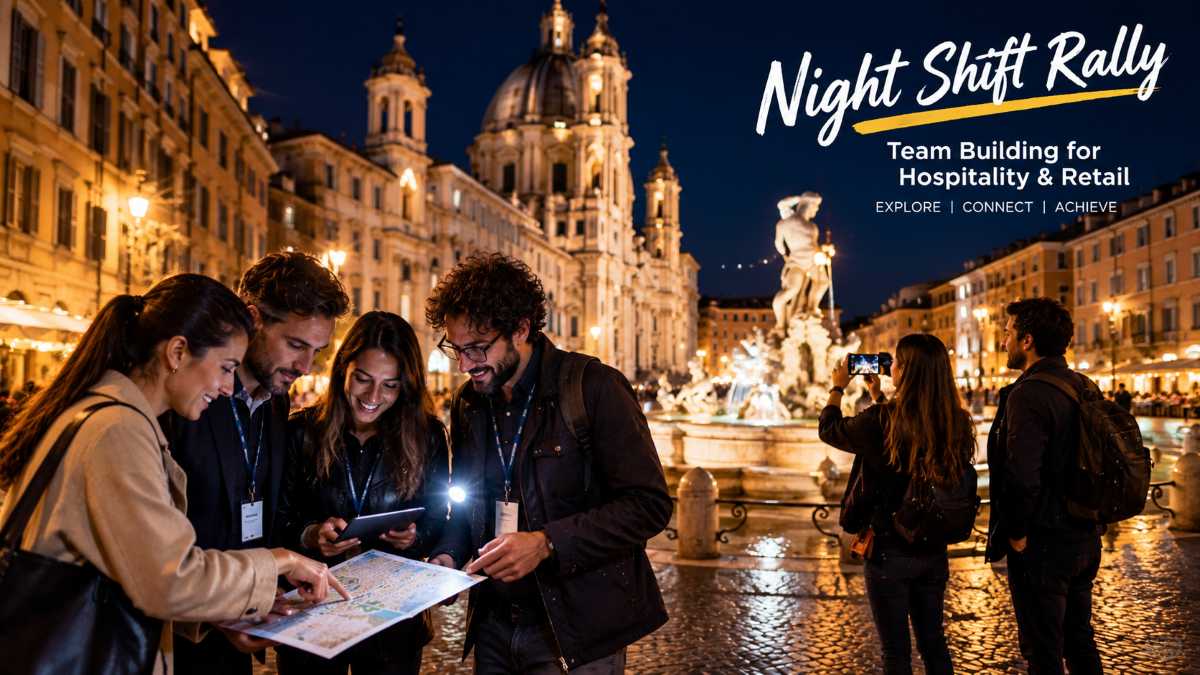
Night Shift Rally: evening and nighttime activities designed for the Hospitality and Retail sector
When the offices close, for many hospitality and retail professionals, the work is not over yet.
In a hotel lobby, new guests arrive.
A boutique welcomes the last customers.
A restaurant prepares for the evening service.
The reception continues to coordinate arrivals and requests.
A retail team is still managing customers, sales, visual merchandising, and closing the store.
That’s exactly when Night Shift Rally is born: a team-building format designed to turn the evening into a true team experience.
It’s not simply a company activity moved to after dinner.
It’s a nighttime mission in which participants must observe, orient themselves, communicate, solve puzzles, make decisions, and collaborate to achieve a shared goal.
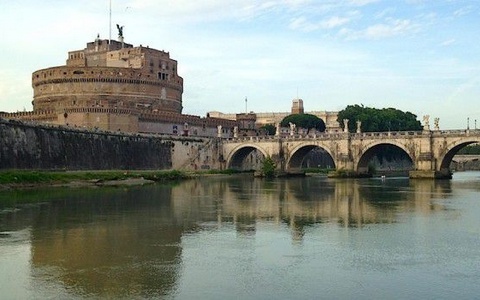
Rome becomes the big game board.
Illuminated squares become checkpoints.
Monuments become clues.
Store windows become challenge elements.
Alleys become routes.
And the group of colleagues becomes, for one evening, a real operational team.
Why Night Shift Rally was created
Hospitality, retail, food service, and hospitality businesses have a feature that sets them apart from many other professional activities: the customer relationship can continue until late evening.
This often makes it more complex to organize a traditional Team Building during normal working hours.
Receptionists, concierges, housekeeping, F&B, store managers, sales assistants, commercial managers, and other professionals may work different shifts.
Night Shift Rally was created to address exactly this need.
The experience can be organized in the evening time slot, after the shift, before a company dinner, or as an integral part of a convention or incentive.
So the schedule becomes part of the concept.
When the shift ends, the mission begins
Let’s imagine a group of employees from a large hotel in Rome.
During the day, each person has a precise role.
Reception welcomes the guests.
The concierge handles requests and information.
Housekeeping coordinates the rooms.
Food & beverage takes care of the service.
Management supervises the organization.
Then evening arrives.
The group gathers in a room.
On the table there’s an envelope.
A participant opens it.
Inside they find a map, a photograph, and a message:
“The city is ready. The mission begins now.”
From that moment, everything changes.
The receptionist can become a navigator.
The manager can handle the photo.
The retail colleague can solve a puzzle.
The person who knows the city best can become the guide.
Another participant can coordinate the team.
Professional hierarchies become less important.
What matters is what the group can build together.
How Night Shift Rally works
The format can be customized based on the number of participants, the event duration, the location, and company goals.
A possible structure includes four moments.
1. Briefing
Teams meet at the starting location.
The Game Master presents the story, the rules, and the mission.
Each team receives materials, maps, any digital devices, and the first clue.
From that moment, the game begins.
2. Night Mission
Teams head into the urban area.
The route can include different POIs in Rome, chosen based on the duration and structure of the mission.
Each stop hides a challenge.
To know the next point, you must solve a puzzle.
To earn a bonus, you must complete a photo.
To unlock a code, you need to observe a detail.
The city becomes one big puzzle.
3. Night Challenges
Along the way, you can include:
-
photo challenges;
-
puzzles;
-
quizzes;
-
observation missions;
-
creative challenges;
-
communication tasks;
-
QR Code;
-
mini escape challenge;
-
time-based missions;
-
tasks related to the story and culture of Rome.
The variety helps highlight different skills.
You don’t necessarily win by running the fastest.
The team must know how to observe, listen, decide, and collaborate.
4. Final Night
At the end, all teams reach the final point.
The Game Master reconstructs the mission.
Challenges, bonuses, and results are counted.
Then the game makes room for the social part.
An aperitif.
Dinner.
A toast.
An awards ceremony.
Or an evening with music and entertainment.
The mission ends, but the shared experience remains.
Night in Rome becomes the game field
Rome offers a particularly suitable setting for Night Shift Rally.
In the evening, the perception of its monuments changes.
A square known during the day can become completely different after sunset.
Lights, shadows, storefronts, and the presence of people transform the city into a narrative scenario.
Spanish Steps: the retail challenge
Spanish Steps – Tourism Rome can become one of the stops in a Night Shift Rally dedicated to the retail world.
The area has a strong historical connection to commerce, hospitality, and the city’s international presence. (Tourism Rome)
The mission could use:
-
store windows;
-
signs;
-
architectural details;
-
photographs;
-
elements of visual merchandising;
-
hidden clues in the urban narrative.
A team might receive a partial photo of a storefront and have to identify the exact location.
Another team could receive a set of details to arrange in the correct order.
A third team might have to build a story based on what they observe.
Navona Square: art, observation, and strategy
Navona Square – Tourism Rome is an ideal setting for an observation-based challenge.
The presence of the Fountain of the Four Rivers, other fountains, and Baroque architecture provides numerous details that can be used as elements of a challenge. (Tourism Rome)
The Game Master could hand out a photograph.
The team must identify the detail.
But it’s not enough to find it.
You must use it to solve the next clue.
So the group must observe Rome with different eyes.
Not like tourists.
Like investigators.
Trastevere: Rome of the evening
Trastevere – Tourism Rome can become one of the most scenic areas of the route.
Alleyways, squares, venues, and the evening atmosphere offer a natural setting for an urban treasure hunt.
A mission can go through the area of Santa Maria in Trastevere, use architectural details as clues, and turn the neighborhood into a sequence of checkpoints.
The route can also be built with photo challenges and creative missions.
Trevi Fountain: photography as a mission
The Trevi Fountain can become the starting point of a photo challenge.
The brief could be:
“Tell the story of Rome without photographing the Trevi Fountain in its entirety.”
So the team must look for a different perspective.
A reflection.
A detail.
A person.
An architectural feature.
A composition.
The seemingly simple challenge becomes an exercise in creativity and communication.
Night Urban Rally: the city as a game board
One possible development of the format is to turn Night Shift Rally into a real night-time Urban Game.
The structure can be adapted from formats like Amazing Race by TeambuildingRome, which is already based on puzzles, challenges, and missions in the center of Rome.
The night version can add:
-
evening checkpoints;
-
photo missions;
-
time-based challenges;
-
QR codes;
-
messages from the Game Master;
-
hidden bonuses;
-
special missions;
-
challenges dedicated to hospitality and retail.
A city, multiple strategies
The interesting feature of an urban rally is that teams can be asked to make decisions.
Which challenge to tackle first?
Which route to choose?
Is it better to look for a bonus or go straight to the checkpoint?
Who should handle orientation?
Who should solve the puzzle?
The team must build a strategy.
Night Retail Challenge
The retail sector offers many elements that can be turned into game materials.
Store windows.
Packaging.
Signs.
Brand.
Colors.
Displays.
Lighting.
So the city becomes a big visual surface.
Visual Merchandising Challenge
Each team receives a mission.
They must observe a series of store windows and identify specific elements.
After that, they must create their own concept through photos, storyboards, or materials provided.
The challenge can train:
-
observation;
-
creativity;
-
communication;
-
time management;
-
collaboration;
-
ability to synthesize.
Brand Story Challenge
Another challenge can focus on storytelling.
The team must tell the story of an imaginary brand in 60 seconds.
They can use photos, videos, slogans, and locations found along the route.
The difficulty lies in creating a coherent story starting from different elements.
Mystery Shopper Mission
The team receives a customer profile and an objective.
They must observe the environment, gather information, and build a solution.
The activity can be done as a playful simulation, without interfering with real customers.
The goal isn’t to evaluate individual professional performance.
It’s about creating a situation in which the group must communicate and make decisions.
Hotel Night Mission: the hotel becomes a big game
Night Shift Rally can also be organized directly inside a hotel property.
The lobby can become the starting point.
A meeting room can host a challenge.
A hallway can become a route of clues.
A room can turn into the headquarters.
A terrace can become the final point.
The Missing Guest
The story can begin with a mysterious situation:
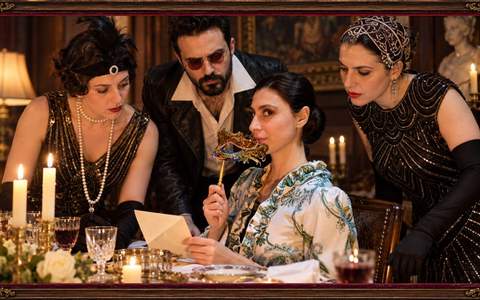
“A guest has arrived at the hotel, but no one can find them anymore.”
The story is naturally fictional and is only the beginning of the game.
Teams receive:
-
a booking;
-
a photograph;
-
a number;
-
an object;
-
a message;
-
a code.
They must reconstruct the sequence of events.
Every piece of information is useful.
But none is sufficient on its own.
Escape Box Night Edition
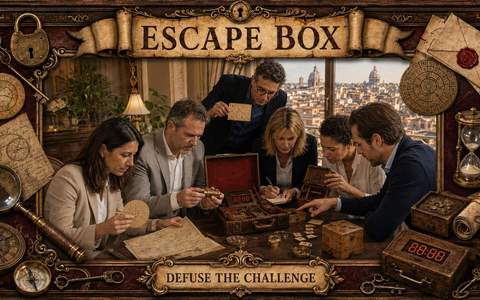
One of the activities that can be adapted to the concept is Escape Box by TeambuildingRome, based on suitcases, codes, and puzzles to solve as a team.
The Night Edition version can be set directly in the hotel’s meeting room.
The lights dim.
The countdown starts.
A suitcase appears on the table.
The group must find a way to open it.
Each code leads to the next.
Time is running out.
Communication becomes essential.
Rome’s Ages: history and an urban game after dark
Another possible reference for designing Night Shift Rally is Le Età di Roma by TeambuildingRome.
The route passes through several locations in the historic center, including the Pantheon, Campo de’ Fiori, the Jewish Ghetto, and Trastevere, combining storytelling, puzzles, and collaboration.
A Night Shift version could turn the same principle into an evening mission.
Rome’s past becomes the narrative thread.
Teams must follow the clues.
A monument provides a hint.
A photograph unlocks a challenge.
A historical detail leads to the next checkpoint.
The city is not just the setting.
It is part of the story.
Night Shift and shift work
One of the strengths of the format is its flexibility.
Night Shift Rally can be designed as:
-
an activity of about 90 minutes;
-
a 2-hour experience;
-
a 3-hour format;
-
an activity before dinner;
-
an activity after dinner;
-
an event connected to a convention;
-
a parallel experience for different groups;
-
an evening program for teams that work shifts.
In this way, Team Building can adapt to the company’s operational needs.
Team Building across different departments
The format becomes especially interesting when teams are built by mixing people who normally work in different departments.
For example:
Reception + Housekeeping + F&B + Sales
or:
Store Manager + Sales Assistant + Marketing + Visual Merchandising
During the game, each person has part of the information.
To solve the mission, they must share it.
Who can orient themselves should guide.
Who observes best should look for clues.
Who communicates well should explain the solution.
Who has strong strategic ability should help choose the route.
The result is a hands-on exercise in collaboration.
Night Shift Rally and customer experience
For hotels and retail, there’s another level of interest.
The customer experience often comes from the collaboration of people performing different functions.
A hotel guest can interact with reception, concierge, housekeeping, the restaurant, and management.
A retail customer can connect with sales assistants, store managers, visual merchandising, and customer service.
Night Shift Rally can turn this idea into a question:
“How can we turn many individual actions into a single experience?”
So the game becomes a way to observe collaboration from a different perspective.
From Night Rally to the company evening
Night Shift Rally can also be the centerpiece of a larger corporate night.
An example schedule could be:
18:30 – Welcome
Welcoming the participants.
19:00 – Briefing
Presentation of the story and formation of teams.
19:15 – Night Rally
Teams set off.
21:15 – Final Challenge
Gathering of the groups and final challenge.
21:30 – Aperitif or dinner
Social time.
22:30 – Award Ceremony
Awards and final photo.
Times can naturally be adjusted to the company’s needs.
When Team Building becomes an evening
One of the most interesting options is to connect Night Shift Rally to a real evening experience.
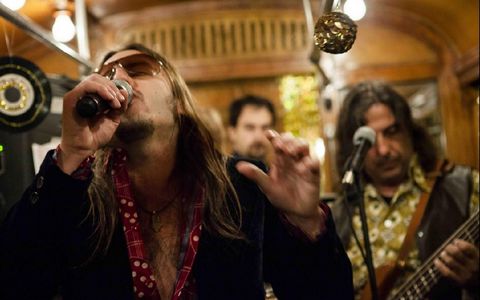
For example, after the urban mission, the group can board a format like TRAM ROCK EXPRESS by TeambuildingRome, which uses a historic tram as the setting for an evening with music and socializing.
Alternatively, the route can end with dinner, an aperitif, a show, or another company experience.
The special thing is that the evening is not just what comes after Team Building.
It’s the natural conclusion of the story.
Why choose an evening activity?
The evening changes the pace.
It changes the light.
It changes the atmosphere.
And it changes the way you perceive the city.
A square you know during the day can become a completely different setting.
A phone can stop being a work tool and become a compass.
A map can turn into a mission.
A colleague can take on a completely new role.
It’s this transformation that makes Night Shift Rally interesting.
The value of collaboration
The real goal of the format isn’t simply to get there first.
It’s to understand how to get there together.
One team can be fast but poorly organized.
Another team can be slower but very precise.
Another might find a creative solution that helps them recover time.
The game makes dynamics visible that normally stay hidden in everyday life.
Who takes the initiative?
Who listens?
Who coordinates?
Who suggests?
Who mediates?
Who manages to keep the group focused?
These dynamics can become topics for reflection during the final debriefing.
Debriefing: from the mission to everyday work
After the fun part, an important moment comes.
The group stops.
The Game Master goes over the challenges.
Decisions are analyzed.
Mistakes are remembered.
Insights are shared.
And the experience is connected to work.
The question can be simple:
“What did we do this evening that we can do even better tomorrow?”
So Team Building becomes not only entertainment, but an experience you can start from to talk about communication, collaboration, and coordination.
Night Shift Rally: a new perspective on Team Building
Team Building doesn’t necessarily have to take place during the day.
For hotels, retail, hospitality, and companies with shift-based activities, the evening can become the ideal time to create a new team experience.
The Night Shift Rally turns this need into a concept.
Rome becomes the game board.
Monuments become clues.
Squares become checkpoints.
Store windows become challenges.
Hotels become scenarios.
People become a team.
From the Spanish Steps to Navona Square, from Trastevere to the Trevi Fountain, every place can become part of a story.
And when the city lights up, a new mission can begin.
Night Shift Rally: when work ends, the game begins.
FAQ – Night Shift Rally
What is Night Shift Rally?
It’s an evening or nighttime Team Building format based on urban games, treasure hunts, puzzles, photo challenges, and team missions.
Who is it for?
It’s especially suitable for hospitality, retail, hospitality businesses, restaurants, travel, and companies characterized by shift work or evening operational activities.
Can it be organized directly in a hotel?
Yes. The format can be carried out inside meeting rooms, lobbies, and other spaces of the property, or combined with an urban route.
How long does it last?
It can be designed for about 90 minutes, 2 hours, 3 hours, or integrated into a larger company evening.
Where can it be organized in Rome?
The route can be built across different areas of the historic center and in other neighborhoods, choosing the POIs based on the season, duration, group size, and event goals.
Can it be connected to a company dinner?
Yes. The mission can end with an aperitif, dinner, music, entertainment, or an awards ceremony, creating a complete evening program.
Is it possible to customize it for a hotel or a retail brand?
Yes. Storytelling, challenges, missions, and materials can be built around the sector, the brand, the location, and the company’s objectives.
If you want to experience this or similar events, click here; you’ll find our proposals:
Request a free quote and receive all the information about your Team Building experience.
Request a free quote and receive all the information about your Team Building experience.