













































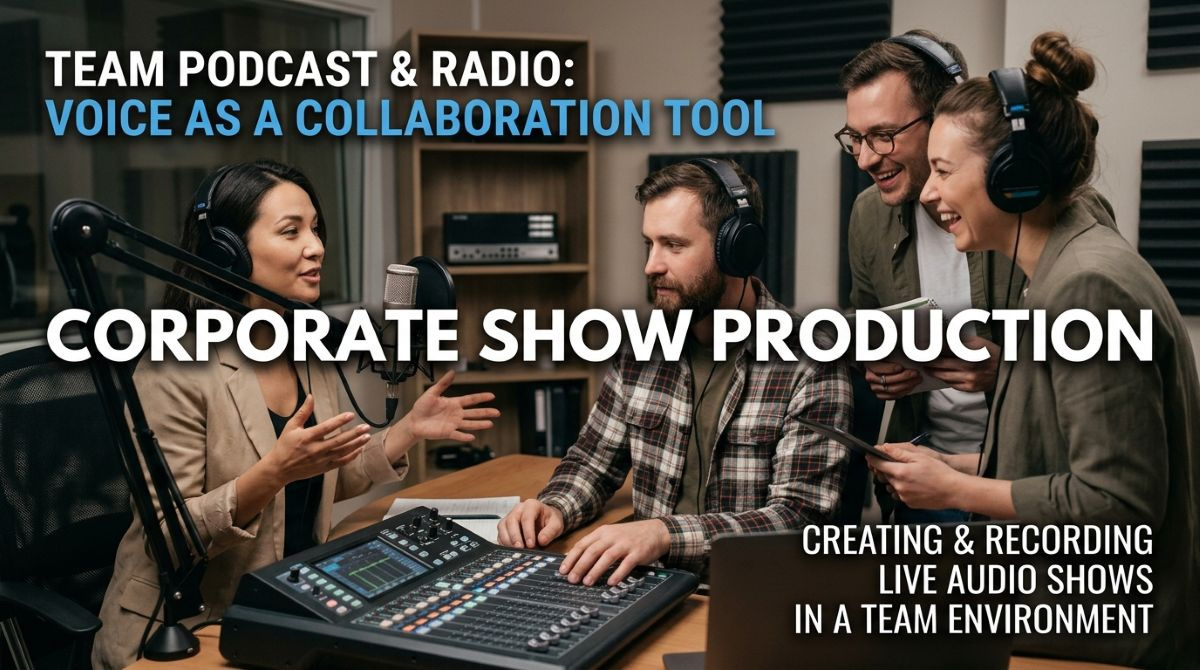
Podcast & Company Radio: creating and recording a live audio show as a team
When the team enters the studio and the voice becomes a tool for collaboration
A voice introduces the program.
Someone else asks a question.
Someone keeps track of the time.
A colleague handles the music.
Another person takes the microphone and improvises a punchline.
Then comes the moment when everyone must listen to each other at the same time.
We’re not a professional radio station.
We’re in front of a corporate group that, for a few hours, has transformed a room, a Roman venue, or an event space into a real temporary company radio station.
This is how the format Podcast & Company Radio was born: a creative team-building activity in which participants design, host, and record an audio show built together.
The goal isn’t to become professional speakers.
The real goal is to learn how to communicate, listen, improvise, respect other people’s timing, and turn many different voices into a single narrative.
It’s a particularly interesting experience for companies looking for an original team-building experience in Rome, one that combines technology, communication, creativity, and entertainment.
From briefing to live broadcast: how a company show is created
It all starts with an idea.
The group is split into small teams and given a mission: create a radio episode or a live podcast.
The theme can be free or connected to the company.
It can tell a project.
It can turn into a talk show.
It can become a fake radio broadcast dedicated to Rome.
Or it can take the form of a fully ironic program, with hosts, reporters, guests, segments, and music.
The editorial team
Before turning on the microphones, the most important phase comes: planning.
Participants must decide:
-
the name of the show;
-
the host;
-
the speakers;
-
any guests;
-
segments;
-
the rundown;
-
the music theme;
-
the questions;
-
the timing of each contribution;
-
the show’s ending.
This phase instantly turns a group of people into a small editorial team.
Someone naturally takes on the coordinator role.
Someone else proposes ideas.
There’s also someone who prefers to write.
Someone who loves to talk.
Someone who handles the technical aspects.
And someone—maybe initially quieter—finds their space right behind the microphone.
The real challenge: learning to listen
A company podcast may seem, at first glance, mainly like a communication activity.
In reality, it’s also a listening exercise.
When two people talk at the same time, the message gets lost.
When a host doesn’t follow the rundown, the program slows down.
When a guest goes on for too long, someone else has to know how to step in.
When an unexpected question arrives, you have to react.
And that’s exactly where the game becomes interesting.
The microphone makes certain dynamics immediately visible that would normally remain hidden during everyday work.
Talking, but also making room
A good broadcast isn’t built by the person who talks the most.
It’s built by the interaction among people.
The host must know when to jump in.
The speaker must understand when to stop.
The technician must anticipate what’s about to happen.
The group must keep the thread of the story.
In this sense, radio team-building becomes an extremely concrete metaphor for daily work.
Communicating doesn’t only mean sending information.
It also means knowing when to speak, when to listen, and when to leave space for others.
Live podcast: when the unexpected becomes part of the show
The most fun part often comes when something doesn’t go exactly according to plan.
A surprise question throws the host off.
A guest improvises an answer.
A participant forgets a line.
A segment ends earlier than expected.
The music starts at the wrong moment.
And it’s precisely in these moments that the team has to respond.
There isn’t always a prepared solution.
Collaboration is needed.
Presence of mind is needed.
Adaptability is needed.
So the format can integrate techniques taken from the world of improvisational theater, where listening, creativity, and handling the unexpected become essential elements. Theatrical improvisation is already among the creative experiences offered in Rome and is a natural complement to an activity based on live communication.
Technology enters team-building
One of the most interesting aspects of the format is the chance to build a real small radio setup.
Microphones.
Headphones.
Mixer.
Computer.
Music.
Sound effects.
Audio recording.
Possibly also cameras to turn the podcast into an audio-visual content piece.
But technology isn’t the purpose of the experience.
It’s the tool that allows the group to build something together.
Even someone who has never used a mixer can try out the technician role.
Anyone who has never spoken in front of an audience can try hosting a segment.
Anyone who loves writing can handle the scripts.
Anyone with strong organizational skills can become responsible for the rundown.
The result is an experience in which very different skills can find room.
From podcast to company radio: two formats, one experience
The project can be developed in different ways.
Company podcast
The group creates a real podcast episode.
The structure can include:
-
introduction;
-
interviews;
-
in-depth segments;
-
testimonials;
-
segments;
-
funny moments;
-
music;
-
conclusion.
The content can be recorded and then edited later to create an audio product to keep or share internally.
Live company radio
Alternatively, the show can be fully created live.
In this case, the experience takes on a more spectacular dimension.
The other participants become the audience.
The team must respect precise timing.
The hosts must maintain the pace.
The speakers must interact.
Production control must coordinate everything.
The result can become the concluding moment of a meeting, a convention, or a company day.
Rome becomes the backdrop of the broadcast
A company podcast can be made practically anywhere.
But Rome allows you to add a particularly strong narrative element.
The city can become a real character in the show.
An episode can start from Piazza Navona, turning its story and architecture into material for a segment.
A reporter can tell the story of the Pantheon.
Another team can build an imaginary interview while walking around the Trevi Fountain.
A more contemporary format can use Trastevere as the setting for a broadcast dedicated to Roman culture.
Or the group can transform the historic center into a mobile editorial office, combining podcasts, interviews, and small city missions.
In that case, the format can also connect with experiences like Rome in a Shot, where the historic center becomes a narrative set and the group must turn the city’s places into part of the story.
The same logic can be applied to the podcast: don’t just talk about Rome—use Rome to build the narrative.
A common language for international teams
The podcast can be especially interesting for international companies as well.
The broadcast can be produced in Italian, English, or with multiple languages within the same program.
A segment can be in English.
An interview can be in Italian.
Another section in French, Spanish, or German.
This creates a very particular situation: the group must learn to manage language differences while still maintaining a shared structure.
So the rundown becomes a kind of shared language.
Each participant knows their role.
Every voice contributes to the same broadcast.
From the microphone to the performance: the connection with music
Radio can also meet music.
A rhythmic introduction.
A jingle created by the group.
A short percussion moment.
A live intro/outro.
From this point of view, the format can be paired with musical experiences like TEAM BEAT, where the group works on rhythm, coordination, listening, and synchronization through percussion.
Transitioning from words to rhythm creates a natural continuity.
First, the group learns to listen to each other’s voices.
Then they learn to listen to each other’s rhythm.
In both cases, the result comes from the ability to coordinate.
What the Podcast & Radio Team Building develops
Behind the apparent lightness of a radio broadcast, many skills are hidden.
Communication
Speaking in front of others requires clarity, conciseness, and the ability to adapt the message.
Active listening
A good host must listen to the other person’s response and build the next question.
Collaboration
The broadcast works only if hosts, speakers, technicians, and the editorial team work in the same direction.
Creativity
Program name, segments, jingle, questions, and format all require original ideas.
Problem solving
During a live broadcast, unexpected situations may arise that force the group to find a solution quickly.
Shared leadership
There isn’t necessarily a single leader. Each phase may require a different person capable of coordinating the group.
Public speaking
The microphone creates a safe context where people can experiment with communicating in front of others.
An ideal activity for meetings, conventions, and kickoffs
The Podcast & Company Radio can be included in very different corporate programs.
It can open a meeting.
It can represent a creative break during a convention.
It can become the central activity of a team-building event.
It can conclude a training day.
It can be used during a kickoff to present goals and new strategies in a more engaging way.
It can also be customized based on the message the company wants to convey.
A company presenting a new product can create a dedicated launch program.
A sales team can build a fake broadcast dedicated to sales.
An HR department can create a talk about people and company culture.
An international group can create a multilingual radio station.
In this way, the content becomes an integral part of the experience.
When the voice tells the group
Something interesting happens at the end of the recording.
People listen to their own voice.
They hear the jokes.
They recognize mistakes.
They laugh at the improvised moments.
They might discover that the most reserved colleague was an excellent interviewer.
Or that someone used to coordinating projects can improvise really well.
So the podcast also becomes a mirror.
It lets the group observe themselves from a different perspective.
And that’s one of the most interesting values of experiential team-building: creating situations where people can try roles different from their usual ones.
A temporary radio in the heart of Rome
Imagining a room in the center of Rome transformed for a few hours into a radio studio means completely changing perspective.
Outside there are monuments, squares, and the city’s movement.
Inside there are microphones, headphones, and a rundown.
A voice announces the start.
Production control gives the go-ahead.
The first speaker talks.
The others listen.
The broadcast takes shape.
And at that moment, the group is no longer simply made up of colleagues taking part in an activity.
It has become an editorial team.
A small creative team.
A group able to build a story starting from individual voices.
This is the true strength of Podcast & Company Radio: turning communication into experience and each individual voice into a collective project.
FAQ – Podcast & Company Radio
Is radio experience necessary?
No. The format is designed for people without experience, and roles can be assigned based on participants’ characteristics.
How many people can take part?
The format can be adapted to groups of different sizes, potentially creating multiple editorial teams or multiple squads.
Can the podcast actually be recorded?
Yes. The format can include audio recording of the episode, possibly edited later.
Is it possible to run a live company radio?
Yes. The show can be built and hosted live in front of the other participants, turning the team-building activity into a real performance.
Where can it be organized?
It can be set up in hotels, meeting rooms, event spaces, companies, historic venues, and other locations suitable for the format’s technical setup. In Rome, it can also be combined with urban activities and POI.
Can it be done in English?
Yes. The format can be adapted for international teams and can include multiple languages within the same experience.
If you want to experience this or similar activities, click here; you’ll find our proposals:
TeamBuildingRome – Team Building in Rome
Request a free quote and get all the information about your Team Building experience.





