Flag Throwers & Drummers: Coordination, Rhythm and Stage Presence in Period Costume
A flag rises toward the sky.
For a moment, it seems to hang there.
Then it spins, changes direction, and returns to the flag thrower’s hands at exactly the right moment.
At the same time, a drumbeat sounds.
One.
Two.
Three.
The group moves forward.
The flags move together, the drums keep time, and the costumes transform the scene into a little theatrical machine.
But behind all that spectacle, there is no improvisation.
There is practice.
There is listening.
There is precision.
And above all, there is coordination.
It is this combination that gives rise to an original Team Building experience with flag throwers and drummers, where the tradition of Italian historical performances meets the modern dynamics of teamwork.
For a few hours, a company team becomes a small group of standard-bearers and musicians.
Flags take the place of slides for a moment.
Rhythm takes the place of words.
And the final performance becomes the result of a collaboration in which every individual mistake can change the entire composition.
From the tradition of flag throwing to a new Team Building experience
The art of flag throwing has roots in European military history: banners were also used as signaling tools, and standard-bearers practiced controlling the flag and performing coordinated movements. Over time, these practices evolved into a spectacular discipline characterized by technique, athleticism, and precision. (Bandierai degli Uffizi)
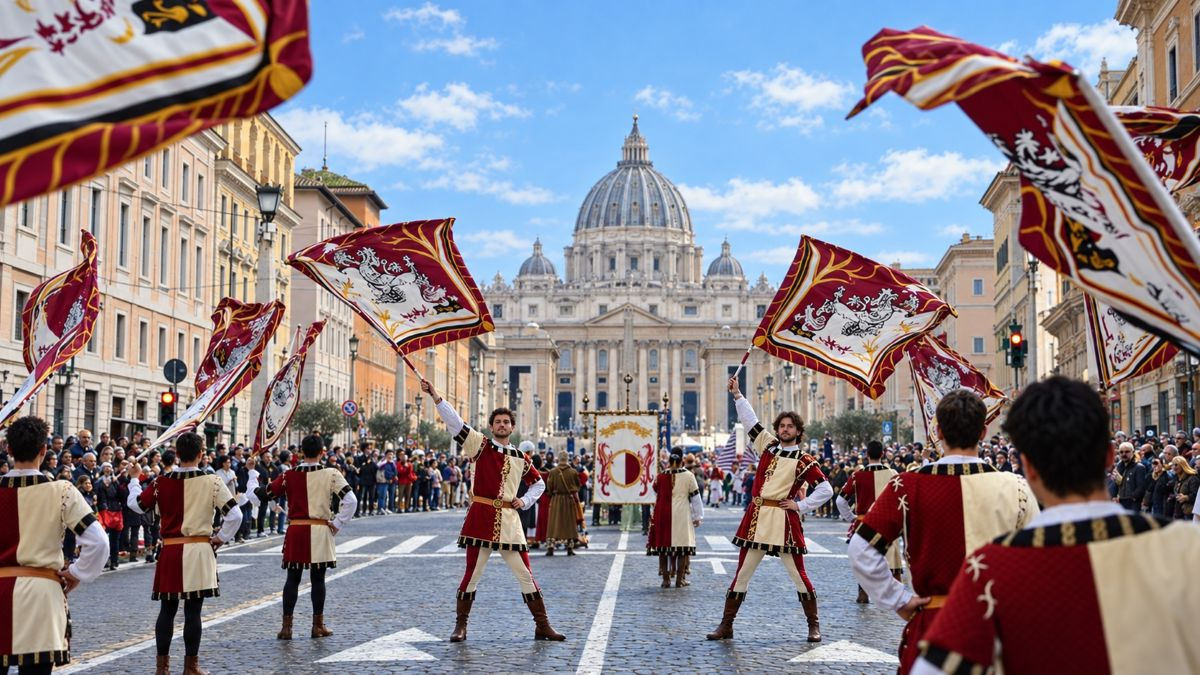
Today, flag throwers are key figures in historical reenactments, festivals, parades, and events.
The flags whirl.
The drums build the rhythm.
Trumpets can accompany the music.
The costumes evoke eras when squares and courtyards were places for celebration, parades, and performances.
Bringing this language into a Team Building activity means transforming it into a truly participatory experience.
You don’t simply watch the performance.
You become part of it.
The first goal: learning to move together
A flag never really moves on its own
Imagine a company team arriving at a historic venue in Rome.
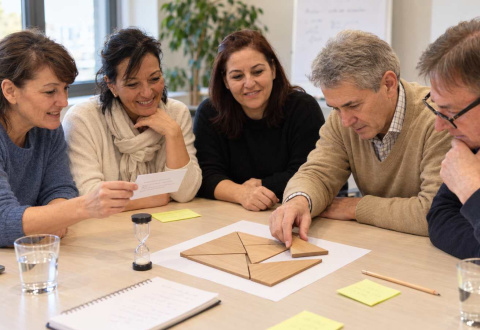
Flags are laid out on the table.
Drums are beside them.
Participants wear costume pieces inspired by historical parade traditions.
At first, someone watches with curiosity.
Someone else smiles.
Someone tries spinning a flag right away.
Then comes the first briefing.
The fundamental rule is simple:
before moving, you need to learn to listen.
The group then discovers that flag throwing is not just an individual challenge.
It’s a system.
Every movement must follow a sequence.
Every gesture must happen at the right moment.
Everyone needs to know what the others are doing.
Rhythm as a shared language
The drum introduces an even more interesting dimension.
Rhythm provides a shared point of reference, even when people do not have the same experience, role, or way of communicating.
It is similar to the dynamic explored in the TEAM BEAT format, where percussion is used to develop coordination, listening, and collaboration without requiring musical skills.
With flag throwers, however, movement is added to sound.
The group must coordinate ears, eyes, hands, and body.
Flag throwers and drummers: two roles, one team
The musicians must listen to those who are moving
One of the most interesting features of the format is the opportunity to divide the group into different roles.
Some participants can become the flag-throwing team.
Others can take care of percussion.
Others can take on performance or coordination roles.
The important thing is that no one is truly working alone.
The drummer has to keep the rhythm.
The flag thrower has to interpret it.
The coordinator has to observe the whole group.
The performance comes from interaction.
Leadership shifts during the activity
In a company team, we are often used to identifying one person in charge.
Here, leadership can instead shift according to the moment.
When the group needs to keep the rhythm, the drummer can become the point of reference.
When a sequence of movements begins, attention shifts to the flag throwers.
When preparing the final performance, the person who can coordinate the group comes to the fore.
Leadership therefore becomes situational.
The person with the highest-ranking role does not necessarily lead the group at every moment.
Period costume completely changes the experience
When the group gets into character
There is a moment when the atmosphere of the activity changes.
Participants put on the costumes.
A complex historical reconstruction is not necessarily required.
A single stage element may be enough: a tunic, a headpiece, a sash, or an accessory inspired by historical parades.
Suddenly, the group is no longer just a collection of colleagues.
It has become a small performance troupe.
This element has an important value.
Costume helps people step out of their professional routine temporarily.
The person who says little during meetings may find themselves leading a sequence.
The manager may become a drummer.
The quietest colleague may find themselves center stage.
Stage presence as a skill
Being in front of others means managing posture, space, attention, and confidence.
That is why the activity can also be connected to skills such as:
-
public speaking;
-
nonverbal communication;
-
presence;
-
expressiveness;
-
managing attention;
-
confidence;
-
coordination.
The aim is not to turn participants into professional performers.
It is to let them experience a different way of communicating.
A performance is built on precision
The moment when everything has to work
After the briefing comes the rehearsal phase.
The group practices.
Once.
Then again.
Someone moves too soon.
Someone else loses the rhythm.
A flag is late.
The drum speeds up.
They start over.
And this is precisely when the true value of Team Building emerges.
The team realizes that the result does not depend on a single spectacular gesture.
It depends on collective precision.
The dress rehearsal
Before the final performance, a full dress rehearsal can be organized.
The group must:
-
enter the performance area;
-
take their places in formation;
-
follow the rhythm;
-
perform the sequence;
-
hold their positions;
-
coordinate their movements;
-
finish at the same time.
At this point, the activity becomes a small theatrical production.
Rome as a stage
A city built for performances
Rome has an extraordinary quality for this kind of experience: many of its squares are already natural stage sets.
The historic center makes it possible to connect the performance with the city’s history, architecture, and theatrical urban spaces.
A venue can be selected according to the event program and the logistical requirements of the activity.
Possible narrative POIs include Piazza del Campidoglio, Piazza Navona, Piazza di Spagna, Campo de’ Fiori, or other historic areas suitable for the project.
Piazza del Campidoglio
Piazza del Campidoglio, designed by Michelangelo on Capitoline Hill, offers a particularly striking backdrop for a story connected to history and pageantry.
The square’s geometry, staircase, and Renaissance architecture can become stage elements in an activity built around precise movements.
Piazza Navona
Piazza Navona also has a naturally theatrical character.
Its shape derives from the ancient Stadium of Domitian, and over the centuries the square has hosted popular festivals, races, and jousts. (Turismo Roma)
It is easy to imagine how evocative it could be to create a Team Building experience that uses its theatrical character as part of the story.
Piazza di Spagna
Piazza di Spagna, with the scenic Spanish Steps and the Fontana della Barcaccia, has been one of the city’s most recognizable meeting places for centuries. (Turismo Roma)
Here, Team Building can take on an even more visual dimension, especially if the performance is designed as a scenic, photographic event.
Flag throwers, drums, and storytelling
Not just technique: there has to be a story to tell
A performance becomes memorable when it is more than just a sequence of movements.
That is why Team Building can be built around a story.
Each team can represent a neighborhood, a historic family, an imaginary guild, or a delegation.
Each group can have:
-
a color;
-
a symbol;
-
a flag;
-
a rhythm;
-
a stage entrance;
-
a short introduction.
At that point, the final result becomes a true narrative.
The flag as the team’s identity
Customization can go even further.
Each team can design its own banner inspired by the company’s values.
A symbol for innovation.
One for collaboration.
One for sustainability.
One for creativity.
The flag is no longer just an object to move.
It becomes the group’s visual symbol.
From musical Team Building to historical performance
The connection with TEAM BEAT
The format can naturally complement other musical experiences offered by Team Building Rome.
TEAM BEAT uses rhythm to build harmony, energy, and collaboration. Participants are guided by a professional percussionist, and no musical experience is required. (Teambuilding Rome)
Flag Throwers & Drummers adds another dimension.
Rhythm is joined by:
movement + costume + space + performance + visual identity.
The group doesn’t just create a sound.
It creates a scene.
A possible company challenge
From the first drumbeat to the final performance
Imagine a company event in Rome.
The group is divided into teams.
Each team is given an identity.
Phase 1 – The choice
Each team chooses a name, symbol, and colors.
Phase 2 – The rhythm
The drummers introduce the musical sequence.
Phase 3 – The flag
The flag throwers learn their first movements.
Phase 4 – Synchronization
The groups practice together.
Phase 5 – The staging
The entrance, formation, and finale are decided.
Phase 6 – The performance
The teams perform.
Phase 7 – The debrief
The group analyzes what enabled it to achieve synchronization.
In this way, the final performance is not simply a show.
It is the tangible demonstration of the team’s work.
What does Team Building with Flag Throwers & Drummers develop?
Coordination
Every movement must happen at the right moment.
Listening
The group must pay attention to everyone else’s signals.
Nonverbal communication
Gestures, posture, eye contact, and positioning become tools for communication.
Trust
When a flag is tossed, the person catching it must trust the precision of the sequence.
Concentration
A group performance requires continuous attention.
Creativity
The group can create its own stage identity.
Leadership
The different phases of the activity allow participants to experience different forms of leadership.
Stage presence
Being in front of others requires confidence, body control, and the ability to hold people’s attention.
Flag Throwers & Drummers for meetings, conventions, and incentive events
When tradition becomes a company experience
The format may be especially appealing to companies looking for something different from classic sports-based Team Building.
It can be included in:
-
company conventions;
-
meetings;
-
incentive travel;
-
international events;
-
company dinners;
-
inaugurations;
-
celebratory events;
-
networking activities;
-
corporate programs in Rome.
It can also be combined with other experiences.
For example, the day could begin with an urban activity such as Rome in a Snapshot, which turns the historic center into a photographic set and gives participants the chance to work on creativity, interpretation, and collaboration. (Teambuilding Rome)
The day could then conclude with a flag-throwing and drumming performance.
First, Rome is told through images.
Then it is interpreted through rhythm and movement.
A performance that speaks about teamwork
At the end of the activity comes the most important moment.
The participants are lined up.
The flags are ready.
The drums begin.
For a few seconds, no one speaks.
Then the rhythm starts.
One flag rises.
Another responds.
The movements begin to fall into sync.
The team no longer focuses on individual gestures.
It focuses on the whole.
And this is precisely where Team Building achieves its goal.
A flag-throwing performance can be spectacular.
But the real experience is everything that happens before the show.
The rehearsals.
The mistakes.
The laughter.
The corrections.
The listening.
The trust.
The concentration.
The search for a shared rhythm.
The value of rhythm in teamwork
A company can be seen as a large orchestra.
Different people.
Different skills.
Different rhythms.
But one common goal.
If everyone works completely out of time, the result loses its effectiveness.
But when individual contributions are coordinated, something emerges that no one could have created alone.
Flag throwers make this metaphor visible.
Drummers make it audible.
The costumes make it theatrical.
And Team Building turns it into an experience.
When the group finds its rhythm
Perhaps that is the most interesting lesson to take away.
Not everyone needs to do the same thing.
What matters is that everyone knows when to enter the scene, when to listen, when to make room for others, and when to contribute.
As in a great performance.
As in a team.
As in a company.
FAQ – Flag Throwers & Drummers Team Building
Do you need experience with flags?
No. The activity can be designed for people with no experience, with an introductory session and progressive instructions.
Do you need to know how to play the drums?
No. The drumming role can also be introduced through simple, progressive exercises.
Are period costumes used?
The format can include stage elements and costumes inspired by historical traditions, depending on the concept and venue.
Where can the activity be organized?
It can be designed for either indoor or outdoor settings, with venues and spaces selected to suit the technical and logistical requirements of the performance.
Can the activity be organized in Rome’s historic center?
Yes, when the venue, permits, and operating conditions allow it. Some iconic sites in the center can become part of the event’s story.
Is it suitable for international groups?
Yes. The musical, visual, and physical elements make the format especially suitable for international teams, with multilingual briefings and facilitation when needed.
If you’d like to enjoy this or a similar experience, click here to see our proposals:
Request a free quote and get all the information about your Team Building experience.
To plan a personalized Flag Throwers & Drummers experience in Rome, you can also request a quote, specifying the number of participants, dates, venue, and event requirements.