Team Building in LIS: when hands become the language of the team
Imagine a room where, for a few minutes, words stop being the main means of communication. No voice giving directions, no phone ringing, no colleague who can simply raise their voice to be heard. What remains are the eyes, hands, facial expressions, posture, and above all, the ability to observe others.
This is where a special Team Building in LIS experience begins: an inclusive activity in which Italian Sign Language becomes a tool for putting communication, listening, trust, and collaboration to the test.
This is not simply about learning a few signs or turning gestures into a game. LIS is a language with its own structure and grammar, using the visual-gestural channel and including manual and non-manual components, such as facial expressions and posture. For this reason, a team-building experience built around LIS can become a true workshop on communication within work groups.
When communication changes, the way we collaborate changes too
At work, we are used to communicating through words, meetings, emails, phone calls, presentations, and instant messages. We often think of communication as something automatic: someone speaks, someone else listens, and the message gets through.
But what happens when we temporarily take away the voice?
The answer comes almost immediately. Participants begin to look at one another more. They try to interpret every movement. They wait for the right moment to step in. They discover that a facial expression can change the meaning of a gesture, and that a movement that is too fast can cause misunderstandings.
It is precisely this new situation that makes Team Building in LIS particularly interesting for companies that want to improve the quality of professional relationships.
Communication becomes more intentional, and the group is forced to slow down, observe, check, and find a new shared code together.
LIS is not simply gesturing
One of the most important aspects of this experience is starting from the right premise: Italian Sign Language is not a mime version of Italian, nor is it simply an alphabet performed with the hands.
LIS is an independent language, with its own grammatical, syntactic, morphological, and lexical rules. Meaning is conveyed through a range of elements: handshape and movement, position in space, facial expressions, posture, and other non-manual elements.
For this reason, a well-designed corporate activity should be supported by people with expertise in LIS, avoiding any attempt to turn sign language into mere imitation or caricature.
Those who would like to learn more about the nature and characteristics of LIS can consult resources dedicated to the Italian Sign Language provided by the Italian National Deaf Association and the documentation on LIS Grammar.
A team that learns to look one another in the eye
The real value of Team Building in LIS emerges when the activity moves beyond simply discovering the language to take on a collective challenge.
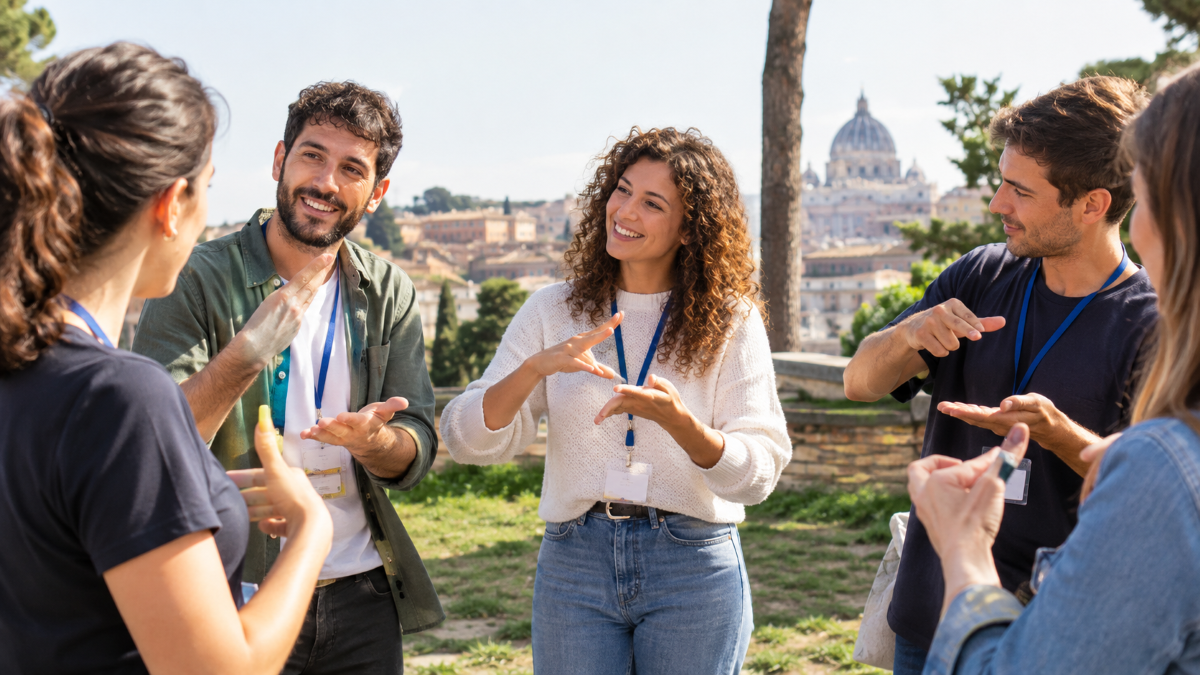
Imagine a group of colleagues divided into small teams. Each team is given a sequence of words, images, concepts, or instructions. One person has to communicate the message using LIS, while the others observe and understand it.
At first, there may be hesitation, laughter, mistakes, and interpretations that are completely different from those intended. Then something interesting happens: the group begins to develop its own approach.
Someone becomes particularly good at observing. Another proves skilled at repeating a movement. Someone discovers an extraordinary ability to express themselves without speaking. Others, on the other hand, realize how difficult it is to communicate when their usual means of expression is temporarily unavailable.
And this is where the game becomes a learning experience.
Team Building activities in LIS
1. The team's living dictionary
The first phase can focus on discovering and memorizing a few signs. The group learns words related to working life, collaboration, the city of Rome, or the event's theme itself.
Each participant is not simply given a word to remember: they must learn to recognize it, reproduce it, and use it in a situation.
2. The sign relay
A team receives a message. The first participant must pass it on to the second using only LIS, the second to the third, and so on.
At the end of the activity, the original message is compared with the one received by the team's last member.
The result can be surprising and often very funny, but above all, it provides an opportunity to reflect on how easily information can be distorted when communication is not given enough attention.
3. The story without a voice
A photograph, a scene from Rome, or a short story becomes the starting point for a completely visual narrative.
One participant tells the story through LIS, while the others have to reconstruct the sequence of events. This challenge involves memory, observation, creativity, and the ability to interpret.
4. The LIS treasure hunt
The format can become even more dynamic by turning into a real corporate treasure hunt in Rome.
Clues are not provided as ordinary written instructions; instead, they must be interpreted through signs, images, symbols, and visual communication.
The route can wind through the streets of the historic center, turning iconic places such as Piazza Navona, the Pantheon, and Campo de' Fiori into a large game setting.
5. The impossible message challenge
One of the most interesting challenges can involve communicating a complex message without using the voice.
The team has to decide how to organize itself: Who observes? Who communicates? Who checks? Who corrects? Who keeps track of the sequence?
There is no one-size-fits-all strategy. The team has to build its own.
Rome as the setting for a visual experience
Rome offers a particularly evocative setting for this kind of team building. The city has an extraordinary number of recognizable places, images, symbols, and settings that can become an integral part of the activities.
An LIS activity can start at the Colosseum, the Imperial Fora, and the Palatine Hill, continue through Piazza Navona and the Pantheon, or take place in other neighborhoods of the capital.
The opportunity to combine visual communication with the discovery of the city's historical and cultural heritage makes the experience even more engaging.
A monument can become a clue. A fountain can become the starting point for a challenge. A square can turn into an urban chessboard. An architectural detail can provide the solution to a riddle.
In this way, Team Building in LIS is not confined to a meeting room, but becomes an immersive experience in the city.
Inclusion: not a word, but a real experience
Talking about inclusive team building also means creating situations in which people can experience different ways of communicating and relating to one another.
An LIS experience can be particularly effective because it invites all participants to step temporarily outside their usual communication habits.
The aim is not to put anyone in a position where they feel “different,” but to give the whole group the opportunity to engage with a different linguistic and communication system.
This approach is also important because inclusion should not be limited to a single celebratory activity. It can become part of a broader corporate program focused on diversity, inclusion, and team collaboration.
Team Building in LIS and soft skills
Behind the game lie numerous transferable skills.
Listening and observation
When communication is primarily visual, attention is essential. Every detail can matter, and distraction can undermine understanding of the message.
Empathy
Trying to communicate through a code other than the one you usually use helps you understand how frustrating it can be not to communicate what you want to say immediately.
Leadership
The challenges can bring new leaders to the fore naturally. The usual leader will not necessarily be the most effective when the rules of communication change.
Problem solving
When a message is not understood, the team has to find a solution. It can change its strategy, simplify, repeat, use space, or rely on another team member.
Trust
Communicating without a voice requires trust in others. You have to accept that your message may be interpreted and that the final solution will be built collectively.
The value of silence in the workplace
One of the most interesting aspects of this experience is the relationship with silence.
In a typical workplace, silence is often perceived as a lack of communication. During an LIS activity, exactly the opposite happens: silence can be full of information.
Hands speak. Eyes listen. The face conveys meaning. The body becomes part of the message.
The team discovers that communicating is not just about speaking well. It also means observing, waiting, understanding, checking, and adapting.
Why choose Team Building in LIS in Rome
A company may choose this experience for several reasons: to strengthen collaboration among colleagues, address the topic of inclusion, offer an original activity during a corporate event, or simply give its team a challenge that breaks from the norm.
The format's unique strength lies in its ability to bring together experiential learning, inclusion, communication, and culture.
The city of Rome adds another narrative layer. Its squares, monuments, and neighborhoods can become part of the story, making it possible to create customized routes based on the company's objectives and the number of participants.
For an international group, the experience can also provide an interesting opportunity to explore the very concept of language. LIS is not universal: there are different sign languages around the world, such as American Sign Language in the United States and British Sign Language in the United Kingdom, each with its own characteristics.
From hands to team: a new idea of communication
At the end of the activity, a particular feeling may remain: having talked a lot without having spoken a word.
This is the most interesting paradox of Team Building in LIS.
When the voice is no longer available, all those elements of communication that we usually overlook become more obvious. Our gaze, distance, movement, facial expression, rhythm, and ability to wait for others.
The team discovers that language is not limited to words.
Sometimes, to truly learn how to communicate, all it takes is to stop speaking for a moment and start looking at one another.
If you would like to experience this or something similar, click here to explore our offerings:
Request a free quote and get all the information about your Team Building experience.
To request a quote and plan a customized experience for your group, contact us.