

































The Role of Emotions in Team Building: the true engine of corporate collaboration
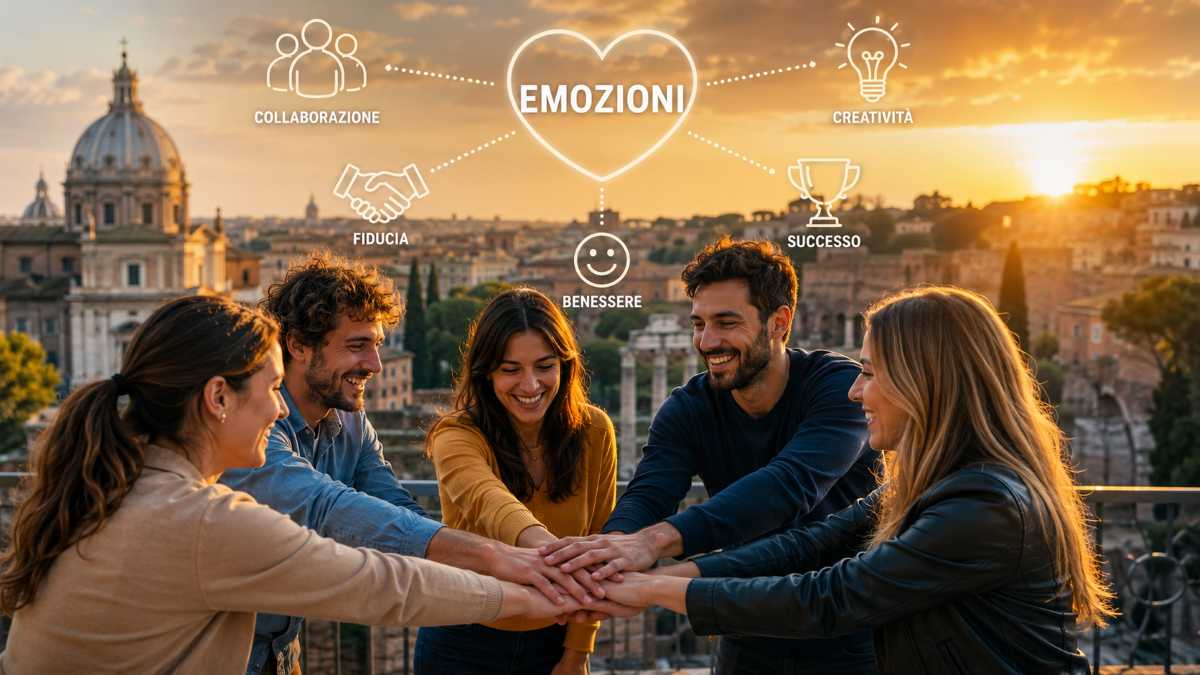
Emotions are the invisible language that guides every human relationship. Even in professional settings, where technical skills and measurable results are often prioritized, it is precisely emotions that determine the quality of collaboration, mutual trust, and the ability to face challenges together.
For this reason, modern Team Building is no longer just a set of playful activities, but a true experiential journey capable of engaging people on an emotional level. Through fun, surprise, shared moments, and even the handling of unexpected events, a group becomes a team.
Rome, with its historical, artistic, and cultural heritage, offers the ideal setting to create experiences capable of leaving an authentic and lasting memory.
Why emotions are essential in Team Building
Every decision we make is influenced by emotions. Neuroscience has shown this for years: memory, learning, and collaboration improve when an experience emotionally involves the people taking part.
An effective Team Building creates situations in which each participant experiences authentic emotions:
-
enthusiasm;
-
curiosity;
-
surprise;
-
sense of belonging;
-
personal satisfaction;
-
trust in colleagues.
When these emotions are shared, a connection develops that would be difficult to create during a normal workday.
The result is a group that communicates better, tackles problems with greater calm, and builds stronger relationships.
From theory to practice: when the group becomes a team
Let’s imagine a team that starts from Piazza Navona with a mission to complete.
No one knows the route.
The information is distributed among the various team members.
Each clue leads to a new location in the city.
At first, a slight sense of uncertainty prevails.
Then someone proposes a strategy.
A colleague discovers a detail that the others hadn’t noticed.
Another encourages the group during the hardest moments.
Tension makes room for trust.
The first success arrives.
Then another.
Without realizing it, the participants are building something far more important than the simple final win: they are learning to trust one another.
This transformation represents the true goal of emotional Team Building.
Positive emotions improve performance
The effect of sharing
When a group experiences something memorable together, the brain links that memory to the colleagues who were there.
People start to see themselves as part of a shared project.
This feeling produces tangible effects:
-
increased collaboration;
-
reduced conflict;
-
improved communication;
-
fosters listening;
-
boosts motivation.
Companies that invest in engaging experiences often see a better internal atmosphere and greater participation in shared projects.
Emotional memory
Emotions are the best ally of memory.
A traditional course can be forgotten after just a few weeks.
An experience lived in the heart of Rome, on the other hand, stays with you for years.
Every time a participant remembers that day, they will unconsciously relive the sense of belonging created with their team.
Rome: a city that amplifies every emotion
Few cities in the world can convey emotions like Rome.
Walking through the Roman Forums, admiring the Colosseum, crossing Piazza Venezia, reaching the Pantheon, getting surprised by the beauty of Trevi Fountain, wandering the alleys of Trastevere, or arriving in front of Castel Sant’Angelo means living a continuous journey between history, art, and culture.
Each place tells a story.
Each square becomes a perfect setting for a team test.
Each monument represents an opportunity to spark curiosity, observation, and collaboration.
The urban setting thus becomes an integral part of the emotional experience.
Storytelling and emotions: when every team writes its own story
Every activity becomes a narrative
The best experiences are the ones that make participants feel like protagonists.
They don’t just solve puzzles.
They live a story.
They take on roles.
They face missions.
They make decisions.
They celebrate successes together.
Storytelling increases emotional involvement and turns a simple activity into a shared memory.
This is one of the elements that makes Team Building such an effective tool.
Emotions develop transferable skills
During an experiential activity, skills often emerge naturally—skills that are usually difficult to observe in the office.
Natural leadership
Those who can motivate the group stand out without needing titles.
Effective communication
Information is shared with greater clarity.
Stress management
Unexpected events become opportunities to find new solutions.
Problem solving
Collaboration makes it possible to tackle even the most complex challenges.
Empathy
Understanding others’ emotions makes the group more united.
These skills last over time and continue to produce effects even after returning to the workplace.
The value of emotions in international Team Building
When participants come from different cultures, the language of emotions becomes universal.
A smile.
A shared victory.
A challenge faced together.
These are elements capable of breaking down linguistic and cultural barriers.
Rome, thanks to its international charm, represents one of the most effective settings for creating authentic connections among people from all over the world.
Why companies invest more and more in emotional experiences
The most innovative organizations have understood that human capital is the real competitive advantage.
Technical skills can be taught.
Trust, however, is built through shared experiences.
A Team Building designed to emotionally involve participants produces benefits that carry over into everyday work:
-
greater collaboration;
-
more effective communication;
-
increased motivation;
-
positive company atmosphere;
-
greater sense of belonging;
-
growth of distributed leadership.
Investing in emotional experiences therefore becomes a concrete strategy to improve organizational well-being and business performance.
The future of Team Building is driven by emotions
Future companies will be increasingly oriented toward experiences that put the person at the center.
Emotions are the invisible glue that connects skills, goals, and relationships.
When a group laughs together, overcomes a challenge, discovers an extraordinary place, and builds shared memories, something is created that no meeting will ever be able to create: a true team.
And this is exactly the strength of experiential Team Building.
If you want to live this experience or something similar, click here—you’ll find our proposals:
https://www.teambuildingrome.com