



































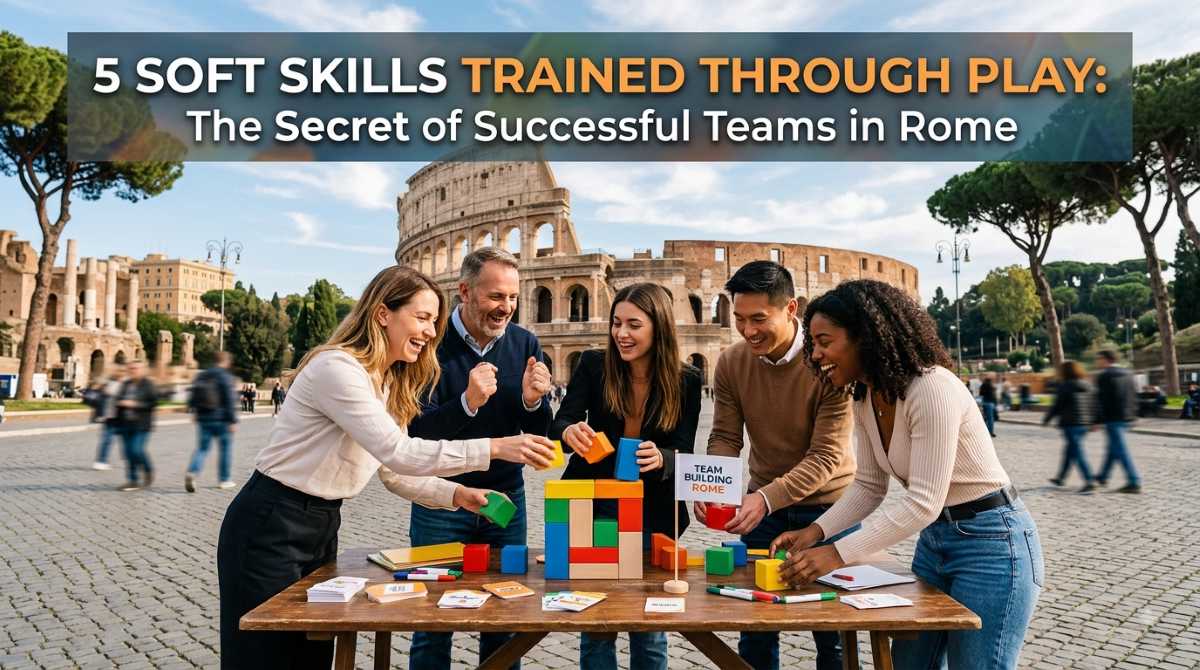
The 5 soft skills you can train by playing: the secret of successful teams in Rome
Between the ancient stones of the Roman Forums and the grandeur of Piazza Navona, there’s a truth that the most enlightened leaders have understood for a long time: the real value of a company is measured by the cohesion of the people who make it up. And yet, in the era of hyper-connectivity and hybrid work, there’s a widespread paradox. We spend hours in front of screens in perfect video calls, but we risk losing human connection, empathy, and spontaneous flexibility. How do you rekindle that inter-personal spark that’s essential for performing at high levels?
The answer doesn’t lie in yet another theoretical slide during an in-class seminar, but in direct, engaging experience. When designed with specific goals, play turns out to be a powerful learning accelerator. Through the experiential method, playful dynamics break down hierarchical barriers, stimulate neuroplasticity, and turn learning into a natural, lasting, and engaging process.
Let’s explore the 5 key transferable skills you can build by putting yourself in the game through Rome’s alleyways and history.
1. Empathetic and effective communication: listening beyond words
Understanding each other on the spot in a business meeting requires far more than simply exchanging information: it takes alignment. During a team-building play activity—such as an exciting interactive treasure hunt among Rome’s monuments or a collective construction workshop—verbal and non-verbal communication is put to the test in real time.
In dynamic, informal settings, participants learn to:
-
Practice active listening: Give value to colleagues’ ideas without judging them prematurely.
-
Summarize messages: Deliver clear, unambiguous instructions in fast-paced situations.
-
Tune in to the team’s language: Understand the other person’s emotional reactions to calibrate tone and approach.
Aligning communication under pressure becomes a fun exercise that directly reflects in everyday project management at the office.
2. Strategic problem solving and lateral thinking: breaking out of conventional patterns
When an unexpected issue threatens to derail a business project, people with strong problem-solving skills can turn the obstacle into an opportunity. The game creates scenarios outside your daily routine in which standard solutions simply don’t work.
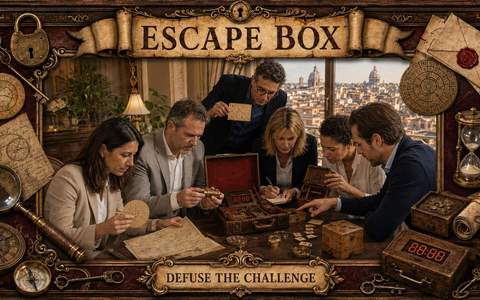
Imagine an Urban Escape Room among the historic districts of Trastevere, or around the imposing silhouette of Castel Sant’Angelo: faced with complex riddles and hidden clues in Roman culture, the group is forced to activate lateral thinking. To solve the puzzles, you need to connect elements that seem unrelated, evaluate alternative routes, and make decisions quickly. This type of training develops mental agility that’s essential for tackling challenges in a rapidly and continuously evolving market.
3. Shared leadership and delegation: unlocking everyone’s potential
Modern leadership is no longer tied to a single role on an organizational chart, but to the ability to enhance the group’s skills depending on the context. In the game, leadership becomes dynamic, fluid, and collaborative.
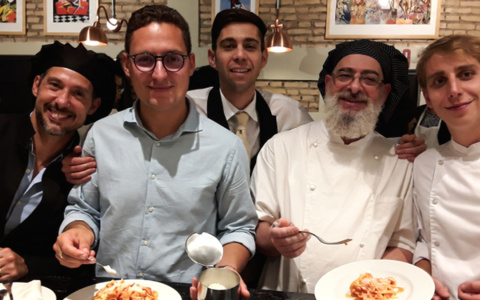
Through step-by-step challenges—such as an orientation test in the vast green lung of Villa Borghese or a cooking challenge to prepare pasta—unexpected attitudes emerge:
-
Mutual trust: Learn to delegate specific tasks to the colleague best suited for that particular challenge.
-
Role management: Recognize who has the big-picture vision and who has operational precision, to guide the team to victory.
-
Support and empowerment: Encourage team members during difficult moments, keeping collective motivation high.
This approach teaches that to lead means, above all, placing oneself at the service of the group’s goals.
4. Resilience and stress management: staying on course through challenges
Being able to handle unexpected situations without losing your composure is one of the most sought-after abilities in high-performance work environments. During company play activities, time passing, an opponent score that’s higher, or an incorrect initial strategy perfectly simulate the pressures of the corporate world.
In the protected microcosm of a team game, participants train emotional resilience:
-
Accept mistakes as an opportunity: Recognize a misstep, reset the strategy, and start again right away without blaming yourself.
-
Maintain clarity: Manage momentary frustration so you can focus on corrective actions.
-
Share responsibility: Turn a critical moment into a chance to tighten the team up rather than split apart.
Overcoming a moment of difficulty together during the game creates a strong sense of group effectiveness that stays with the team in memory.
5. Emotional intelligence and team spirit: the glue of the group
Finally, emotional intelligence is what transforms a collection of individual people into a real, cohesive team. Laughing together, celebrating a milestone just one step from the finish line, or supporting each other creates an authentic bond that goes far beyond the formal office context.
Experiencing the beauty of Rome—starting from the magnificence of the Colosseum all the way to the evocative Terrazza del Pincio—shared in a playful setting, strengthens a sense of belonging to the organization (corporate identity). The empathy developed by playing translates, when you return to work, into a climate of trust, improved organizational well-being, and a drastic reduction in internal conflicts.
If you want to live this experience or something similar, click here—you’ll find our proposals: