
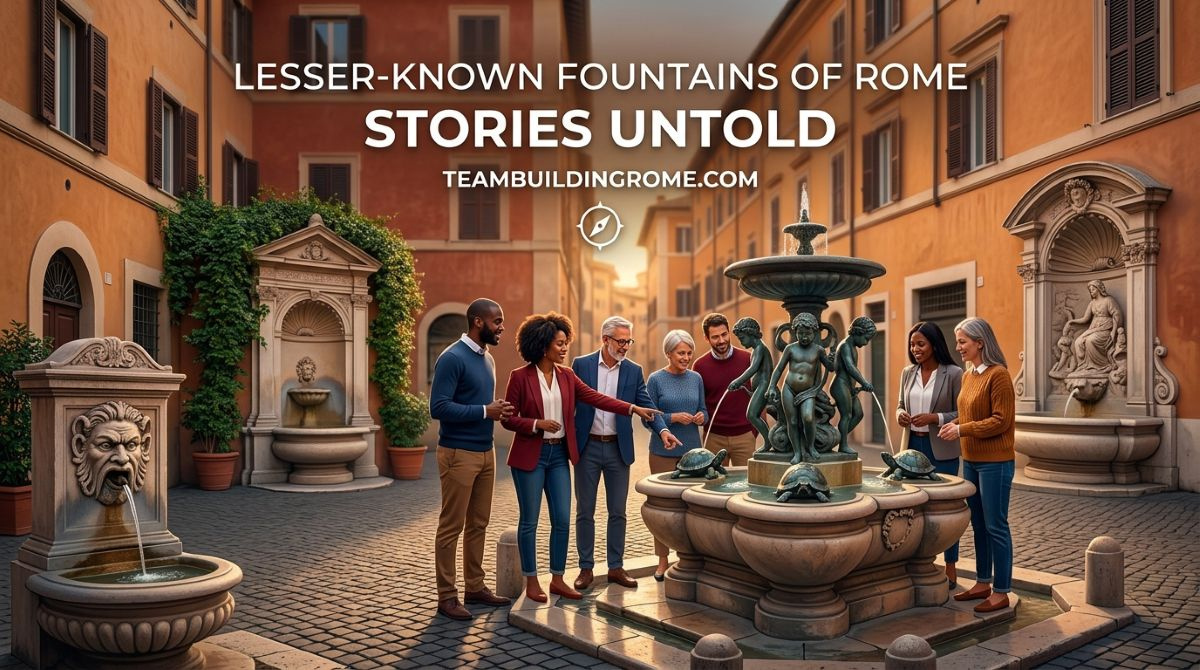
The least known fountains in Rome that tell a story
Rome is often associated with the majestic Trevi Fountain, the charm of Piazza Navona, and its famous works of art. Yet anyone who chooses to explore the city with curious eyes discovers a less well-known heritage: small fountains, hidden details, and forgotten tales.
These are places that many Romans pass every day without stopping to look at them, but that hold legends, symbols, and curiosities capable of turning a simple stroll into an engaging experience.
And that is precisely the principle behind an experiential Team Building activity: learning to notice what usually goes unnoticed, collaborating to find clues and solve riddles, turning Rome into a large discovery laboratory.
Every fountain tells a story
Imagine a team walking through the streets of the historic center.
The first clue doesn’t lead to the Trevi Fountain.
Instead, it takes you to a small fountain hidden among the alleyways.
Someone notices a detail carved into the stone.
Another person recalls a legend.
Someone else connects a symbol to the next challenge.
No one would have solved the riddle alone.
But together, every detail gains meaning.
This is how teamwork begins.
The Capital’s secret fountains
Treasures worth discovering
Rome has thousands of fountains, but some hold surprising stories that slip away from the more traditional tourist routes.
Discovering them means looking at the city with a different perspective.
Fountain of the Turtles
In the heart of the Jewish Ghetto, you’ll find one of the masterpieces of the late Roman Renaissance.
The legend says that the four bronze turtles were added later to celebrate the skill of a young nobleman who managed to build the fountain in a single night to win the hand of the woman he loved.
True or not, this story continues to fascinate visitors from all over the world even today.
Fountain of the Books
Hidden in the Sant’Eustachio district, this small fountain pays tribute to the ancient University of Sapienza.
Books carved into stone and a deer’s head tell the deep connection between Rome and culture.
It is one of the most photographed spots by fans of unusual itineraries.
Fountain of the Porter
While strolling near Via Lata, you come across one of Rome’s talking statues.
For centuries, the Porter has been the protagonist of anonymous satires and ironic messages aimed at the city’s powerful people.
A small monument that tells the story of freedom of expression in Renaissance Rome.
Fountain of the Jugs
In the picturesque Trastevere neighborhood, this curious fountain designed by Pietro Lombardi celebrates the ancient tradition of Roman inns.
A perfect symbol of the district’s convivial spirit.
Fountain of the Amphorae
In the Testaccio district, the fountain recalls the historic link with the river port and Monte Testaccio, formed by millions of ancient Roman amphorae.
A little-known place, yet rich in historical meaning.
Team Building becomes a hunt for details
Observation as a skill
In a corporate treasure hunt, the winner isn’t the one who runs the fastest.
The winner is the one who observes best.
So the least known fountains become perfect stops for Team Building activities.
Every bas-relief can turn into a clue.
Every inscription can become a riddle.
Every sculpture can become a team collaboration challenge.
Teams learn to share information, compare ideas, and make decisions together.
POIs that complete the route
An itinerary between history and wonder
The fountains fit perfectly into an itinerary that passes through some of the city’s most iconic places.
Pantheon
A masterpiece of Roman engineering.
Piazza Navona
Famous for the Fountain of the Four Rivers and the heart of Roman Baroque.
Campo de’ Fiori
A historic meeting point between merchants and citizens.
Jewish Ghetto
Home to the splendid Fountain of the Turtles and a centuries-old story.
Trastevere
The neighborhood where every alley tells a legend.
Piazza Venezia
A crossroads between ancient Rome and the modern city.
Largo di Torre Argentina
A place where archaeology and history coexist just a few steps from the ancient fountains.
What a route through the fountains teaches
The Soft Skills that develop
A Team Building experience set in the historic center helps train essential skills.
Communication
Sharing observations and insights.
Problem Solving
Interpreting symbols and connecting information.
Leadership
Guiding the group during decisive moments.
Creativity
Looking at a detail from different perspectives.
Collaboration
Bringing together different skills to achieve a common goal.
Stories make experiences unforgettable
People remember what moves them.
A small, unknown fountain can leave a stronger memory than a famous monument.
Because behind every stone, a story is hidden.
And every shared story becomes an experience that strengthens the group.
This is the value of storytelling applied to Team Building.
Turning a visit into an adventure.
A detail into a discovery.
A team into a tight-knit group.
Rome is made of great monuments… and small secrets
Those visiting Rome for the first time look for the Colosseum, the Pantheon, and the Trevi Fountain.
Those who return a second time look instead for what doesn’t show up on postcards.
The less well-known fountains represent one of the city’s most authentic treasures.
They are places that tell of art, traditions, legends, and curiosities.
Including them in a Team Building route means offering participants an original experience capable of combining culture, fun, and collaboration.
Because it is often the most hidden details that leave the greatest memories.
If you want to live this experience or others like it, click here—you’ll find our proposals:
Request a free quote and receive all the information about your Team Building experience.







