


























The bridges of Rome and their legends: stories, mysteries, and tales on the Tiber
Rome è a city built over time, but also over water. The Tiber has been flowing through it for centuries, and to allow people, goods, armies, and pilgrims to move from one bank to the other, the city built bridges that became far more than just pieces of infrastructure.
Some are extremely ancient, others have changed their appearance more than once. Some still connect neighborhoods and monuments today, others have survived only partly. And almost all have something to tell.
Behind a stone arch, a statue, or an inscription, a story of emperors, popes, architects, commanders, pilgrims, and ordinary people may be hidden. Sometimes it’s documented facts; other times they are legends handed down through the centuries, born from the need to give the story a mysterious face.
Discovering the bridges of Rome and their legends therefore means looking at the city from a different perspective: no longer only through its most famous monuments, but by following the thread of the Tiber and the stories that its waters have carried.
The Tiber: Rome’s great water road
Before talking about the bridges, we must talk about the river.
The Tiber is not simply an element of the Roman landscape. For centuries, it has been a route of communication, an economic resource, and a natural border.
Even the very birth of Rome is tied to the presence of the river and Tiber Island, one of the most evocative places for understanding the relationship between the city and the Tiber.
A river to cross
For a community that was growing on both banks, crossing the Tiber was a daily necessity.
The first crossings could be carried out with wooden structures and, later on, with increasingly imposing masonry works.
From this comes one of the most fascinating features of Rome: its bridges are an integral part of urban history.
They are not simply connections between two points. They are places of passage.
And every place of passage, in Rome, tends sooner or later to generate a story.
Ponte Fabricio: the bridge that seems to keep a secret
Among the oldest still-standing bridges in Rome, Ponte Fabricio holds a special place.
Built in 62 BC, it still today connects the left bank of the Tiber with Tiber Island.
Its structure has spanned more than two thousand years of Roman history, reaching our days with extraordinary continuity.
The Four Heads and the legend of the architects
The bridge is also known as Ponte dei Quattro Capi, referring to the four-headed herms located at the entrance.
A curious legend was born around these sculptures.
According to the traditional account, the bridge would have been entrusted to four architects who, after completing the work, would have argued heatedly among themselves.
The legend says that the pope, irritated by the ongoing disputes, decided to have them executed. Afterwards, he would have commissioned a sculpture with four heads, one for each architect, so that their bickering would remain immortalized in stone.
It’s a fascinating story, but it should be considered for what it is: a popular legend, not the historically documented explanation for the origin of the herms.
A perfect detail for a Team Building
Just this kind of tale shows how Rome can become a huge open-air book.
A team could find itself in front of the bridge with a question:
"Which part of this story is true, and which is legend?"
From there, an observation, research, and collaboration challenge can begin.
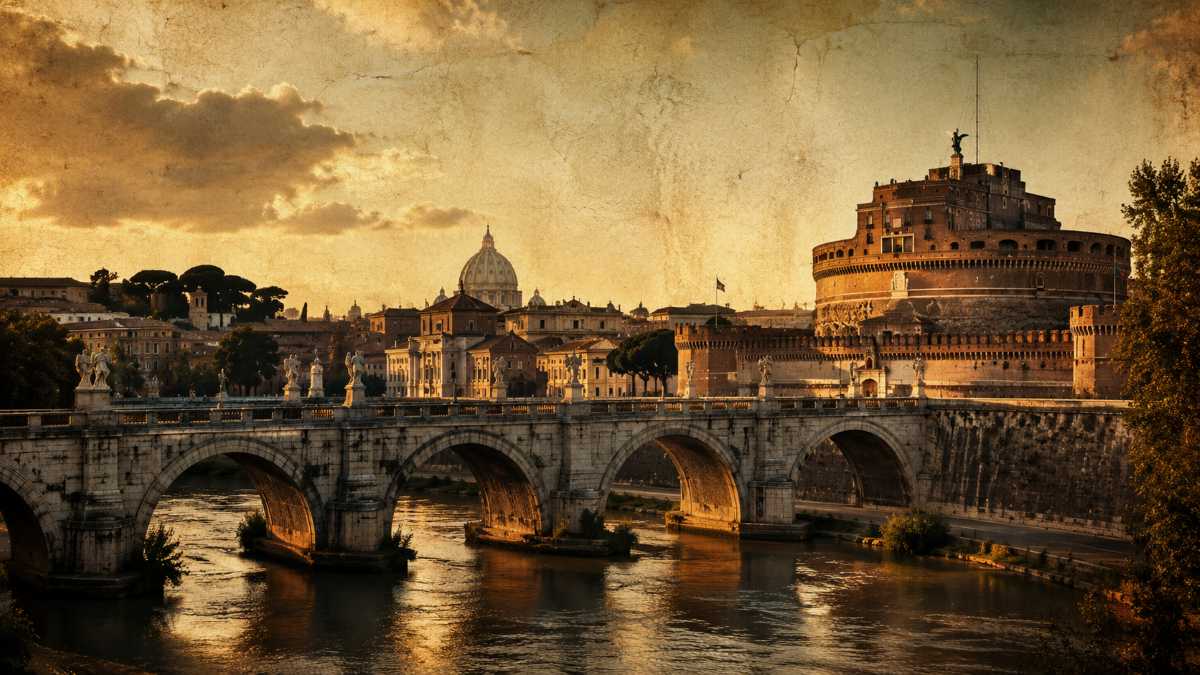
Ponte Sant'Angelo: angels, the emperor, and the fortress
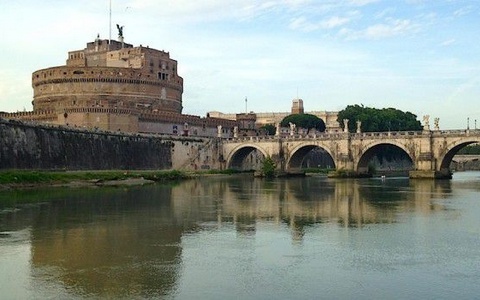
Few Roman bridges have a setting comparable to that of Ponte Sant'Angelo.
The bridge connects the historic center with Castel Sant'Angelo and ideally leads toward the Vatican.
Originally built by Emperor Hadrian in the 2nd century AD to reach his mausoleum, the bridge has changed its name and meaning over the centuries.
The legend of the angel on Castel Sant'Angelo
The story of the bridge is closely linked to that of Castel Sant'Angelo.
According to Christian tradition, in 590 Rome was struck by a serious epidemic. During a penitential procession led by Pope Gregory the Great, the bridge would have been the setting for a remarkable vision: atop the Mole Adriana, the archangel Michael appeared as he was putting his sword back into its sheath.
The episode was interpreted as a sign that the plague was coming to an end.
This tradition gives rise to the name Castel Sant'Angelo and to the presence of the angel atop the fortress.
Bernini's angels
Centuries later, the bridge was transformed into an extraordinary scenic route.
The ten angel statues that accompany the path toward Castel Sant'Angelo are linked to the project by Gian Lorenzo Bernini.
The original angels made by Bernini and his workshop are preserved today in the Basilica of Sant'Andrea delle Fratte; copies are on the bridge.
Walking here therefore means crossing at the same time several eras: Imperial Rome, Christian Rome, and Baroque Rome.
Ponte Milvio: the bridge of battles and symbols
Heading north, you come to Ponte Milvio, one of the most famous bridges on the Tiber.
Its history is extremely old, and its name is linked to one of the most important events in Roman history: the Battle of Ponte Milvio in 312 AD.
Constantine and the battle of 312
According to Christian sources, before the battle against Maxentius, Constantine would have had a vision connected with the sign of the cross and with words traditionally associated with his future victory.
The battle ended with the defeat and death of Maxentius.
The episode represents one of the decisive moments in the history of the Roman Empire and in the subsequent spread of Christianity.
From history to the modern symbol
Many centuries later, Ponte Milvio gained a new fame thanks to the tradition of love locks, which became particularly popular in the early years of the 21st century.
It’s a curious example of how a historic place can continue to generate new rituals and new stories.
Thus, the bridge moved from being the setting of an imperial battle to, in contemporary times, becoming one of the city's romantic symbols.
Ponte Sisto: the Jubilee bridge
In the heart of Rome there is Ponte Sisto, characterized by the famous four-arched structure and the distinctive central large eyeglass.
The bridge was built in the 15th century by order of Pope Sixtus IV for the Jubilee of 1475.
A window onto the water
The central opening is not only a decorative element.
Its function was also to allow people to observe the level of the Tiber and to reduce the pressure of the water on the structure during floods.
Even today, looking through the eyeglass, you can catch one of the most fascinating aspects of Roman architecture: beauty often comes from necessity.
From Ponte Sisto to Trastevere
The bridge connects the historic center to the Trastevere area.
From there, a route can continue to Piazza Trilussa, pass through the neighborhood’s alleys, and reach places such as the Basilica of Santa Maria in Trastevere.
For an experiential activity, the bridge becomes a true narrative gateway: you cross the Tiber and, just a few minutes later, the urban atmosphere changes completely.
Ponte Rotto: the ruin that tells of the river’s strength
Not all of Rome’s bridges have survived intact to the present day.
The so-called Ponte Rotto, now officially known as Ponte Emilio or Ponte Palatino in its immediate urban relationships, preserves only part of the ancient structure.
Its history is one of the clearest demonstrations of the difficult relationship between Rome and the Tiber.
When the river takes over
The bridge has ancient origins and, over the centuries, has been damaged and rebuilt multiple times.
The floods of the Tiber represented a concrete threat to structures built along the river.
What today appears as a romantic and almost painterly fragment is therefore the result of a long history of destruction, restoration, and transformation.
A lesson in resilience
Observing Ponte Rotto also allows you to introduce a surprisingly modern concept: resilience.
A structure can be damaged, modified, adapted, and still continue to tell its story.
It’s a metaphor that fits the business world perfectly.
Even a team goes through moments of change. The value does not lie in avoiding every difficulty, but in the ability to adapt and build new solutions.
Ponte Cestio and Tiber Island: the passage between two worlds
Next to Ponte Fabricio is Ponte Cestio, which connects Tiber Island to the right bank of the Tiber.
Together with Ponte Fabricio, it creates a particularly scenic urban system.
The island that looks like a ship
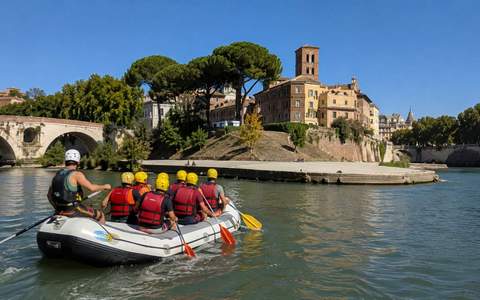
Tiber Island is famous for its distinctive elongated shape, often associated with the outline of a ship.
It’s not only a poetic image: the island’s shape has played an important role in Roman imagination.
Here stood the temple of Aesculapius, a deity connected with medicine, and tradition holds that the cult of Aesculapius itself originated from the arrival in Rome of the sacred serpent from Epidaurus.
In this case too, history, religion, and legend intertwine.
The bridges of Rome as settings for forgotten stories
One of the most interesting aspects of Roman bridges is that many are not visited with the same attention given to the Colosseum or the Trevi Fountain.
Yet they can tell episodes just as fascinating.
The real value lies in the details
An inscription.
A statue.
A particular architectural detail.
A date.
A name.
A legend.
When you look at Rome carefully, every detail can become a clue.
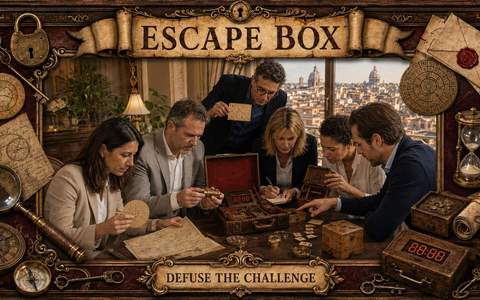
And it’s precisely this characteristic that makes bridges especially interesting even for a treasure hunt or an urban Team Building.
A Team Building among bridges, legends, and mysteries
Let’s imagine dividing a company group into teams.
Each team receives a map of Rome and an initial question:
"Which bridge hides four faces in stone?"
The answer leads to Ponte Fabricio.
Once there, though, the team finds a new clue.
The route continues toward Ponte Sisto.
Then toward Ponte Sant'Angelo.
Finally, a last riddle leads to the Tiber.
The group is not simply touring Rome.
It is learning to:
-
observe;
-
communicate;
-
assign tasks;
-
make decisions;
-
listen to others;
-
manage time;
-
distinguish information and interpretations;
-
build a shared solution.
When history becomes a game
This is one of the strong points of a Team Building set in the historic center.
The city should not be only the backdrop of the activity.
It can become the very material used to build the game.
Bridges become checkpoints.
Legends become puzzles.
Monuments become clues.
Streets become routes.
The group becomes the protagonist.
The legends of the bridges: why do they keep fascinating us?
Legends survive because they often manage to turn an anonymous place into a place with an identity.
A statue is no longer just a statue.
It becomes the memory of a story.
A bridge is no longer only a structure.
It becomes the place where someone crossed the river, fought a battle, built a work, or passed down a legend.
And it’s precisely this narrative ability that makes Rome one of the most interesting cities for cultural and experiential Team Building experiences.
From the Tiber to the team: what the bridges of Rome teach us
Bridges have a simple function: to connect two banks.
But this function can become an exceptionally effective metaphor for talking about teamwork.
A team, in fact, must continuously build bridges:
between different skills,
between people with different personalities,
between ideas that seem far apart,
between problems and solutions,
between individual goals and shared goals.
A solid bridge does not eliminate distance.
It makes it crossable.
And perhaps this is the most interesting lesson we can draw from the bridges of Rome.
Discovering Rome through its legends
Visiting the city’s great monuments is only one way to get to know Rome.
Another is to follow the less obvious traces: those that run along the Tiber and connect eras, neighborhoods, and stories.
From Ponte Fabricio to Ponte Sant'Angelo, from Ponte Milvio to Ponte Sisto, passing by Tiber Island and Ponte Rotto, each crossing tells part of the city.
And when these stories are turned into a team challenge, Rome takes on a completely new dimension.
It’s no longer just a city to see.
It’s a city to decode, cross, and live together.