













































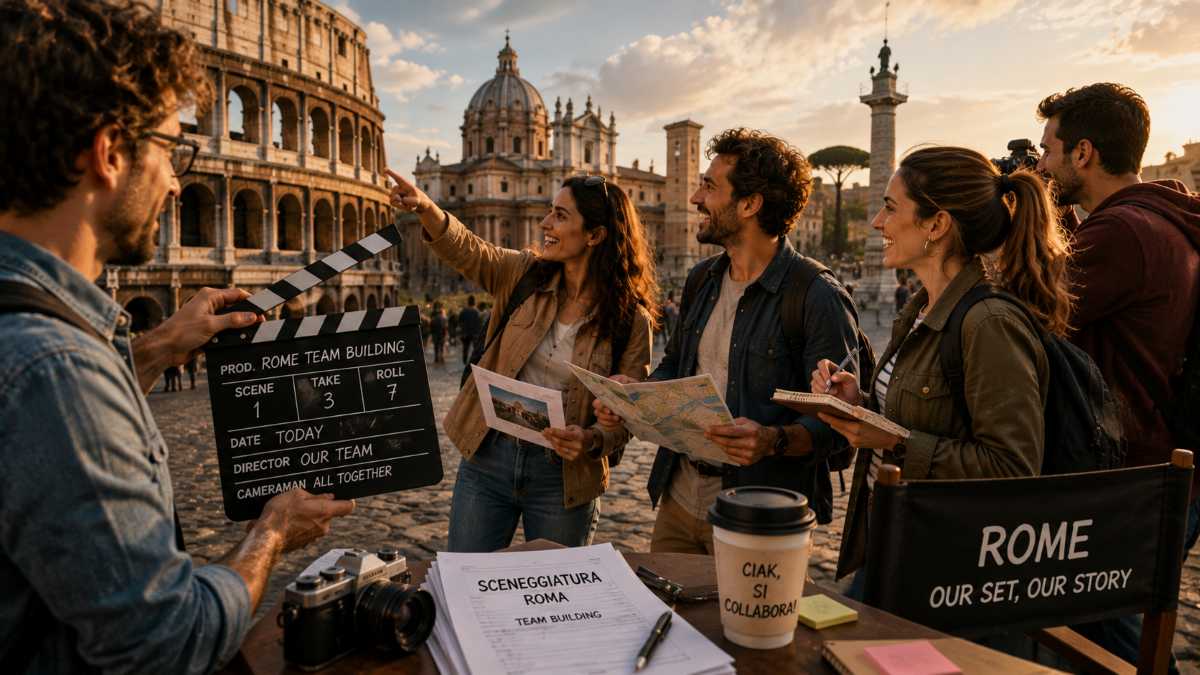
Rome between cinema and Team Building: when the city becomes a set
Rome is not just a city to visit. It is a city to interpret.
Just walk through a square, stroll down a back street, or stop in front of a fountain to get the feeling that you’ve stepped into a screenplay. It’s no coincidence that for decades Rome has been one of the most important places in the history of international cinema: from Roman Holiday to La Dolce Vita, from Ben-Hur to The Great Beauty; the capital has become a true open-air set.
And it’s precisely this feature that makes it especially interesting for Team Building in Rome.
Imagine a group of colleagues who don’t simply receive a list of monuments to visit, but a mission: to transform for a few hours into a film crew, to scout a location, recreate a scene, invent a story, photograph a detail, and solve a puzzle.
The outcome changes completely.
The city becomes the game, the game becomes an experience, and the experience becomes shared memory.
Rome, the city where cinema meets reality
Rome has a rare characteristic: it doesn’t need to be turned into a set.
The set is already there.
The historic center, the bridges over the Tiber, baroque squares, ancient monuments, and the most characteristic neighborhoods make it possible to build highly varied hands-on activities.
The relationship between Rome and cinema is documented in numerous official itineraries. For example, the tourism portal of Rome Capitale dedicates specific routes to the locations of Federico Fellini and Paolo Sorrentino. (Turismo Roma)
And this heritage can become an extraordinary source of material for a Team Building activity.
When a location becomes a challenge
Let’s think of a simple cinematic treasure hunt.
A team receives an instruction:
“Find the place where one of the most famous scenes in the history of cinema turned a Roman fountain into a worldwide icon.”
The answer could be the Trevi Fountain, inseparably linked to the scene from La Dolce Vita by Federico Fellini.
But finding the location is only the beginning.
The team might also need to identify a scene, create a creative photograph, recreate a specific framing, answer a question about film history, or write a short screenplay.
At that point, the monument is no longer just observed.
It’s lived.
From cinema to Team Building: why it works
Cinema is, by its very nature, a team effort.
Behind just a few minutes of film work directors, actors, screenwriters, production designers, costume designers, sound technicians, cinematographers, and many other professionals.
No one can make a film alone.
This is exactly the principle that makes cinematic language interesting for Team Building.
A crew is a team
During a cinema-inspired activity, each participant can take on a different role.
The director
They must have an overall vision, assign tasks, and make decisions.
The screenwriter
They turn an idea into a clear, engaging story.
The actor
They must get involved, communicate, and interpret a role.
The cinematographer
They observe the environment and look for the best vantage point.
The crew
They collaborate so that all parts work together.
This distribution of roles highlights different skills and, above all, brings out abilities that normally remain hidden during everyday work life.
Rome’s great sets become Team Building routes
Rome makes it possible to create very different itineraries by choosing locations based on the company’s goals.
Trevi Fountain: the scene everyone knows
Few locations are immediately recognizable as the Trevi Fountain.
The link to La Dolce Vita is one of the most famous in the history of Italian cinema: the scene with Anita Ekberg and Marcello Mastroianni has become part of the collective imagination. (Turismo Roma)
For a Team Building, it can become a starting point for a creativity-focused challenge.
For example, participants can receive a partial photograph of the location and identify the exact spot, or they can build a new scene set in contemporary Rome.
Spanish Steps: from the film to the team
The Spanish Steps is another place that immediately evokes cinema.
Locations connected to the city’s cinematic history also include the Spanish Steps, used by Fellini in Rome. (Turismo Roma)
Here, a test could focus on observation.
The team must identify architectural details, reconstruct a visual sequence, or create a group photo while following specific instructions.
It’s a simple exercise, only at first glance.
To succeed, you need attention, communication, and coordination.
Piazza del Popolo and Via Veneto
Piazza del Popolo, Via Veneto, Trinità dei Monti, St. Peter’s Square, and Castel Sant’Angelo are part of Fellini’s real cinematic geography. (Turismo Roma)
These places allow you to build a narrative route.
One team can follow the clues of an imaginary character, while another must reconstruct a story starting from photographs, hints, and quotes.
In this way, Team Building becomes at the same time:
-
cultural experience;
-
outdoor activity;
-
team game;
-
problem-solving exercise;
-
photography experience;
-
narrative route.
Cinecittà: the place where Team Building meets cinema
If Rome is a natural set, Cinecittà is the industrial and creative heart of this story.
The studios were founded in the 1930s and, throughout their history, have hosted Italian and international productions. Official documentation tells a story that includes titles such as Roman Holiday, Ben-Hur, and Cleopatra, helping give rise to the myth of “Hollywood on the Tiber”. (Cinecittà)
The heritage connected to Federico Fellini is also particularly important: the famous Theater 5 is associated with the director and the creation of some of his most important works. (Turismo Roma)
A Team Building behind the scenes
Cinecittà offers a different perspective compared with a simple activity in the historic center.
Here the group can reflect on the concept of production.
To make a film, you need:
-
an idea;
-
a strategy;
-
a division of tasks;
-
coordination;
-
managing unexpected events;
-
the ability to meet a deadline.
These are exactly some of the skills required within a business organization as well.
Rome as a screenplay: the real value of the experience
The advantage of using cinema as the thread of a Team Building isn’t just entertainment.
The strength lies in storytelling.
A traditional activity may ask participants to reach an objective.
A narrative activity, instead, asks:
“What’s your story?”
It’s an important difference.
From monument to experience
The Pantheon is no longer just a historic building.
It becomes the location for a scene.
The Tiber is no longer just a river.
It becomes the backdrop of a mission.
A square is no longer just a point on the map.
It becomes the place where the team must make a decision.
This shift in perspective increases engagement because it adds an emotional component.
Cinematic Team Building builds real skills
An activity built around cinema can be designed to work on different cross-cutting skills.
Communication
The team must exchange information quickly and clearly.
Leadership
Someone will have to take the initiative, but effective leadership doesn’t necessarily mean commanding.
It means steering the group toward a goal.
Creativity
The need to tell a story or solve a challenge creates room for different ideas.
Problem solving
Unexpected events are part of the game, just like in film production.
Listening
An individual idea becomes useful only when it can integrate with the ideas of others.
Time management
As on a real set, during a Team Building there is often also a deadline.
And when time runs out, very interesting dynamics emerge.
The Great Beauty: when Rome becomes the protagonist
Rome has also been told by contemporary cinema.
One of the most significant examples is The Great Beauty by Paolo Sorrentino, which uses many locations around the city as an integral part of the narrative.
Among them is also the Parco degli Acquedotti, a location that the official Rome tourism portal includes among the city’s film locations. (Turismo Roma)
This shows how much Rome can offer even beyond the best-known routes.
A well-designed cinematic Team Building can therefore move away from the usual tourist stops and lead teams to discover less obvious places.
An ideal format for Italian and international companies
Cinema also has a linguistic advantage.
An image, a scene, a location, or a photograph can be understood regardless of the spoken language.
That’s why a cinema Team Building in Rome can work very well even with international groups.
Instructions can be translated, while the creative part can be built through images, gestures, and storytelling.
So Rome becomes a shared language.
How to design a “Rome Movie” Team Building
An effective format should be built like a real screenplay.
Act I – The briefing
Participants receive a mission.
Not everything is explained.
Part of the story must remain hidden.
Act II – The search
The teams move through Rome looking for locations, clues, and details.
This is the phase where organization, leadership, and communication emerge.
Act III – Production
The teams must use what they have found.
A photograph, a scene, a video, a reconstruction, or a short performance becomes the result of the collective work.
Act IV – The finale
Everyone comes back together.
The productions are shared, and the group can see how the same city has been interpreted in completely different ways.
And it’s right here that the game makes room for reflection.
Why Rome is the perfect set for Team Building
The capital has something that no film studio can recreate completely: the layering of time.
Roman antiquity, the Renaissance, Baroque, Neorealism, auteur cinema, and contemporary life coexist in the same space.
For example, the Turismo Roma portal dedicates a specific itinerary to the relationship between the historic center and cinema, including places such as the Pantheon, Piazza Navona, Piazza Farnese, and the old Jewish Ghetto. (Turismo Roma)
For a corporate group, this means having an enormous stage at their disposal.
And every stage can become a challenge.
From play to shared memory
By the end of the day, probably no one will remember only how many points their team scored.
They’ll remember the person who improvised a scene.
The photo taken in the wrong place that, by chance, became the funniest one.
The solution found at the last minute.
The team that seemed to be in trouble but managed to recover.
This is the real value of experiential Team Building.
It’s not only a team you build during the activity: you build a shared memory.
And Rome, with its squares, its monuments, and its incredible film history, offers a practically infinite backdrop to do it.
Conclusion: when work becomes a story worth telling
Imagine going back to the office the day after.
Someone will talk about the meeting.
Someone about deadlines.
And someone else will say:
“Do you remember that scene we filmed in Rome?”
In that sentence there’s everything that matters about a well-designed experience.
The cinematic Team Building in Rome doesn’t simply take colleagues out of the office. It puts them in front of a story to build together.
For a few hours, they become a crew.
And Rome becomes their set.





