Street Food Tour: team building in taste and culture
Rome can be visited in many ways. You can walk through the city following the history of its monuments, get lost in its alleys and squares, or let yourself be guided by the scents that come from shops, markets, and the small signs of the historic center.
But there’s an even more engaging way to discover the Capital: enjoy it together.
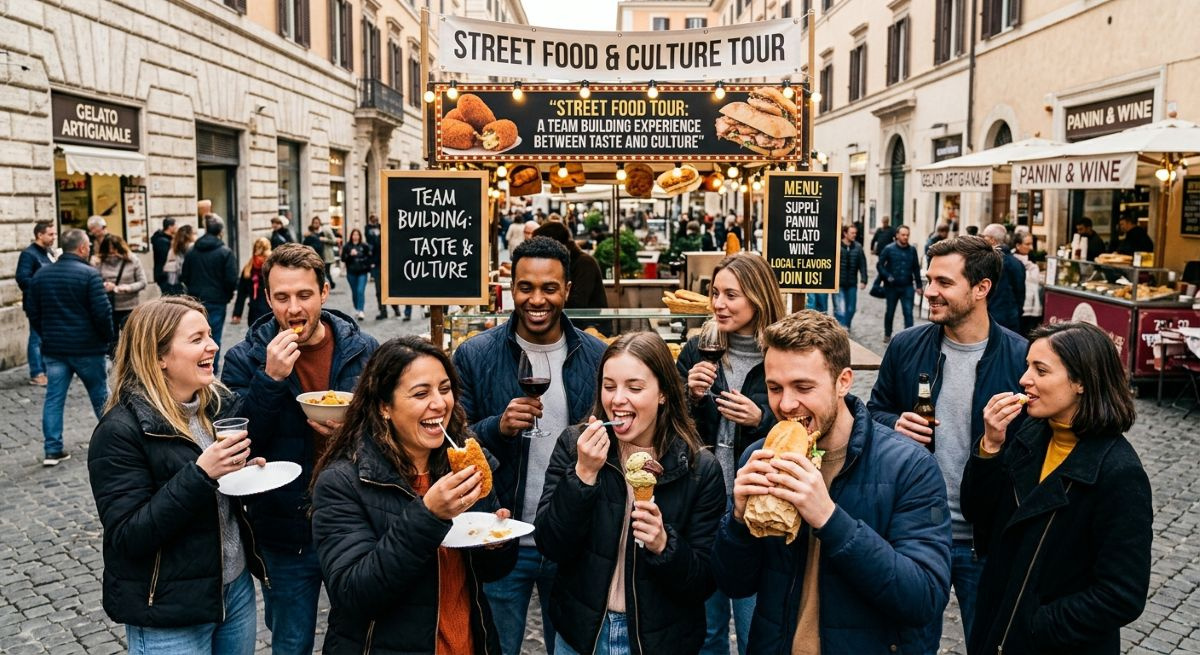
A Street Food Tour turned into Team Building becomes, in fact, much more than a simple food experience. It’s a journey through Rome where food becomes a tool to encourage socializing, spark curiosity, foster collaboration, and put people in a position to live a shared experience.
Between a freshly fried supplì, Roman pizza, maritozzo, artisanal gelato, and a specialty from tradition, the group walks, observes, talks, discovers stories, and builds memories.
Because when you eat together, you often communicate better.
Why choose a Street Food Tour as Team Building
An effective Team Building activity doesn’t necessarily need to include sports challenges, competitions, or particularly structured events.
Sometimes the right setting is enough to encourage interaction.
The Street Food Tour works for precisely this reason: it creates an informal environment where people can get to know each other outside the usual professional roles.
During the tour, participants have the chance to:
-
share an experience different from the normal work environment;
-
discover Rome through its food;
-
compare preferences;
-
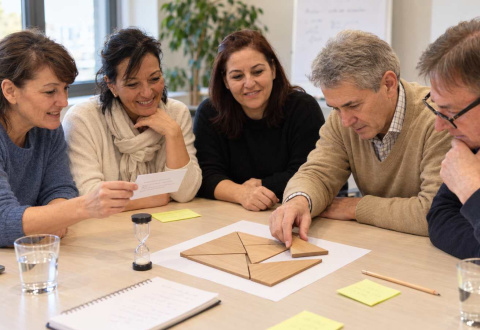
collaborate during any games and challenges;
-
get to know colleagues they normally interact with little;
-
develop listening and communication;
-
create a shared company-related memory.
So food becomes a true relationship facilitator.
From the table to the street: the value of conviviality
Conviviality has a special characteristic: it puts people on the same level.
In front of a Roman specialty, there is no corporate hierarchy. There are people who taste, comment, laugh, compare memories, and discover new flavors.
This makes the Street Food Team Building especially interesting even for international groups or newly formed teams.
A dish can become a conversation topic. An ingredient can tell a tradition. A recipe can open a window onto the city’s history.
And a simple walk can turn into a group experience.
Rome through its street food
Rome is an ideal city for building a food itinerary because each neighborhood offers different atmospheres, traditions, and specialties.
The Street Food Tour can be designed as a real urban journey, alternating tastings and discovery moments.
So it’s not just about “eating on the street,” but reading the city through its food.
Trastevere: alleys, trattorias, and popular tradition
Trastevere is one of the most charming neighborhoods to build a route like this.
By strolling through alleys, squares, and characteristic views, the group can alternate tastings with stories connected to Roman tradition.
The neighborhood also offers an especially social-friendly context: distances are limited, the atmosphere is lively, and the route can easily be turned into a small team challenge.
So food becomes the guiding thread of a walk discovering a popular and authentic Rome.
Campo de’ Fiori and the historic center
Another possible starting point is the Campo de’ Fiori area, historically linked to the city’s commercial life.
Here, street food can meet the market dimension, shopfronts, and Roman squares.
The route can continue toward Piazza Navona, Pantheon, and the streets of the historic center, turning the tasting into a broader cultural experience.
Each stop can become an opportunity to introduce a curiosity, a question, a photo to take, or a small group task.
Testaccio: the neighborhood where food tells Rome
For a gastronomic Team Building with strong Roman character, Testaccio is a particularly interesting choice.
The neighborhood’s history is deeply connected to the world of commerce and food, and its culinary heritage allows you to tell a Rome different from the more well-known monuments.
Here, the route can focus on traditional recipes, popular products, and stories connected to Roman cooking.
This is precisely one of the most interesting aspects of Street Food Team Building: not just seeing Rome, but understanding it through what its residents eat.
Which specialties can become the stars of the Team Building?
Roman cuisine offers many ideas.
The Street Food Tour can include, depending on the chosen route and the venues’ availability, some of the most representative specialties of Roman tradition.
Supplì
Crispy on the outside and melting on the inside, the supplì is one of the symbols of Roman street food.
It can also become a game element: which team will recognize the ingredients? Which one will manage to tell their story? Which one will identify the best tasting?
Roman pizza
Pizza, in its different interpretations, is another perfect element for a food route.
Sharing more tastings also allows you to turn the experience into a moment of discussion.
Maritozzo
Maritozzo is one of the most recognizable sweets in Roman tradition.
A sweet break during the tour helps change the pace and create an informal moment where the group can simply talk.
Artisanal gelato
Gelato can become the ideal conclusion to a Street Food Tour, especially during organized activities in the warmer months.
Again, the tasting can be included within a small challenge, asking participants to recognize flavors, ingredients, or product characteristics.
Street Food Tour becomes a game
The real added value comes when the food tour is designed as an interactive experience.
This way, we don’t just have a group following a guide, but a team that must observe, choose, collaborate, and make decisions.
The flavor challenge
Teams can receive a series of missions related to the tastings.
Recognizing an ingredient, identifying a specialty, discovering the origin of a recipe, or matching a dish to a Roman tradition—these are simple activities, but they can generate meaningful discussion.
Gastronomic treasure hunt
The Street Food Tour can be combined with a real urban treasure hunt.
The clues lead participants from one stop to the next, and the group must solve riddles, answer questions, and complete photo missions.
The POIs of Rome thus become an integral part of the game.
A square can hide a clue. A monument can provide the answer to a question. A street can become the starting point for the next stop.
The result is an experience that combines street food, culture, gamification, and Team Building.
The photo challenge
Another option is to create a photo contest.
Each team receives a series of missions: photographing an architectural detail, recreating a scene, spotting a particular feature of a monument, or telling—through an image—the relationship between Rome and food.
The outcome isn’t only fun: it stimulates creativity, collaboration, and observational skills.
Street Food and culture: why the experience is more memorable
One of the reasons why an experience like this can be particularly effective is the combination of multiple stimuli.
Participants aren’t just listening to an explanation.
They walk. They look. They taste. They talk. They take photos. They solve problems. They laugh.
This variety makes the experience dynamic and helps build shared memories.
Think, for example, of a group crossing the center of Rome after receiving a clue.
The team must identify a detail from a square. Once the riddle is solved, they reach the next stop. Here they find a culinary specialty to taste and a new challenge.
The monument isn’t just something to photograph anymore.
It becomes part of the game.
Food isn’t only something to eat anymore.
It becomes part of the story.
What skills does a Street Food Team Building develop?
Even an apparently relaxed activity can be designed to work on important skills for professional life.
Communication
To solve clues and complete challenges, participants must share information and listen to the ideas of others.
Collaboration
Team missions require a spontaneous distribution of tasks and the ability to value different skills.
Problem solving
A clue can be ambiguous, an answer may require creativity, and a team may need to quickly adjust its strategy.
Leadership
In an informal setting, different leadership styles may emerge compared to those seen day-to-day in the office.
Creativity
Photo challenges, riddles, and narrative missions allow participants to find original solutions.
Listening
When a team has to make a decision in a short time, listening to others becomes essential.
Who is this type of Team Building suitable for?
The Street Food Tour is especially versatile.
It can be offered to:
-
companies that organize a Team Building day in Rome;
-
international groups visiting the Capital;
-
teams that want to strengthen internal relationships;
-
companies that want to welcome new collaborators;
-
large groups looking for a dynamic but non-sporty activity;
-
teams that want to combine training, culture, and conviviality;
-
companies looking for an original experience for a corporate incentive.
It’s also easy to adapt to the event duration and the group’s goals.
A customizable experience
One of the strengths of Street Food Team Building is the ability to build the activity around the company’s characteristics.
The route can be more food-focused or more culture-focused. It can include a greater competitive component or focus on socializing.
It can be organized as a guided tour, treasure hunt, photo challenge, team route, or a combination of multiple activities.
Even the choice of POIs can completely change the character of the experience.
An itinerary between Trastevere and the historic center will have a different atmosphere than a route dedicated to Testaccio and culinary Rome.
This flexibility makes it possible to create a Team Building that is truly coherent with the group.
Street Food Tour in Rome: not just a tasting
Let’s imagine being at the end of the day.
The group is seated for one last break. Someone is still discussing the answer to a riddle, someone else says that the supplì tasted at the first stop was the best, while one team is reviewing on their phone the photos taken during the tour.
At that point, the Team Building has already reached its most important goal.
Not only are there photos of Rome left behind.
A shared memory remains.
And that’s exactly what makes a Street Food Tour interesting as a corporate activity: turning a culinary walk into an experience that connects people, places, flavors, and stories.
Rome becomes the stage.
Food becomes the common thread.
The group becomes the protagonist.
Street Food Team Building: when Rome becomes part of the team
A good Team Building doesn’t necessarily have to take participants far from the city.
Sometimes all it takes is changing the way you look at it.
Searching Rome for a specialty, solving a clue in front of a monument, discovering a story connected to a recipe, and sharing a tasting all mean turning the city into a huge experiential space.
This is the value of the Street Food Tour in Rome: an activity that brings together taste and culture, fun and discovery, relationships and play.
Because a team can get to know each other in a meeting room.
But it can also discover each other by walking together through Rome’s streets, with a new mission to solve and a new flavor to taste.