































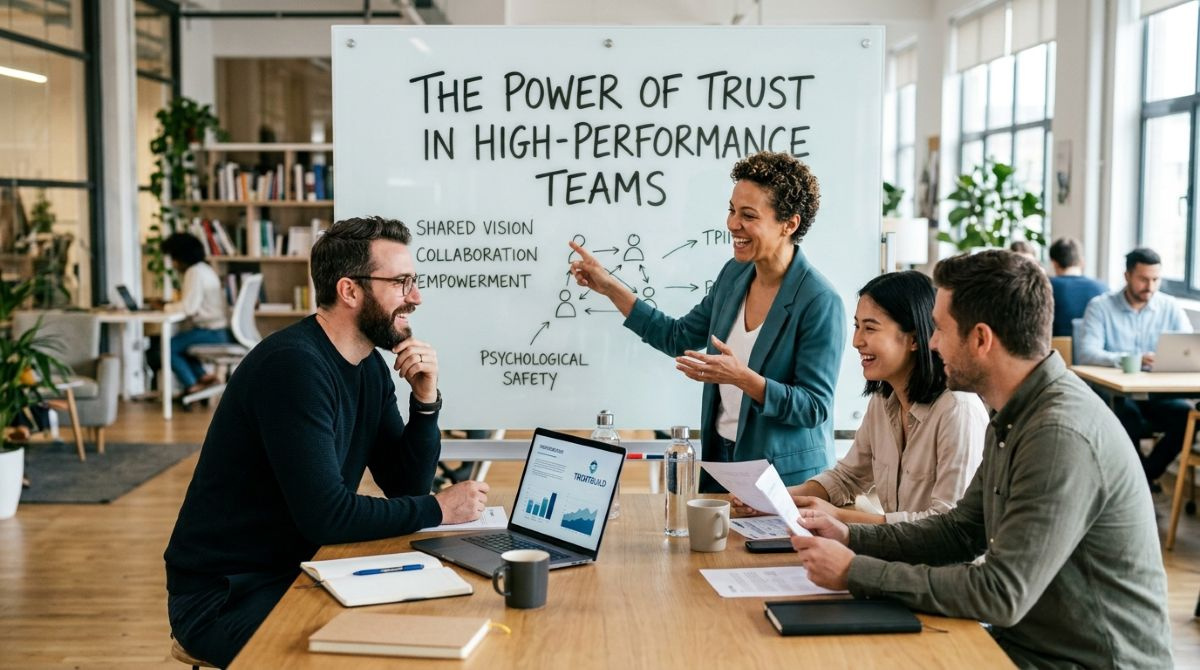
The power of trust in high-performing teams
Let’s imagine a group of people facing a challenge.
They don’t yet know the solution. Time passes. Everyone has only a part of the information needed, and the answer can’t be found by one person alone.
At some point, someone suggests an idea.
A colleague listens to it, develops it, and adds an insight.
Another person spots a detail that had escaped the others.
The group decides to follow that path.
The solution arrives.
Not because someone was better than the others, but because people trusted one another.
This is where the power of trust in high-performing teams is born.
At work, trust isn’t just an abstract value or a positive characteristic of professional relationships. It’s a real, invisible infrastructure that helps people communicate, take ownership, share ideas, ask for help, and make decisions even when there’s no absolute certainty.
And when this trust is built through shared experiences, Team Building can become a particularly effective tool.
What is trust within a team?
Professional trust can be described as the belief that other members of the group are reliable, competent, and oriented toward a common goal.
But trusting a colleague doesn’t mean thinking they’ll never make mistakes.
On the contrary.
A truly solid team is one in which people know they can make mistakes, ask for clarification, propose unconventional solutions, and admit a difficulty without immediately feeling judged.
Trust doesn’t mean the absence of control
A common misunderstanding is confusing trust with a lack of control.
In reality, they are two very different concepts.
An organization can have extremely clear processes, responsibilities, and objectives, and at the same time build relationships based on trust.
Trust helps reduce what we might call “relational noise”: the time spent constantly checking other people’s intentions, protecting oneself, avoiding exposure, or trying to prove one’s value.
When this noise decreases, more room opens up to work together for real.
Why is trust essential in high-performing teams?
A high-performing team isn’t simply a group made up of highly competent people.
It’s a system in which individual skills manage to combine.
A lone talent can produce excellent results.
A group of talents that doesn’t communicate, however, can achieve far lower results than their potential.
Trust represents the link between individual competencies.
Trust improves communication
When a person feels listened to, they’re more likely to share information.
They can flag a problem before it becomes critical.
They can say that a strategy isn’t working.
They can propose an alternative.
They can even admit: “I don’t know.”
That simple phrase, in an environment shaped by trust, isn’t interpreted as weakness.
It becomes the starting point for a collective search for a solution.
Trust encourages collaboration
Collaborating means accepting that the final result doesn’t belong to a single person.
In an effective team, success is shared.
Trust makes it possible to delegate, distribute responsibility, and leave space for others’ skills without feeling the need to control every step.
Trust speeds up decisions
When people know how their colleagues work, they can make decisions more quickly.
They don’t have to start from scratch every time.
There’s a shared foundation.
They know that if something doesn’t work out, the group will be able to step in and correct the course.
Trust and psychological safety: two closely related concepts
Talking about trust inevitably brings up the topic of psychological safety.
A psychologically safe environment is one in which people can express themselves without the constant fear of being humiliated or penalized for asking a question, raising a problem, or expressing a different opinion.
This doesn’t mean creating an environment where everything is accepted without any challenge.
It means creating the conditions for productive debate.
The value of dissent
A team where everyone always agrees isn’t necessarily an effective team.
It might simply be a team where nobody feels free enough to disagree.
Different opinions can improve decisions, especially when they’re expressed constructively.
Trust allows exactly that: to discuss without turning every difference of opinion into a personal conflict.
When trust is missing
To understand the value of trust, it can be useful to look at what happens when it isn’t there.
People start protecting their information.
Problems get reported too late.
Responsibilities get shifted.
Meetings become longer.
Decisions get postponed.
People seek confirmation before acting.
The group works, but not necessarily together.
The invisible cost of mistrust
Mistrust has a cost that often doesn’t show up directly in budgets.
It’s wasted time.
It’s the energy used to manage misunderstandings.
It’s creativity that doesn’t get expressed.
It’s the decision that never gets made.
It’s the idea that stays in someone’s head because they don’t feel free enough to share it.
That’s why trust can be considered a real organizational resource.
How do you build trust in a team?
Trust can’t be imposed through corporate communication.
It’s not enough to say, “We need to trust each other.”
Trust comes from repeated behaviors.
It’s built over time through real experiences.
Keeping commitments
Consistency is one of the fundamental building blocks of trust.
If a person promises to do something and regularly keeps their word, they become progressively more trustworthy in the eyes of others.
Communicate clearly
Ambiguous communication leads to interpretations.
Clear communication, on the other hand, reduces misunderstandings and makes collaboration easier.
Admitting mistakes
A mistake recognized in time can become a learning opportunity.
A hidden mistake, instead, can turn into a much bigger problem.
Asking for help
The ability to say “I need a hand” also contributes to trust.
It shows that the collective goal comes before the need to always appear independent and infallible.
Giving feedback
Effective feedback isn’t meant to judge a person.
It’s meant to improve a behavior or a process.
When it’s expressed with respect and received without defensiveness, it strengthens the quality of the professional relationship.
Team Building as a training ground for trust
And that’s where Team Building comes into play.
A well-designed experience allows people to step temporarily out of their usual roles and face situations where collaboration becomes necessary.
The difference from everyday corporate life is significant.
During an experiential activity, the group’s dynamics become visible.
Who listens?
Who takes initiative?
Who tends to make decisions?
Who involves others?
Who takes responsibility?
Who helps a colleague in difficulty?
Trust because collaboration is required
Think of a treasure hunt in the historic center of Rome.
A team receives a clue, but not the solution.
One person knows Roman history well.
Another is very good with riddles.
Another still has an excellent sense of direction.
None of these skills, on their own, is sufficient.
The team must trust the information from others.
And it must quickly learn to recognize each person’s contribution.
So the game becomes a concrete metaphor for teamwork.
Rome as a lab to build trust
Rome offers a particularly interesting setting for activities of this kind.
The historic center makes it possible to turn entire neighborhoods into a playfield.
A challenge can start from Piazza Navona, continue to the Pantheon, cross the streets of the center, and reach Fontana di Trevi.
Another can develop around the Colosseum, the Roman Forums, and Capitoline Hill.
Every POI can become a stop, a clue, or a test.
The city becomes part of the team
When a group has to reach a destination without having all the information, the city becomes an integral part of the experience.
You can’t just know Rome.
You have to communicate.
You have to listen.
You have to make decisions.
And above all, you have to trust the people walking alongside us.
A trust-based Team Building activity doesn’t have to be competitive
Competition can be an interesting element, but it’s not necessary.
In fact, in some situations it’s more useful to design activities in which teams must collaborate with each other.
A shared mission
Imagine that different groups receive different pieces of information.
Each team has only part of the solution.
To complete the final mission, all of them must share what they’ve discovered.
No one can win alone.
The result depends on the ability to cooperate.
This kind of experience makes a fundamental principle very clear:
individual performance reaches its maximum value when it contributes to collective performance.
The most effective Team Building activities for working on trust
There’s no single perfect activity.
The choice depends on the company’s goals, the group size, the level of collaboration already present, and the type of experience you want to create.
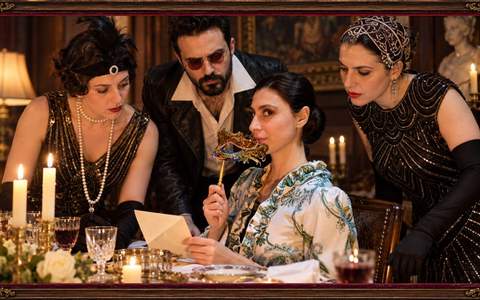
Urban treasure hunt
Ideal for working on communication, orientation, problem-solving, and collaboration.
In Rome it can be built using the main POIs in the historic center or through lesser-known routes.
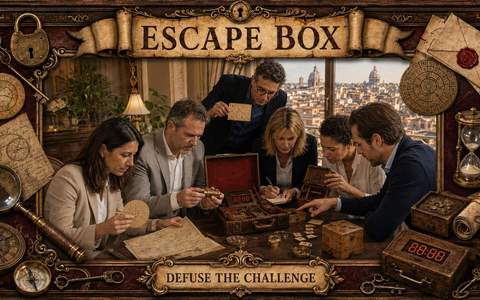
Escape experience
Escape rooms and investigative experiences put the group in a situation where time is limited and communication becomes essential.
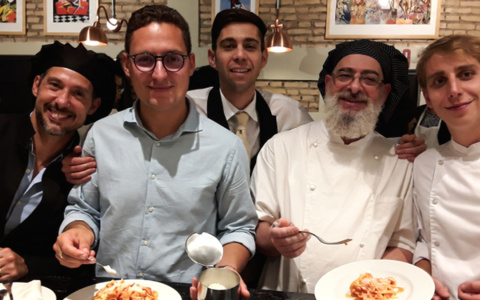
Culinary Team Building
Preparing a dish together requires coordination, organization, and task assignment.
The kitchen also has an important element of friendliness and togetherness.
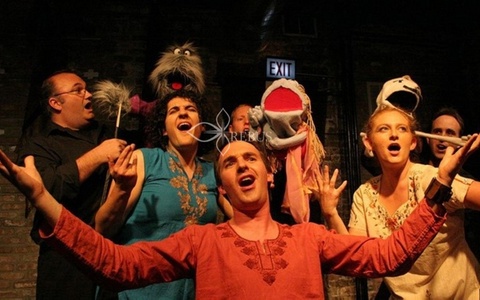
Team Beat
A music activity based on percussion is especially interesting for working on listening skills.
Each participant produces an individual rhythm, but the final result exists only when the rhythms synchronize.
It’s an extremely effective metaphor for how a team works.
Outdoor activities
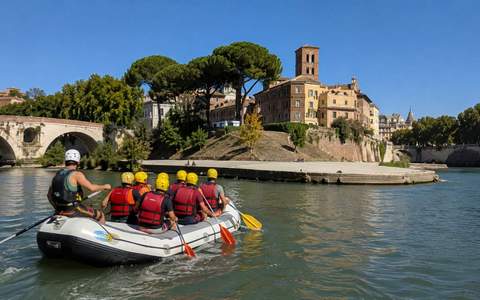
Outdoor routes and challenges can put participants in situations where they must organize, support one another, and make quick decisions.
Trust is also built through vulnerability
One of the most interesting aspects of experiential activities is that they allow people to show themselves in situations different from their usual ones.
The manager may find themselves not knowing the answer.
The quietest person may become essential to solving a puzzle.
The newly arrived team member may have the decisive idea.
The colleague who is usually very confident may ask for help.
These moments have important value.
They allow people to see their colleagues in a different light.
Discovering skills that the office doesn’t show
The professional setting tends to highlight certain specific skills.
An experiential Team Building event can bring out other abilities:
-
creativity;
-
listening skills;
-
orientation;
-
intuition;
-
leadership;
-
mediation skills;
-
stress management;
-
observation skills;
-
problem solving.
Discovering these qualities can change how team members perceive one another.
And when perception changes, the level of trust can also change.
Trust and error management
A high-performing team isn’t one that doesn’t make mistakes.
It’s the one that knows how to respond quickly to errors.
During a Team Building, this principle can be experienced in a particularly clear way.
A team can choose the wrong clue.
It can take an incorrect path.
It can misinterpret a test.
The point isn’t to avoid mistakes at all costs.
The point is to observe how the group responds.
Individual failure or collective learning?
If the first reaction is to look for a culprit, trust weakens.
If instead the group asks, “What can we learn from what happened?”, the mistake becomes information.
It’s a fundamental difference that also applies to day-to-day work.
The role of leadership in building trust
Leadership plays a decisive role.
A leader who asks others for trust must be willing to offer it first.
Truly delegate.
Listen.
Admit a mistake.
Make room for different opinions.
Recognize others’ contributions.
These are behaviors that communicate a message far stronger than any corporate slogan.
Leadership and Team Building
An experiential activity can also be used to observe leadership dynamics.
Not to create rankings or individual judgments, but to understand how people react when faced with a new situation.
Who coordinates?
Who listens?
Who encourages?
Who mediates?
Who makes decisions?
Who manages to involve the whole group?
These observations can become useful starting points for the subsequent corporate work.
Trust and performance: the real long-term effect
A Team Building doesn’t automatically create a high-performing team.
Trust can’t be built in a single day and then considered permanently established.
The experience, however, can represent a turning point.
The real value comes when what was experienced during the activity is brought back into everyday work.
From play to work
After a shared experience, the team can reflect on questions such as:
-
How did we make decisions?
-
Did we listen to everyone?
-
Did we distribute tasks well?
-
How did we react to mistakes?
-
Did we trust each other’s skills?
-
What can we transfer into our daily work?
This is the step that turns Team Building from a simple event into a team development tool.
Trust as a competitive advantage
In markets characterized by rapid change, hybrid work, international teams, and increasing complexity, no single person can hold all the answers.
The most effective organizations are the ones able to connect different skills.
And to do that, you need trust.
A team member should be able to share an idea.
A manager should be able to delegate.
A team should be able to discuss.
A group should be able to make mistakes and correct itself.
Trust makes all of this possible.
It doesn’t eliminate difficulties.
It allows you to face them together.
When a group becomes a real team
There’s a specific moment when a group stops being simply a collection of people.
It happens when participants start thinking in terms of “we” rather than “me.”
When someone listens to another person’s intuition and decides to follow it.
When someone pauses to help a colleague.
When a team gives up a individually beneficial solution because it has understood that the best solution is the shared one.
That’s where trust is born.
And that’s where a high-performing team is born.
The power of trust: a skill to practice
Trust isn’t magic.
It’s a relational skill that can be developed through concrete behaviors, shared experiences, and a consistent organizational culture.
Team Building can contribute to this process by creating situations in which people necessarily have to rely on each other.
Rome provides an extraordinary stage to do this.
Between the Colosseum, the Roman Forums, the Pantheon, Piazza Navona, Fontana di Trevi, Trastevere, and the many lesser-known places in the Capital, an activity can become at the same time an experience, a game, and an opportunity for growth.
Because in the end, it doesn’t only matter who found the solution.
It matters how the group got there.
And maybe the real measure of a high-performing team isn’t how quickly it reaches a goal.
It’s how well it can trust the people reaching it together.