













































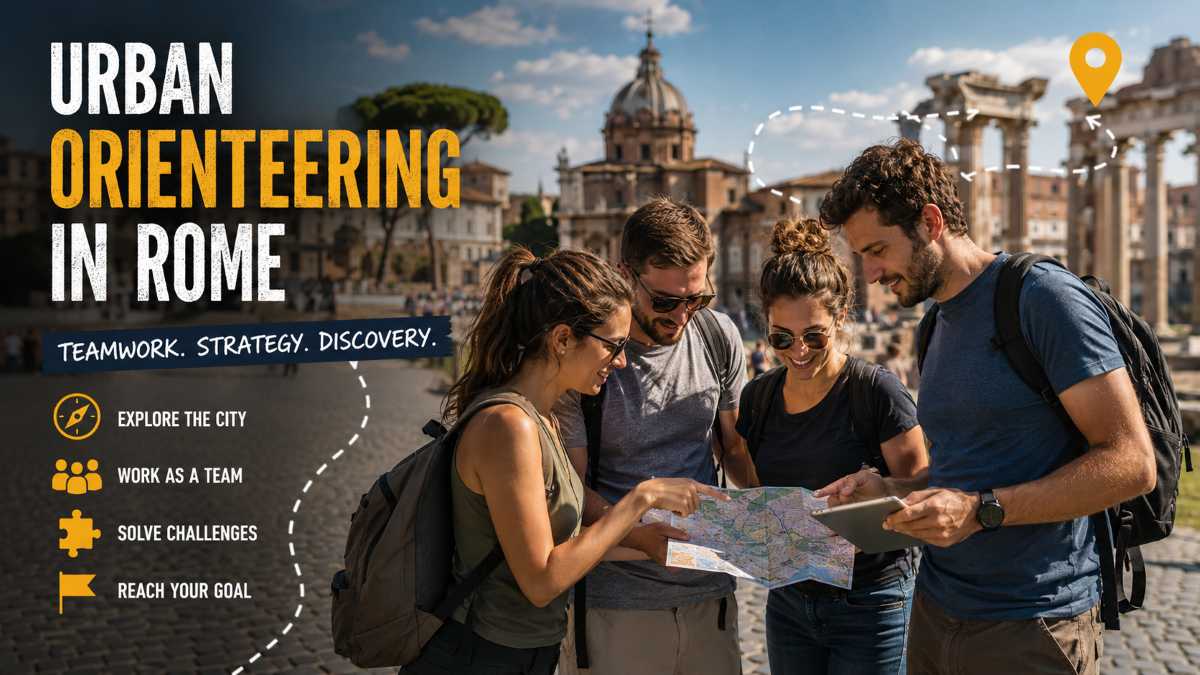
Urban orienteering in Rome: the Team Building that turns the city into a challenge to experience together
Rome is not a city you can discover all at once. To really know it, you have to walk, observe, choose a direction, make a wrong turn, and then find your way back.
And that’s exactly where the idea of an Urban orienteering in Rome comes from: a Team Building activity that turns the city center into a large playfield, where each team must orient itself, interpret clues, make decisions, and collaborate to reach a shared goal.
This is not just a stroll among monuments and squares. Urban orienteering is a dynamic experience in which the city becomes an integral part of the challenge. A map can indicate a direction, an architectural detail can hide an answer, a statue can become a point of reference, and an apparently simple choice can make the difference between a team that stays together and one that wastes time along the route.
In a city like Rome, where every street tells a story and every corner can hold a surprise, Team Building becomes an adventure built step by step.
What is Urban Orienteering and why is it perfect for Team Building?
Orienteering was created as a discipline based on the ability to orient yourself and reach a series of points using a map and other navigation tools. When brought into an urban and business context, this idea becomes something even more interesting.
During Urban orienteering in Rome, participants are divided into teams and take on a route made up of stops, challenges, puzzles, missions, and strategic decisions.
The goal is not only to arrive first.
The real challenge is to figure out how to get there.
Each team must organize itself, assign roles, read the available information, and share different skills. There’s the person with a great sense of direction, the one who pays attention to details, the one who can keep the group focused, and the one who finds solutions when the route starts to get more complicated.
It’s exactly this combination of abilities that makes orienteering a particularly effective tool for Team Building.
One city, one map, many decisions
Imagine a group starting from a square in the historic center.
In front of the participants there’s a map—or a set of digital instructions. Somewhere, among narrow streets, monuments, and squares, are the next stops.
The first decision seems simple: which street should we take?
Then more questions appear.
Who leads the group?
Who checks the map?
What is the fastest route?
Is it worth stopping to solve a challenge or should we search for other clues first?
Are we sure we interpreted the information correctly?
Within a few minutes, the city becomes a concrete metaphor for teamwork.
Because in business too, often, it’s not enough to know the destination. You have to choose the route, share information, and adapt when something doesn’t go according to plan.
Rome as an open-air big playfield
Few cities can offer the variety of scenarios that Rome provides for an urban orienteering activity.
The historic center makes it possible to create routes where art, history, architecture, and curiosities become part of the challenge. Each neighborhood has a different identity and can completely change the pace of the experience.
A route can take you through iconic places, monumental squares, hidden alleys, and viewpoints, turning Team Building into a journey across different eras.
From Imperial Rome to the alleys of the historic center
The Imperial Forums can represent one of the most inspiring points in an urban route. Here the group is immersed in a setting that tells the story of an entire civilization.
Not far away, the area of the Colosseum can become a strategic reference point, a passing stop, or the start of a new mission.
But urban orienteering doesn’t have to focus only on the most famous monuments.
The real surprise might be around the corner.
A route can lead teams to the Pantheon, where the geometry of the dome and the precision of Roman architecture can become elements of a challenge. Or it can continue toward Piazza Navona, where fountains, artistic details, and urban perspectives become clues to observe carefully.
Then there are the streets that completely change the atmosphere.
The maze of narrow lanes between Campo de' Fiori, Piazza Farnese, and the Tiber can test your sense of direction and your ability to keep the group together.
And that’s exactly where the experience becomes even more interesting.
Because Rome isn’t a city built to be traveled in a straight line.
And, in the end, neither is teamwork.
Urban Orienteering as a metaphor for teamwork
An effective Team Building activity shouldn’t just entertain participants. It should create situations where group dynamics naturally emerge.
Urban orienteering manages to do this because it puts people in front of a shared goal and a set of variables to manage.
Communication: when information must become a decision
During the route, every piece of information can matter.
One participant notices a detail the others didn’t see. Another interprets a clue differently. Someone suggests a shortcut while someone else proposes sticking to the original path.
The quality of communication becomes essential.
It’s not enough to talk: you have to be heard.
It’s not enough to have an idea: you have to be able to share it with the rest of the group.
The experience therefore allows natural work on skills such as:
-
active listening;
-
effective communication;
-
sharing information;
-
managing different opinions;
-
the ability to make decisions together.
Leadership: who guides the group when the road changes?
One of the most interesting aspects of Urban orienteering in Rome is that leadership can change continuously.
The person who seems most suited to lead the team at a given moment might make room for another colleague when the challenge shifts.
In front of a map, you need someone with a sense of direction.
In front of a puzzle, someone else’s analytical thinking may come to the surface.
When the group has to decide quickly, it can become crucial to have someone’s ability to synthesize—someone who, until then, had been in the background.
This makes the activity particularly useful for observing how different roles spontaneously emerge within a team.
Problem solving: finding a solution when there isn’t just one road
Rome is perfect for expressing an important concept: there isn’t always a single way to reach a goal.
Two teams can start from the same point and choose completely different routes.
One might focus on speed.
Another might prefer safety.
A third might stop more times to check every detail.
The result will depend on the ability to analyze the situation and adapt the strategy.
That’s exactly what happens in many business situations.
The POIs that can turn into the stages of the challenge
The choice of Points of Interest is one of the elements that makes every urban orienteering activity different from the others.
Rome offers an extraordinary wealth of options and allows you to build customized routes based on the duration of the activity, the number of participants, and the Team Building goals.
Possible POIs include:
Pantheon
A masterpiece of engineering and architecture that can become a starting point for challenges linked to observation, geometry, and the city’s history.
Piazza Navona
Its fountains, its special shape, and its history offer many elements that can be turned into clues and missions.
Campo de' Fiori
A dynamic place rich in history, ideal for including challenges that require observation and interpretation skills.
Castel Sant'Angelo
An extraordinary visual landmark, capable of connecting the route to the relationship between Rome, the Tiber, and the city’s history.
Tiber Island
A stop that allows you to change perspective and turn the river into an element of the experience’s narrative.
Trastevere
A real urban maze, perfect for testing your sense of direction and your ability to collaborate in decision-making.
Of course, the route can also be designed through less well-known places. And it’s often right there that Urban orienteering surprises the most.
Because while you search for a solution, you end up discovering a different Rome.
An experience that blends competition and collaboration
Competition is one of the elements that makes orienteering engaging.
Each team wants to complete the missions, reach the stops, and achieve the best possible result.
But competition alone isn’t enough.
To succeed in the challenges, you need to collaborate.
This combination creates an interesting balance: teams compete with each other, but within their own group they have to become more cohesive.
A disorganized group may have very prepared people and still waste time.
A less experienced group, but one that can listen to each other and coordinate, may instead find surprising solutions.
It’s one of the great lessons of the experience: individual talent gains value when it becomes a shared resource.
Technology, gamification, and navigation: Team Building evolves
Urban orienteering can also be designed using digital tools and gamification dynamics.
Tablets, smartphones, interactive maps, quizzes, multimedia content, and time-based missions can make the route even more engaging.
Technology doesn’t replace the experience of the city.
It amplifies it.
A team can receive a digital mission that leads them to a square. Once they arrive, they must observe the real environment to find the answer.
This creates a continuous interaction between digital and physical.
You don’t just sit in front of a screen.
You walk, you observe, you discuss, you explore.
The city becomes the main interface of the game.
For which companies is Urban Orienteering ideal?
This activity can be adapted to groups with very different characteristics.
It’s especially interesting for:
-
companies that want to improve collaboration;
-
international teams that want to experience Rome through a shared activity;
-
new work groups;
-
companies involved in onboarding paths;
-
teams that often work remotely;
-
company conventions and meetings;
-
incentives;
-
groups that want to combine discovering the city with hands-on experiential activities.
Urban orienteering is also easily customizable.
The challenges can be more cultural, more strategic, more fun, or more focused on problem solving.
The level of competition can also change.
The important thing is that the structure of the experience is consistent with the company goal.
What makes this experience truly effective?
It’s not just the beauty of the city.
A Team Building works when participants are fully involved firsthand.
Urban Orienteering creates this condition almost naturally.
There are no spectators.
Every person can contribute.
There’s the one who finds the right direction. The one who spots a detail. The one who interprets a clue. The one who manages to bring the group back to focus when time starts running out.
In the end, the result isn’t just a leaderboard.
It’s the sum of the decisions made along the route.
And maybe that’s the most interesting aspect of urban orienteering in Rome.
While participants try to orient themselves in the city, they also learn something about how their team handles uncertainty.
Who takes initiative?
Who listens?
Who analyzes?
Who finds creative solutions?
Who manages to keep the group together?
Rome, with its unpredictable streets, its intersections, and its overlapping stories, becomes something more than just a destination.
It becomes a big map to read together.
Urban orienteering in Rome: when the route becomes part of the experience
At the end of the challenge, the teams come back together.
Someone says they took the wrong street.
Someone else remembers the clue that seemed impossible to solve.
There’s the one who is convinced their team chose the best route, and the one who discovers, with surprise, that another team managed to find a completely different solution.
These are exactly the moments that make the experience memorable.
Because a Team Building activity doesn’t end when the last point on the map is reached.
It continues in the stories, shared memories, and the dynamics participants experienced together.
Urban orienteering in Rome is therefore much more than an orienteering race.
It’s a way to explore the city, discover new perspectives, and test the abilities that make a group a true team.
Sometimes all it takes is a map, a goal, and an extraordinary city.
The rest is built by the team.
FAQ about Urban Orienteering in Rome
How long does urban orienteering for companies last?
The duration can be customized based on the company program. Generally, the activity can take place in a few hours or become part of a larger event, with additional activities and shared moments.
Do I need to know Rome to participate?
No. The activity is designed specifically to allow participants to orient themselves and discover the city during the game. No prior knowledge of the places is required.
Is urban orienteering suitable for international teams as well?
Yes. It’s particularly suitable for international groups because it combines activities, discovering the city, and collaboration. Challenges and game modes can be adapted to the participants’ profile.
How many people can participate?
The activity can be organized for groups of different sizes by dividing participants into teams and designing a route appropriate to the total number.
Can the route be personalized?
Yes. Stops, challenges, and goals can be adapted to the company’s needs, the available time, and the skills you want to highlight.
Can urban orienteering be done all year round?
Rome offers the possibility to organize outdoor activities in many periods of the year. The design of the experience can be adapted to the season, organizational conditions, and the group’s needs.





