







































Do positive emotions really improve productivity?
A meeting can start in many ways.
With people walking into the room in silence, checking their emails on their phone, and waiting for someone to speak.
Or with a laugh.
With a shared joke. With the satisfaction of achieving a result together. With the feeling of being part of a group where your presence truly matters.
At first glance, it might seem like just a difference in atmosphere. In reality, the emotional climate you can feel inside an organization can deeply influence how people communicate, collaborate, handle problems, and, consequently, work.
But there’s an important question to ask: do positive emotions really improve productivity?
The answer is more interesting than a simple yes.
Positive emotions, by themselves, don’t automatically turn a team into a high-performance team. You can’t just plan a fun day or create a pleasant environment and expect better results.
When, however, emotions like trust, enthusiasm, satisfaction, belonging, and gratitude become part of the work experience, they can create favorable conditions for collaboration and productivity.
And that’s exactly where Team Building can play an important role.
Emotions don’t stay outside the office
For a long time, the world of work has tried to separate rationality and emotions.
On one side, decisions, goals, numbers, and strategies. On the other, emotions, considered almost as a private element to leave outside the office door.
The reality is very different.
People don’t stop feeling emotions when they start a workday.
Frustration can affect a meeting. Trust can make it easier to ask for help. Enthusiasm can increase the desire to participate. A sense of belonging can push someone to contribute more confidently to a shared goal.
Emotions are present in every organization, even when they aren’t named.
When a team feels good, does it necessarily work better?
Not always.
It’s important to avoid oversimplifying: positive emotions don’t mean smiling all the time or avoiding difficulties.
An effective team must also be able to handle conflicts, discuss different ideas, recognize mistakes, and manage moments of pressure.
Positive emotions become truly useful when they create a context where people feel safe enough to participate, engage in discussion, and contribute.
In other words, productivity doesn’t come from superficial happiness, but from the quality of the relationships that develop within the group.
The link between positive emotions and productivity
Let’s imagine two teams working on the same project.
The first team works in a climate marked by constant tension. People avoid asking questions for fear of seeming unprepared. Errors are hidden. Ideas are shared cautiously.
The second team faces the same deadlines and problems, but its members are used to discussing things openly. They ask for help, debate, recognize others’ contributions, and handle surprises together.
Which of the two teams is more likely to find effective solutions?
The key point is exactly this.
Positive emotions can encourage certain behaviors that have a real impact on work.
Greater open-mindedness
When people feel involved and valued, it can become easier to propose ideas and consider different points of view.
Creativity, in fact, rarely grows in an environment where every contribution is perceived as a risk.
A positive climate doesn’t automatically guarantee innovative ideas, but it can make participation more likely.
More spontaneous collaboration
Trust reduces many of the barriers that slow down teamwork.
A colleague who trusts their team will generally be more willing to share information, ask for support, and offer help.
This can reduce unnecessary duplication, misunderstandings, and wasted time.
Greater ability to handle surprises
Problems are part of every project.
The difference isn’t in avoiding them completely, but in how a group responds when they arise.
A team used to collaborating can more easily turn a surprise into a challenge to tackle together.
And that’s where positive emotions, along with mutual trust, can help build that adaptability capability that is increasingly important in today’s workplace.
From individual productivity to group performance
When we talk about productivity, we often think about the individual person.
How many tasks can they complete? How much time do they take? How efficient are they?
But many modern organizations work through complex projects, multidisciplinary teams, and groups where the outcome depends on the quality of interactions.
In this scenario, productivity isn’t only an individual matter.
It’s also a matter of connections.
A team can be made up of excellent professionals and still struggle to work well together. Conversely, a group with diverse skills but capable of communicating effectively can achieve surprising results.
Trust as an invisible accelerator
Let’s think about how many times a project slows down not because of a lack of skills, but because of communication problems.
Information that isn’t shared.
Decisions being postponed.
People who avoid asking for clarification.
Conflicts that remain hidden.
Trust can become an invisible accelerator of productivity.
It doesn’t show up on an Excel sheet, but it can influence how work flows within an organization.
The role of Team Building: creating emotions or building relationships?
An effective Team Building activity shouldn’t have as its only goal making participants have fun.
Fun can be important, but it’s only one of the tools for creating a shared experience.
The real value comes when people experience something different from their everyday routine together.
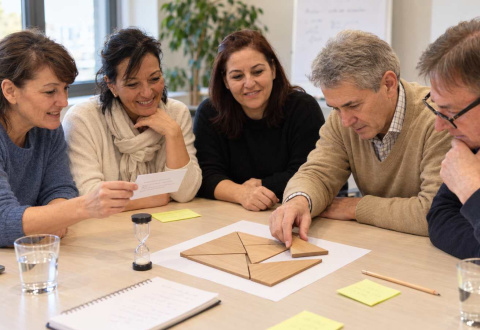
An activity can highlight skills that normally don’t emerge in the office. A particularly reserved person might turn out to be an excellent problem solver. A manager may discover they need to rely on the expertise of their team.
These dynamics can generate positive emotions because they change how people perceive each other.
A shared memory can change how you work together
A Team Building day doesn’t automatically solve all of an organization’s problems.
But it can create a starting point.
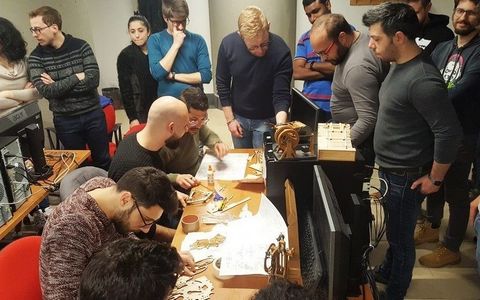
After facing a challenge together, solving a riddle, building something, or reaching a shared goal, people have a new shared memory.
And it’s that memory that can keep influencing relationships even after returning to work.
Sometimes all it takes is a sentence.
“Remember when we solved that test?”
Behind that line there’s something more than just a memory: there’s the concrete experience of managing to collaborate.
Rome as a space to generate positive emotions
Rome offers a particularly interesting setting for designing corporate experiences that engage people.
The city can turn into an environment where culture, play, movement, and collaboration come together.
A challenge among the Fori Imperiali
Let’s imagine a group divided into teams, taking part in an urban treasure hunt.
In front of the Fori Imperiali, people must observe, discuss, and interpret clues to reach the next stop.
You don’t need to know the answer individually.
You need to find together the way to get there.
The satisfaction that comes from solving a shared challenge can turn into a positive emotion that strengthens the group’s sense of perception.
The Pantheon and the value of wonder
There are places that can still surprise us, even after centuries.
The Pantheon, with its dome and the famous oculus, can become a prompt to reflect on wonder and the ability to notice what we normally take for granted.
Curiosity is a powerful emotion.
It pushes you to ask questions, explore, and look for new possibilities.
In a business context, keeping that curiosity alive can be just as important as having established answers.
Piazza Navona and the importance of perspective
In Piazza Navona, history, architecture, and people’s movement create a scenario where it’s easy to understand a fundamental concept: every observer can see something different.
A Team Building challenge might ask the teams to describe the same place from different perspectives.
The result? A concrete demonstration of the fact that diversity of viewpoints can enrich a solution.
Positive emotions and creativity: why getting out of routine can help
Routine is useful.
It helps organize work, build procedures, and save energy.
But sometimes routine can also make it harder to see a problem from a new perspective.
An experience outside the usual environment can temporarily interrupt daily patterns.
A walk in the historic center, a creative challenge near Castel Sant’Angelo, a collaborative activity along the Tiber, or a team game in an unusual space can provide new stimuli.
Not because Rome has a magical power over productivity.
But because changing context can change the dynamics.
When people stop playing their role
In the office, everyone knows their role.
There’s someone who coordinates. Someone who analyzes. Someone who presents. Someone who executes.
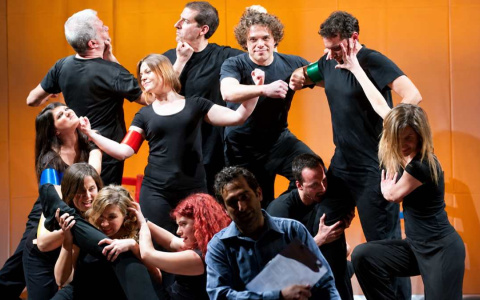
During an experiential activity, these roles may become temporarily less rigid.
The person who normally takes few initiatives might become the natural leader of a team.
Someone used to making decisions could discover the value of listening.
This flexibility can generate one of the most important emotions for a team: surprise.
Discovering something new about others often means changing the way professional relationships are built.
What positive emotions can impact work?
Not all positive emotions act in the same way.
Some may be particularly important in group dynamics.
Trust
It’s the foundation of collaboration.
Without trust, people tend to protect their information more, their ideas, and sometimes even their mistakes.
Gratitude
Recognizing others’ contributions can strengthen the sense of belonging.
A simple “thank you” doesn’t replace a company strategy, but it can help make the value of the work done more visible.
Enthusiasm
Enthusiasm can be contagious.
A team involved in a project can pass on energy and motivation to the other members of the group as well.
Shared pride
Reaching a result together creates a particular type of satisfaction.
It’s not “I did it”.
It’s “we did it”.
This small language difference tells the strength of a collective experience.
Curiosity
Curiosity drives exploration.
It’s a valuable element in an era when companies and professionals must continuously deal with new tools, new technologies, and new scenarios.
Attention: positivity doesn’t mean ignoring problems
A healthy organization isn’t one where everyone always has to be happy.
Demanding constant positivity can even become counterproductive.
People should be able to express doubts, concerns, and disagreements.
A conflict handled constructively can be far more useful than an apparent consensus.
For this reason, talking about positive emotions means talking above all about balance.
A productive team should be able to experience:
-
enthusiasm when it reaches a goal;
-
trust in each other’s dialogue;
-
security in sharing ideas;
-
freedom to express disagreement;
-
satisfaction with a shared result.
The goal isn’t to eliminate negative emotions.
It’s to create relationships strong enough to deal with them.
How to design a Team Building that leaves something with the team
To get real value from the experience, a Team Building activity should be connected to the group’s goals.
Start from a question
Before choosing the activity, it’s useful to ask:
What do we want to improve?
Communication?
Trust?
Collaboration between departments?
Integration of new colleagues?
Problem-solving ability?
The answer to this question should guide the design of the experience.
Create a shared challenge
The most meaningful positive emotions often don’t come simply from having fun.
They come from overcoming a difficulty.
A challenge that’s too easy doesn’t engage.
An impossible challenge creates frustration.
The balance lies in creating an objective that requires collaboration and allows the group to experience the satisfaction of the outcome.
Leave room for reflection
After the activity, it can be helpful to dedicate time to discussion.
What happened?
Which behaviors helped the team?
What difficulties emerged?
What can we take with us into everyday work?
It’s in this step that the experience can turn from a simple event into a learning opportunity.
Are positive emotions truly an investment in productivity?
Probably it’s more accurate to change perspective.
Companies shouldn’t try to “produce happiness” with the goal of automatically getting more results.
Instead, they should ask how to build contexts in which people can work well together.
Positive emotions can be a consequence of this process and, at the same time, help reinforce it.
A team that feels involved can communicate better.
A group that trusts can collaborate with greater ease.
People who share meaningful experiences can develop stronger professional relationships.
And better relationships can create favorable conditions for productivity as well.
Conclusion: productivity can start with an emotion
Maybe it all begins with a simple question.
How do people feel when they work together?
It’s not a secondary question.
Because behind every project there are people. Behind every result there are relationships. And behind many successful performances there is the ability to turn a group of professionals into a team that truly knows how to collaborate.
Positive emotions aren’t a magic formula.
But trust, enthusiasm, curiosity, gratitude, and a sense of belonging can become valuable ingredients for building a more open, participatory, and collaborative workplace.
A well-designed Team Building can offer exactly this: an opportunity to get out of routine, experience something together, and return to the office with a different understanding of your colleagues.
Maybe it all starts with a challenge among the streets of Rome.
With a clue in front of the Pantheon.
With a mission near Castel Sant’Angelo.
With a shared laugh along the way.
And perhaps with the most important discovery of all: when people feel good working together, they can learn to work better together.
FAQ – Positive Emotions and Productivity in Team Building
Do positive emotions really increase productivity?
Positive emotions don’t automatically guarantee better results, but they can help create important conditions for productivity, such as trust, collaboration, communication, and greater participation.
Why can Team Building generate positive emotions?
Because it allows people to live shared experiences outside the work routine, face challenges together, and discover new relationship dynamics.
Is a fun Team Building always effective?
Not necessarily. Fun is important, but an activity is more effective when it’s designed in relation to the team’s goals and includes moments of collaboration and reflection.
Which emotions are particularly important for a team?
Trust, a sense of belonging, enthusiasm, gratitude, curiosity, and satisfaction from achieving a shared goal can play a positive role in group dynamics.
Is Rome a good location for an emotional Team Building?
Yes. Rome offers a context rich in history, culture, and different settings. POI like the Pantheon, the Fori Imperiali, Piazza Navona, Castel Sant’Angelo, and the Tiber can become an integral part of experiential and collaborative activities.
How can you turn a positive experience into concrete improvement?
It helps to connect the activity to business goals and dedicate a final moment to reflection, to identify the behaviors that emerged and understand how to apply them to everyday work.
If you want to live this experience or something similar, click here, you’ll find our proposals:
Request a free quote and receive all the information about your Team Building experience.
You can also request a quote to receive all the information about your Team Building experience.