



































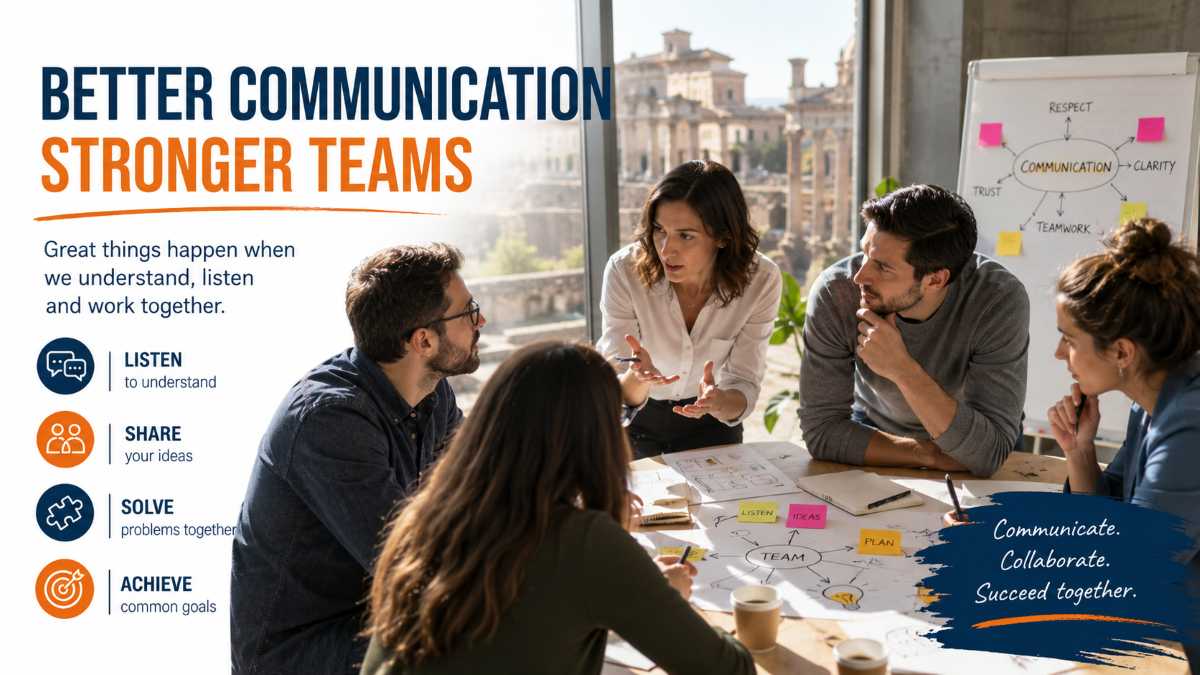
Why Team Building really improves communication
There are moments in a company’s life when you realize that people talk a lot but understand each other very little.
Meetings multiply, emails become longer and longer, and company chats fill with messages and updates. And yet something keeps not working. Information doesn’t reach the right person, a delivery is interpreted in a different way, and a problem stays hidden because no one communicates it openly.
This is where Team Building comes in.
Not as a simple break from the office, but as a hands-on experience in which people can observe, try, and improve the way they communicate.
Because communicating doesn’t simply mean speaking.
It means listening. Interpreting. Asking questions. Understanding others’ point of view. Turning a message into a shared action.
And often it’s precisely outside the daily routine that a team finally manages to understand how it really communicates.
When the problem isn’t what we say, but what others understand
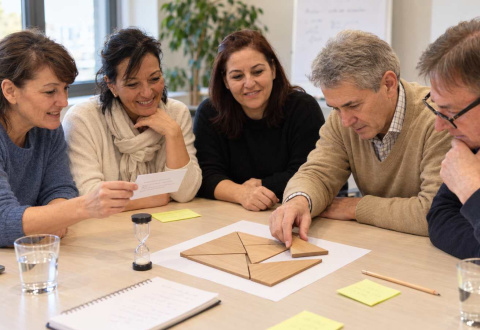
Let’s imagine a team working hard on a challenge.
Time passes. There’s an objective to reach. Each participant has a piece of the information needed, but no one has the full picture.
At the beginning, everyone talks at the same time.
Someone takes the lead. Someone else tries to propose a solution. One person stays silent, even though they may have the crucial information.
Then a mistake happens.
The team has to stop.
And that’s exactly when something interesting happens: participants start asking themselves not only “how do we solve the problem?” but also “why didn’t we understand each other?”
That’s one of the reasons Team Building can truly improve communication.
It turns an abstract concept into a direct experience.
Communication becomes visible
In everyday work life, many communication problems remain invisible.
A colleague may think they’ve been clear. Another may have interpreted the message differently. A third person may not have had the courage to ask for clarification.
During a Team Building activity, however, these dynamics emerge quickly.
A game, a creative challenge, a treasure hunt, or a problem-solving experience can immediately make visible behaviors that, in the office, would remain hidden.
Who really listens?
Who keeps interrupting?
Who can summarize?
Who asks the right questions?
Who communicates only when they’re sure they’re right?
Who has a good idea but struggles to share it?
Team Building creates a safe space to observe these behaviors without turning the experience into a formal evaluation.
And it’s precisely this freedom that supports change.
Team Building creates a common language
Every group develops, over time, its own communication habits.
There are teams that rely almost exclusively on procedures. Others work through informal conversations. Some are extremely quick in making decisions, while others need longer discussion.
The problem arises when these differences aren’t recognized.
A shared activity can become a starting point for building a common language.
After going through a challenge together, participants have a concrete reference point.
They can remember a moment, a mistake, a winning choice.
A simple phrase like:
“Remember what happened during that round?”
can become an effective way to bring the experience back into everyday work life.
From experience to everyday behavior
The real value of Team Building doesn’t end when the activity ends.
The most interesting part comes afterward.
When the group returns to work and starts—perhaps without even realizing it—to recognize dynamics they’ve already experienced.
The person who struggled to delegate during the challenge may notice they have the same behavior in the office.
The colleague who solved a problem by listening to a seemingly minor suggestion may understand the importance of making room for others.
The team that wasted time because no one clarified priorities can start organizing their meetings differently.
So the experience becomes a concrete metaphor for everyday work.
Listening is one of the most important skills for a team
When we talk about business communication, we often immediately think about the ability to express oneself.
But effective communication starts with listening.
Listening doesn’t simply mean waiting for the other person to finish talking.
It means gathering information, interpreting the context, asking questions, and verifying that you’ve understood correctly.
Team Building activities can be particularly effective precisely because they place participants in situations where no one can do it entirely alone.
To find a solution, you have to listen.
To complete a challenge, you need to share information.
To reach an objective, you must understand what others are trying to communicate.
When every piece of information matters
Let’s think, for example, of a treasure hunt through the streets and most scenic places of Rome.
A team may find itself facing a clue related to the Roman Forum, a hidden curiosity near the Pantheon, or a detail to observe along the route toward Castel Sant’Angelo.
Each participant can notice something different.
There’s someone who observes a specific architectural detail. Someone who remembers a historical fact. Someone who interprets the clue better. Someone who manages to organize the route.
The solution comes from the meeting of different perspectives.
And that’s when communication stops being a simple exchange of words and becomes collaboration.
Why playing helps you communicate better
Games have a key characteristic: they lower defenses.
In a professional setting, a person may feel judged for a mistake or be reluctant to show uncertainty.
During an engaging activity, however, traditional roles become less rigid.
The manager can ask for help.
A newcomer can propose an idea.
The quietest person can suddenly become essential to solving a task.
This shift in perspective can change how people perceive their colleagues.
Outside the office, new voices emerge
An effective Team Building experience often makes it possible to discover skills that don’t find room in normal work activities.
Someone who seems reserved may turn out to be an excellent observer.
Someone who is used to working alone may reveal a strong ability to coordinate.
A junior team member may propose the most effective solution.
When these abilities become visible, communication changes too.
People start to recognize each other in a different way.
And a team that recognizes the value of different voices is more willing to listen to them.
Non-verbal communication matters more than we think
Part of communication happens without words.
A facial expression, a pause, a gesture, the tone of voice, or body posture can completely change the meaning of a message.
During a group challenge, non-verbal communication becomes especially evident.
A participant may understand that a colleague is struggling even before they say it.
A group may sense tension when someone is systematically excluded from the conversation.
A simple gesture can coordinate an action faster than a long explanation.
Observe the team while it acts
One of the most interesting aspects of Team Building is the ability to observe the group in action.
Not what people say they do.
But what they actually do.
How do they react to an unexpected situation?
How do they handle disagreement?
How do they communicate under pressure?
How do they deal with mistakes?
These situations can offer valuable insights into the quality of internal relationships.
Rome as a space for communication and discovery
Rome is a city particularly suited to this type of experience.
Because it’s made of routes, details, stories, and different points of view.
A treasure hunt can pass through iconic places, but also lesser-known corners. A group activity can turn a square into a meeting point, a monument into a clue, and a street into a strategic choice.
Let’s think of Piazza Navona, where every perspective can tell you something different. Or the streets of Trastevere, where the group has to navigate, observe, and decide together which direction to take.
The city becomes a metaphor for teamwork.
There isn’t just one way to look.
There isn’t only one road.
To move forward, you have to share what you see.
Team Building and communication: it’s not enough to talk—you need to experience it
Communication is a skill that can hardly be improved by only a theoretical presentation.
Knowing you need to listen doesn’t necessarily mean you know how to listen.
Understanding the importance of collaboration doesn’t automatically mean you collaborate well.
Team Building lets you try out these skills.
And above all, it allows you to make mistakes without professional consequences.
A mistake during a challenge becomes an opportunity for discussion.
An ineffective strategy can be changed.
A misunderstanding can be analyzed.
The group can stop and ask:
What happened?
Why did we waste time?
Who didn’t we listen to?
Which information was missing?
How can we communicate better next time?
These are simple questions, but they can spark deep reflection.
Trust makes communication more authentic
A person rarely communicates openly if they fear being judged.
Trust is one of the key elements of effective communication.
A team that trusts its members is more willing to share doubts, flag problems, and propose ideas.
Team Building experiences can help build this trust through shared goals.
When a group faces a challenge together, it experiences interdependence in a concrete way.
A person’s success also depends on the actions of others.
This leads to greater awareness:
we don’t necessarily all have to be the same to work well together.
But we do need to be able to communicate our differences.
Diversity of perspectives becomes a resource
In an effective team, different opinions shouldn’t automatically represent a problem.
They can be a resource.
The risk arises when people stop expressing their point of view because they think they won’t be heard.
A well-designed activity can reverse this dynamic.
If, in order to succeed in a task, each participant must contribute, the group understands how important it is to gather different ideas.
Communication therefore becomes inclusion.
An experience that continues even after the activity ends
The most effective Team Building isn’t necessarily the most spectacular.
It’s the one that leaves something behind.
A phrase.
An episode.
A laugh.
A mistake turned into a lesson.
A moment when the team realized it can work better.
These shared memories become part of the group’s story.
And the shared story is one of the most powerful tools for improving communication.
Because it creates common references.
It builds trust.
It makes it easier to deal with challenges too.
Conclusion: communicating better means working better together
Team Building truly improves communication when it isn’t considered just a simple break from routine.
Its value lies in the possibility of placing people in a new, engaging, shared situation.
Here, habits, mistakes, hidden skills, and new forms of collaboration come to the surface.
People learn to speak with greater clarity.
But above all, they learn to listen.
To ask questions.
To recognize different points of view.
To trust others.
After all, every team is continuously facing a kind of treasure hunt.
The goal may be a project, a result, a new challenge, or a change.
No one has all the clues by themselves.
To reach the solution, you have to put together what each person has seen.
And to do that, you need one fundamental thing:
to truly communicate.