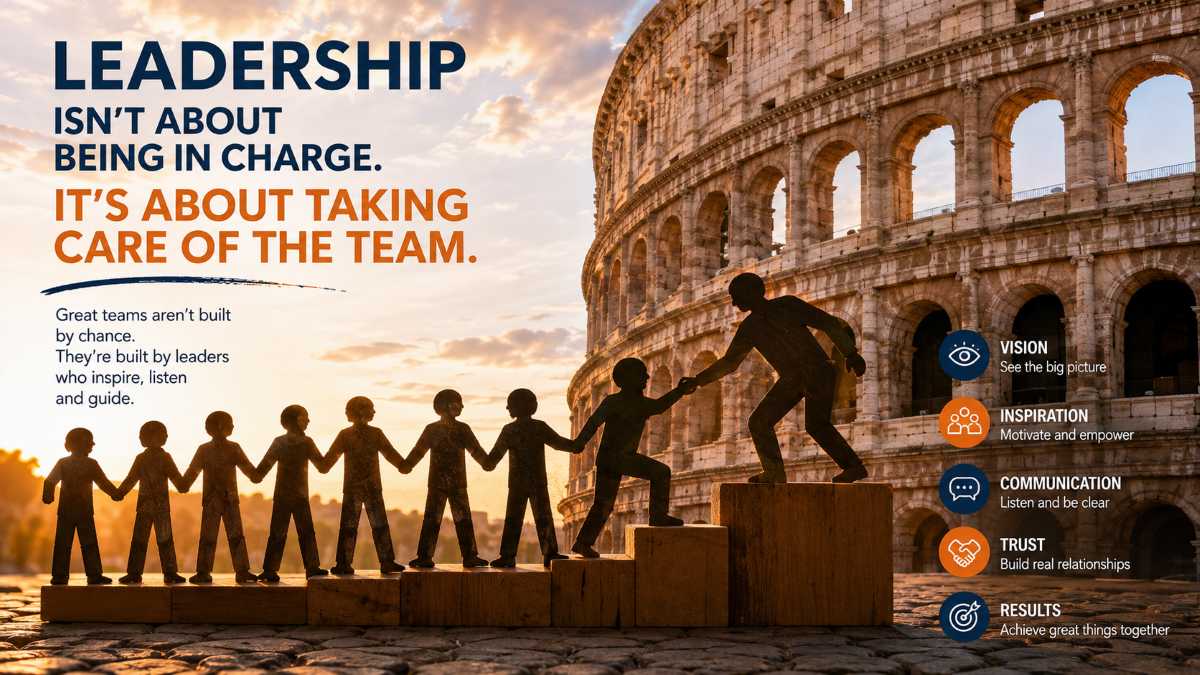
The Colosseum tells the story of leadership
At dawn, when Rome slowly begins to fill with voices and footsteps, the Colosseum looks different.
It is not yet surrounded by crowds. The noise of the city seems to arrive from far away. Its arches, lit by the morning light, tell almost two thousand years of history without needing to say a word.
And yet, looking at it closely, it is hard not to think of a very contemporary question:
what can the Colosseum teach a leader today?
The answer does not concern emperors, absolute power, or the ability to command from above.
The Colosseum instead tells something more interesting: complexity.
Because no great work is born from the efforts of one person alone. Behind a structure capable of spanning centuries there are different skills, organization, design, coordination, and a vision able to hold together hundreds of elements.
Just as happens in a team.
And perhaps that is why the Colosseum can become an extraordinary metaphor for modern leadership.
The Colosseum: a great work built through a shared vision
The Flavian Amphitheatre, known worldwide as the Colosseum, is not just one of Rome’s symbols.
It is the result of a complex project, carried out through the coming together of different knowledge, techniques, and professional expertise.
Every element had a function.
Every space was connected to the others.
Every decision influenced how the entire structure worked.
A key lesson also for anyone who leads an organization.
A leader does not have to build everything alone
One of the most common mistakes in leadership is thinking that leading means having all the answers all the time.
But the most effective teams do not work because one person knows every detail.
They work because people bring different skills to the table and are able to coordinate them toward a common goal.
A good leader does not have to be the only protagonist.
They must be the person capable of creating the conditions so others can do their best.
It’s a subtle difference, but a fundamental one.
To command means to point in a direction.
To lead means helping a group reach it together.
A morning in front of the Colosseum: leadership under pressure
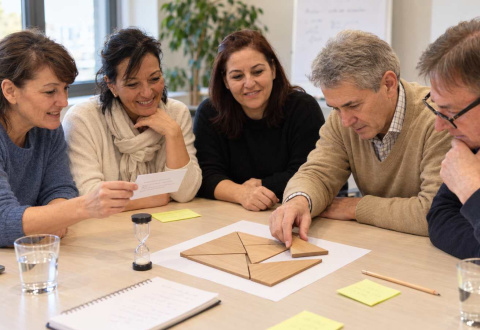
Let’s imagine a group of colleagues working on a Team Building activity in the center of Rome.
In front of them there is a challenge.
Time is limited.
The clues must be interpreted.
Information is distributed among the different participants.
At first, someone spontaneously tries to take charge.
Another person proposes a strategy.
Someone else stays silent and watches.
A colleague, apparently less involved, notices a detail the others hadn’t seen.
The team changes its mind.
It reorganizes the route.
It finds a solution.
In just a few minutes, some of the most important leadership dynamics come to the surface.
Who really listens?
Who makes decisions too quickly?
Who can involve the quietest people?
Who stays calm when something doesn’t work?
Who knows how to change strategy?
Leadership becomes visible.
Not through a theoretical definition, but through behavior.
The leader as an architect of relationships
The Colosseum is made up of different elements that work together.
If we observe its structure, we immediately understand that every part is connected to the others.
A perfect metaphor for an organization.
Even a team is made up of different people.
There are technical skills, creative abilities, experience, intuition, strategic vision, and attention to detail.
The role of leadership is not to make all these people the same.
It is to enable them to function together.
Value differences instead of eliminating them
A group made up of people with different skills can be extremely effective.
Provided there is guidance capable of turning diversity into a resource.
An effective leader does not ask everyone to think the same way.
They make room for different perspectives.
They listen to the person who sees a problem before others do.
They involve those who have useful information.
They accept that a good idea can come from any point in the organization.
In this sense, leadership is not centralization.
It is connection.
The Colosseum and the ability to make decisions
Every big project requires decisions.
Some are simple.
Others involve risks.
And others still must be made without having all the available information.
This is a situation very familiar to anyone who leads a team.
In day-to-day business life, a leader often has to decide while the context changes.
A project encounters an unexpected problem.
A client changes a request.
A deadline is approaching.
A strategy does not produce the expected results.
In these moments, a key quality emerges:
the ability to distinguish between determination and rigidity.
A good leader knows how to change their mind
Being a leader does not mean defending a decision at all costs.
It means having the courage to modify it when new information shows there is a better path.
During a Team Building activity, this behavior becomes very clear.
A team can be convinced it has found the solution.
Then one detail changes everything.
At that point, the group must decide.
Continue along a route already chosen, or stop, listen, and change strategy?
The ability to correct course is one of the most important skills in contemporary leadership.
From the Colosseum to the Imperial Forums: leading means understanding the context
A few steps separate the Colosseum from the Imperial Forums.
Walking among these places makes it easy to understand how Rome’s history was built through continuous transformations.
Each era added something.
Each generation reinterpreted what it had been given.
Businesses go through this process too.
No organization remains the same as itself.
Markets change.
Technologies change.
People’s expectations change.
Operating models change.
That’s why leadership cannot be only management.
It must be the ability to read the context.
Vision does not mean predicting everything
A leader with a vision is not someone who can know the future.
They are someone who can guide the group even when the future is not fully defined.
This means communicating clearly.
Sharing a goal.
Explaining why a certain direction is important.
And leaving people room to contribute to the journey.
A shared vision is stronger than an order.
Because it does not simply force people to move.
It helps them understand why they are going in that direction.
Leadership doesn’t live only in official roles
One of the most interesting lessons that can emerge during a Team Building activity is distributed leadership.
Not always is the person with the most important role the one who, at a given moment, has the necessary skills.
During a challenge, leadership can shift.
At one moment someone is needed who can analyze.
At another, someone who can motivate the group.
Then it may become essential to have someone with greater observational ability.
Leadership becomes dynamic like that.
Make room for others
An effective leader does not have to constantly prove they are indispensable.
On the contrary, their strength can emerge from the ability to make others more autonomous.
Delegating.
Listening.
Trusting.
Asking questions.
Recognizing talent.
These are all forms of leadership.
And they are often far more effective than communication based exclusively on control.
From the Colosseum to the Pantheon: the value of balance
Rome offers numerous examples of architecture capable of becoming metaphors for collaboration.
The Pantheon, with its dome and extraordinary balance, reminds us how important the relationship between the individual parts of a system is.
A team works the same way.
Each person can be competent.
Each department can reach its own goals.
But if coordination is missing, the overall result risks losing effectiveness.
The leader has this responsibility too:
create balance without suffocating autonomy.
Coordinate without controlling everything
There is a big difference between coordination and control.
Excessive control slows down decisions and can reduce the sense of responsibility.
Coordination, on the other hand, allows people to know where they are going and what contribution they can make.
An effective team needs clear goals.
But also trust.
It needs rules.
But also autonomy.
It needs guidance.
But not necessarily someone who decides every single step.
Leadership is also measured in how errors are handled
The Colosseum has survived earthquakes, fires, transformations, and centuries of change.
It didn’t reach us because everything remained unchanged.
It reached us because its history was also made of adaptations.
This is perhaps one of the most interesting metaphors for the world of work.
No project always proceeds according to the original plan.
Errors are part of the journey.
The real difference lies in how they are handled.
Error as information
A leader can turn a mistake into a learning opportunity or into a reason for fear.
In the first case, people learn.
In the second, they simply learn not to put themselves out there.
A Team Building activity can help the group experience this difference.
One attempt fails?
You can try again.
A strategy proves ineffective?
You can change it.
Does someone make a mistake?
The team can decide whether to look for a culprit or a solution.
Leadership shows up here too.
In the way a group responds when something goes wrong.
Team Building as a leadership lab
Leadership skills do not develop only through lessons and theoretical models.
They need to be tested.
Team Building can become a real laboratory.
People find themselves outside their routine.
Usual roles can change.
Dynamics become more visible.
An activity in Rome’s historic center, a treasure hunt, a creative challenge, or a problem-solving experience can turn into opportunities to observe group behavior.
Lead a team through a challenge
In a path that may take teams through the Colosseum, the Imperial Forums, and other symbolic places in the city, each team must continuously make decisions.
Who proposes the strategy?
Who gathers the information?
Who keeps track of time?
Who communicates with the others?
Who steps in when a disagreement arises?
These are all situations that, in different and engaging forms, remind us of what happens every day in an organization.
The advantage is that the experience allows these dynamics to be observed from a new perspective.
And often, precisely away from the office, the most useful lessons emerge.
Leadership that leaves a mark
At the end of the activity, the group can go back to observing the Colosseum.
The challenge is over.
The clues have been solved.
Someone remembers an error that turned out to be funny.
Someone else thinks back to the moment when the team changed strategy.
And perhaps someone realizes something important.
Leadership is not always the loudest voice.
It is not necessarily the person who speaks the most.
It is not the need to control every detail.
Leadership is the ability to help a group work better.
It is creating trust.
Giving direction.
Listening.
Making decisions.
Embracing new ideas.
Recognizing the moment when it’s necessary to change course.
Conclusion: what the Colosseum can teach today’s leaders
The Colosseum continues to tell the story of Rome even after nearly two thousand years.
But looking at it with today’s eyes, it can also tell us something about how we work together.
A great structure is not only the result of individual elements.
It is the result of the connections between those elements.
The same happens in a team.
Individual skills are important.
But they become truly effective when they are able to communicate with each other.
Modern leadership is not about wanting to be at the center of everything.
It is about creating a system in which people can contribute, grow, and take responsibility.
As in Rome’s great architecture, even in teams the outcome depends on balance.
From a vision.
From a structure.
From the ability to adapt.
And above all from the relationships between people.
Perhaps this is the most current message the Colosseum can offer to anyone who leads an organization:
A great leader does not build a monument to themselves.
They build the conditions so their team can create something that lasts over time.
If you want to live this experience or something similar, click here; you’ll find our proposals:
Request a free quote and get all the information about your Team Building experience.
Request a quote