





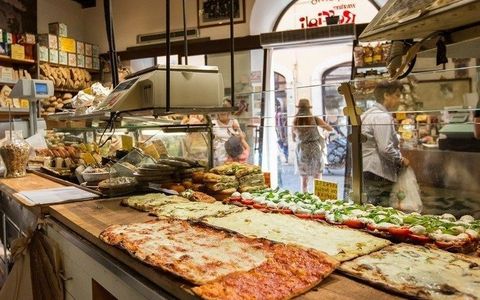


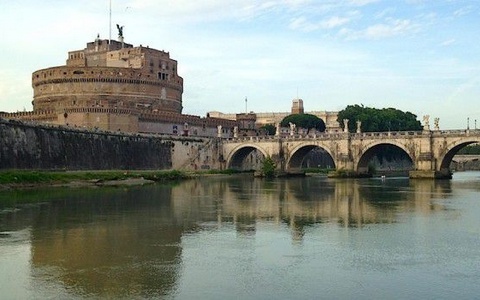


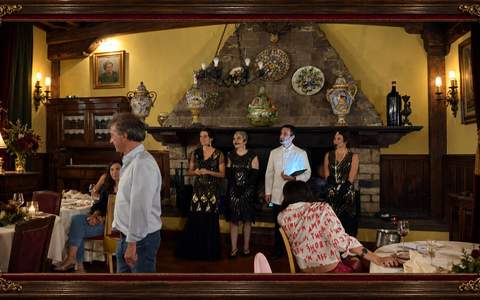


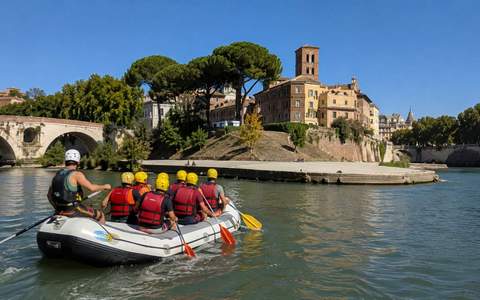















The historic trattorias of Rome to discover with your team
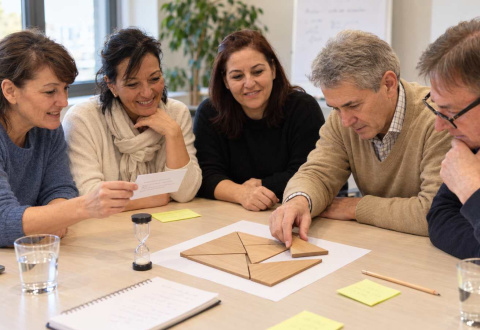
There’s a moment, during a Team Building day, when strategies make room for laughter, challenges turn into stories, and colleagues briefly stop talking about goals, meetings, and deadlines. That moment often arrives at a table.
In Rome, however, a table can tell you much more than just a meal.
It can become the finishing point of a treasure hunt through the alleys, the break after an urban challenge, the place where you discuss a mission just completed, or simply a chance to rediscover the pleasure of being together. The historic trattorias of Rome, with their authentic atmospheres, traditional dishes, and deep connection to the city’s neighborhoods, can become an integral part of a Team Building experience.
Because knowing Rome also means tasting it.
Rome is also discovered at the table
Let’s imagine a group moving through the city during a treasure hunt. One team has just solved a riddle near the Pantheon, another arrives from Piazza Navona, while someone tries to remember the answer to a question they received along the way.
The streets of Rome have a particular effect on groups: they make you observe, choose, and compare.
Then, suddenly, it’s time to sit down.
A historic trattoria can become the place where the experience continues in a different way. Not through a tablet, a challenge, or a mission, but through conversation.
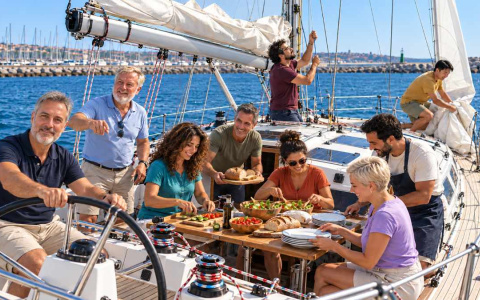
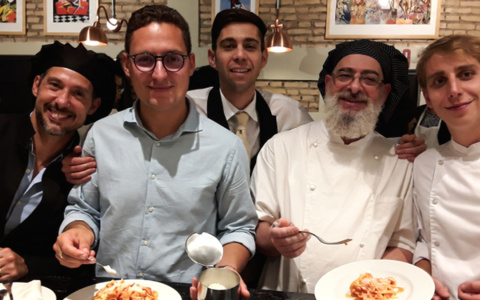
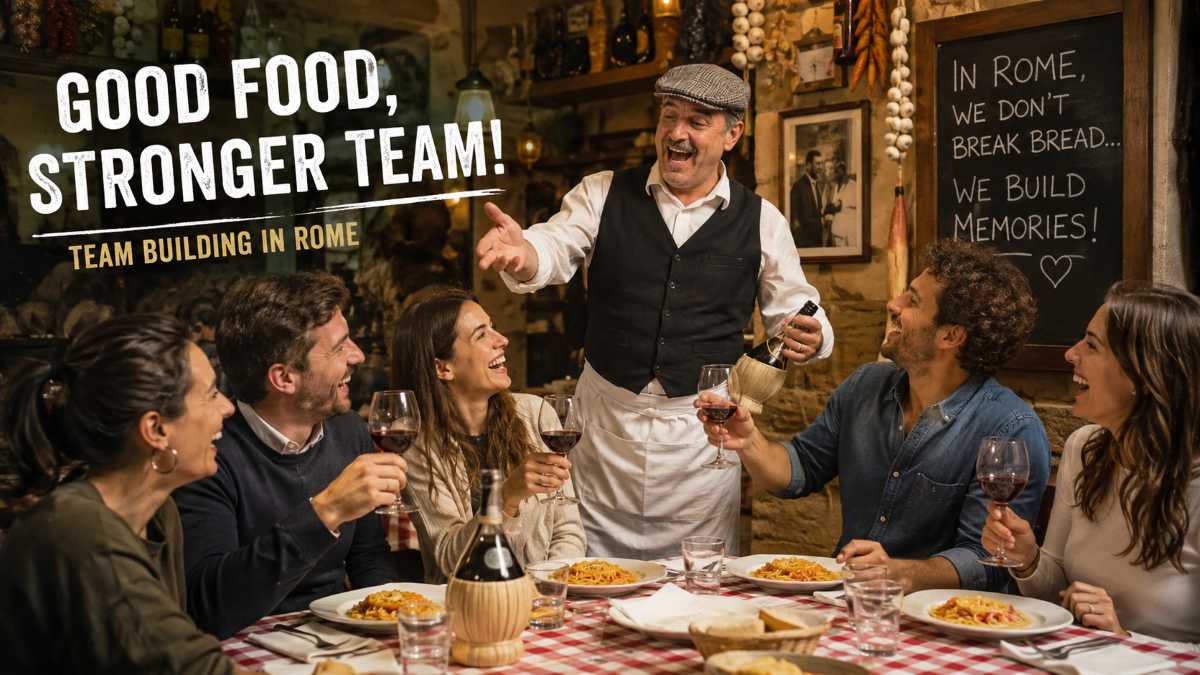
Over a plate of pasta, people comment on what happened, recall the funniest mistakes, celebrate a brilliant solution, and, often without realizing it, build relationships.
This is exactly the power of a shared experience: the social moment doesn’t necessarily represent the end of the activity, but it can become part of the story.
Historic trattorias as a Team Building experience
An effective Team Building isn’t measured only by the number of activities completed.
It also matters what happens between one activity and the next.
A lunch or dinner in a place capable of telling the story of Rome can help create a more complete experience, especially when it’s included in a route designed for the group.
Historic trattorias have features that make them particularly interesting in this context:
-
they convey the identity of a neighborhood;
-
they preserve recipes and traditions;
-
they encourage an informal atmosphere;
-
they help create moments of spontaneous conversation;
-
they can become a stop on an urban itinerary;
-
they let you experience Rome through a multisensory experience.
Not just carbonara: the value of the context
When talking about Roman cuisine, it’s easy to think right away of carbonara, amatriciana, cacio e pepe, or saltimbocca.
But the real value of a food experience in Rome isn’t only on the plate.
It’s in the context.
Eating in a trattoria located in the heart of a historic neighborhood means stepping, at least for a few hours, into a part of the city’s everyday history. Signage, nearby streets and squares, shops, and monuments help create a narrative that goes far beyond the menu.
Trastevere: the neighborhood where conviviality feels at home
If there is a neighborhood that immediately represents the idea of popular and convivial Rome, it’s Trastevere.
Its narrow streets, cobblestones, lively squares, and sudden views make this area especially well-suited to a group experience.
A route can start from Piazza Trilussa, pass through the neighborhood’s alleys, and reach Piazza di Santa Maria in Trastevere, one of the most recognizable places in the area.
Here, between one stop and the next, Team Building can take on a different rhythm.
A break that becomes part of the story
Let’s imagine a team that, after completing a series of missions, arrives at the table convinced they’ve finally finished the day.
Then someone says they misinterpreted a clue.
Another discovers that the opposing team had found the solution much earlier.
A discussion starts. Laughter follows.
And just like that, almost without a plan, the group keeps doing Team Building.
Because collaboration doesn’t only happen when it’s requested. Sometimes it develops in the most spontaneous moments.
Testaccio: where Rome tells its most authentic soul
Talking about Roman cuisine without mentioning Testaccio would be impossible.
This neighborhood is deeply connected to the city’s popular and gastronomic history. Here, cooking tells stories rooted in everyday life, creativity, and the ability to turn simple ingredients into dishes that have become symbols of Roman gastronomy.
For a corporate group, Testaccio can represent an interesting stop within an itinerary that combines culture, play, and food.
Among the area’s points of interest, we find the Monte dei Cocci, the Non-Catholic Cemetery, the Testaccio Pyramid nearby, and the complex of the area of the Ex Mattatoio.
From the neighborhood to the team: a shared common thread
Every neighborhood in Rome has its own identity.
Testaccio, Trastevere, the historic center, the Ghetto, and the city’s most popular areas tell different stories, just like happens within a team.
Each person arrives with different skills, experiences, and points of view.
The challenge is to find a shared language.
An itinerary through Rome can become a concrete metaphor for this process: to get oriented, you have to observe, listen, ask questions, and piece together different information.
Exactly like in a team.
The Roman Ghetto: history, memory, and culinary tradition
Another particularly interesting area for building an urban experience is the Jewish Ghetto of Rome.
Walking through these streets means encountering a complex and fascinating history, tied to the city’s memory and its transformations.
The proximity to Teatro di Marcello, Portico d’Ottavia, Tiber Island, and Campo de’ Fiori makes it possible to include this area within broader routes.
Here too, gastronomy is an important element of the narrative.
After all, culinary traditions tell stories of encounters, influences, communities, and transformations that have taken place over the centuries.
When lunch becomes a stop along the route
In a well-designed Team Building experience, every moment can have meaning.
Lunch break can be simply a break.
Or it can become:
-
a reward after a challenge;
-
a meeting point between teams;
-
a moment of comparison;
-
a surprise stop on the itinerary;
-
the conclusion of a treasure hunt;
-
the start of a new activity.
The difference isn’t only in the place, but in the way that moment is incorporated into the overall experience.
From the historic center to the lesser-known alleys
Rome has a characteristic that makes it perfect for group activities: even when you think you know it, it still manages to surprise you.
You can pass by the Pantheon and then, just a few minutes later, find yourself on a small street you’d never noticed before.
You can cross Piazza Navona, reach Campo de’ Fiori, and then discover an architectural detail that tells a completely different story from the one you imagined.
This element of surprise is especially interesting for Team Building.
The shared experience creates stronger memories
A monument can be photographed.
A route can be narrated.
A dish can be described.
But when all these things are lived together, the experience changes.
Memory becomes collective.
“Do you remember when we took the wrong turn?”
“And when we thought we’d won?”
“And that solution that seemed impossible?”
These are the kinds of lines that often remain after an activity.
Team Building doesn’t necessarily end at the moment a final score is assigned. It can continue when you head back to the office, during a conversation, or, why not, at a Roman table.
How to organize an experience between Team Building and gastronomy
Integrating a historic trattoria into a corporate activity requires attention.
It’s not just a matter of choosing a restaurant and booking a table for many people. The goal should be to create a coherent experience.
1. Choose the right neighborhood
The choice of area should be linked to the type of activity.
A route in the historic center can end at a trattoria near Piazza Navona, the Pantheon, or Campo de’ Fiori.
An activity dedicated to discovering more popular Rome, on the other hand, can find its ideal setting in Trastevere or Testaccio.
So the neighborhood isn’t just a backdrop: it becomes part of the story the group is living.
2. Consider the group’s characteristics
A small team and a large corporate group have different needs.
You should evaluate:
-
number of participants;
-
available time;
-
any dietary needs;
-
logistics;
-
distance between activities and venue;
-
type of experience desired;
-
level of informality of the event.
Good planning helps prevent the convivial part from becoming simply a logistical moment to manage.
3. Connect food to the city’s history
The most interesting aspect is to create a common thread.
For example, a treasure hunt can include clues linked to Roman traditions.
A route can tell curiosities about the history of cooking.
A challenge can ask participants to discover ingredients, traditions, or places connected to gastronomy.
In this way, lunch or dinner becomes the natural conclusion of a story that began much earlier.
Why sharing a meal can strengthen the group
Eating together doesn’t replace a structured Team Building activity.
However, it can be an important part of the experience.
In an informal setting, hierarchies tend to fade. Conversations become more spontaneous and people can get to know each other from different perspectives.
A colleague who seems reserved in the office can suddenly become the best storyteller at the table.
A manager can share a funny episode.
Two people who rarely collaborate can find themselves discussing the best carbonara they’ve ever had.
They’re small moments, but they can contribute to building more authentic relationships.
The value of conviviality
The word “conviviality” comes from the Latin convivium, literally “to live together.”
And maybe that’s exactly the point.
A Team Building isn’t only about putting people in the same room or dividing them into teams.
It’s about creating opportunities for them to experience something together.
An urban challenge, a treasure hunt, a cooking workshop, or lunch at a historic trattoria can take many different forms, but they share a fundamental element: the shared experience.
Historic trattorias as a destination, not just a break
Rome offers endless possibilities for building original corporate routes.
Historic trattorias can be included in a broader program that includes:
-
treasure hunts in the historic center;
-
urban orienteering activities;
-
gastronomy experiences;
-
team games;
-
routes between monuments and neighborhoods;
-
indoor and outdoor activities;
-
final convivial moments.
The secret is to avoid treating each element as separate.
The city, the game, the food, and the group can become parts of the same experience.
Rome, a table, and a team: the memory that lasts
At the end of the day, probably no one will remember all the details of the program.
Maybe someone will forget the final score.
Someone else won’t remember exactly how many missions were completed.
But it’s likely that the memory of a particular day will stay with you.
Of a team that took the wrong turn and then found the solution.
Of a run through the alleys.
Of a challenge solved at the last minute.
And then of a table.
Because in Rome, even a trattoria can become a place where stories meet.
And when those stories belong to a group, Team Building can continue long after the activity ends.
If you want to live this experience—or something similar—click here; you’ll find our proposals:
Request a free quote and get all the information about your Team Building experience.
You can also request a free quote and receive all the information about your Team Building experience.