

























Piazza Navona between games, sports and shows: when Rome becomes a big stage
There are places in Rome that seem designed to tell a story. Piazza Navona is one of them.
Just walk through it to realize that its shape, so particular and unmistakable, is not by chance: the current square in fact reproduces the perimeter of the ancient Stadio di Domiziano, built in 86 AD to host athletics events and horse races. Even the name Navona probably comes from Agones, a Latin term connected to games and competitions.
Today there are no longer ancient Roman athletes competing for victory, but the spirit of competition is still alive. The rules change, the protagonists change and the tools change, but Piazza Navona keeps a fundamental characteristic: it is a space that can turn into a big stage.
And it’s precisely this feature that makes it particularly interesting for team building in Rome.
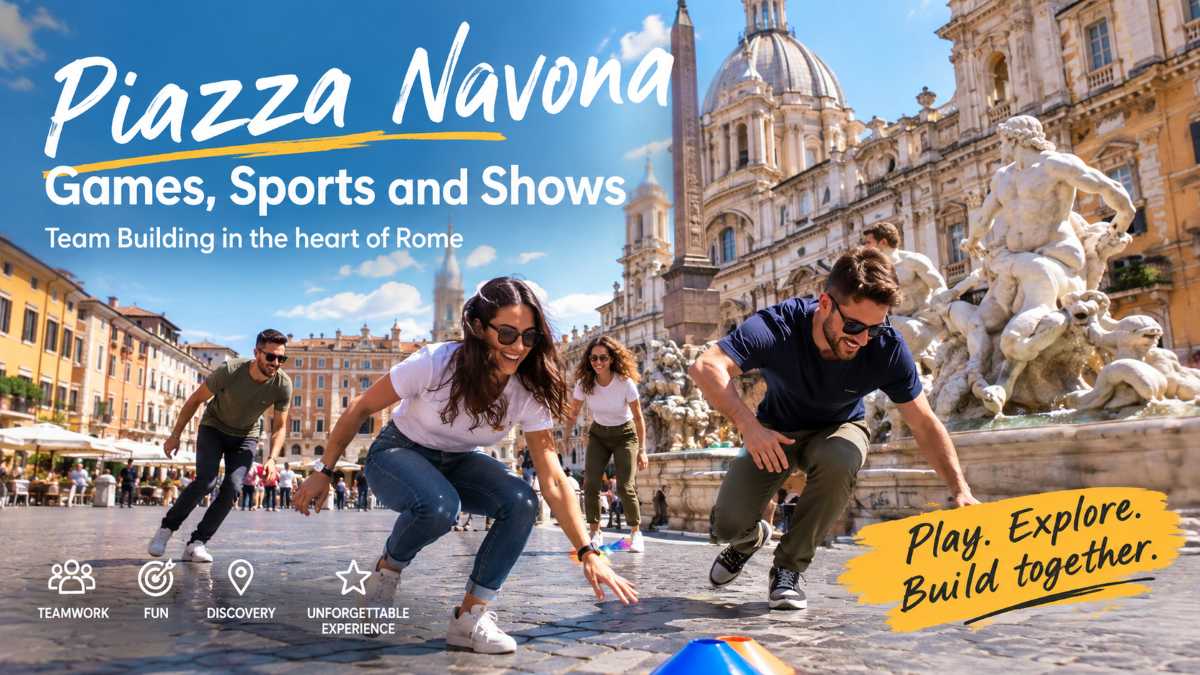
A company group can cross the square by observing architectural details, challenging one another in an urban game, searching for hidden clues among the lanes of the historic center, taking creative photo challenges, doing orientation games, carrying out creative performances, or taking part in activities inspired by the city’s history.
The result is an experience that brings together games, sports, culture, entertainment and collaboration, turning a simple stroll in the center of Rome into a shared adventure.
From ancient stadium to contemporary stage
To understand the potential of Piazza Navona, you need to start with its history.
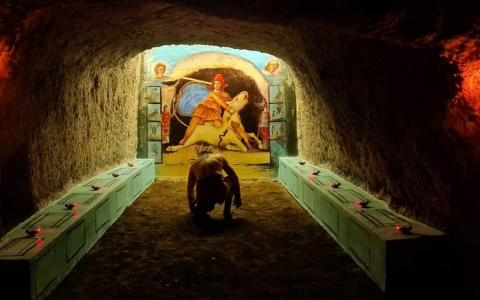
The square occupies the area that once belonged to the Stadio di Domiziano, a structure meant for entertainment and sports competitions. The size and shape of the ancient arena are still readable in today’s urban layout, and some archaeological remains are located several meters below street level.
The relationship between this place and play, then, is not a modern gimmick.
For centuries, Piazza Navona has actually been the setting for popular festivities, races, amusement rides and public events. During the summer, between the 17th and the mid-19th century, the square was even partially flooded to create a place for refreshment and fun.
This long tradition makes Piazza Navona a particularly striking environment for designing hands-on activities.
A team doesn’t simply enter a square: it enters a place that, for nearly two thousand years, has been associated with collective participation, entertainment and competition.
Piazza Navona and team building: the city becomes the playing field
Let’s imagine a group of colleagues arriving at Piazza Navona.
At first, everyone looks at the Fountain of the Four Rivers, the façade of Sant’Agnese in Agone, Palazzo Pamphilj and the other buildings surrounding the space.
Then the first challenge comes.
One team must identify an architectural detail. Another must reconstruct a story using some clues. A third must create a creative photograph. Another team still must reach the next point on the route using a series of coordinates or directions.
In just a few minutes, the perception of the space changes.
What once seemed simply to be one of Rome’s most beautiful squares becomes an interactive map.
This is one of the most interesting features of urban games: the environment is no longer just the backdrop for the activity, but becomes an integral part of the game.
Amazing Race: running, observing, deciding
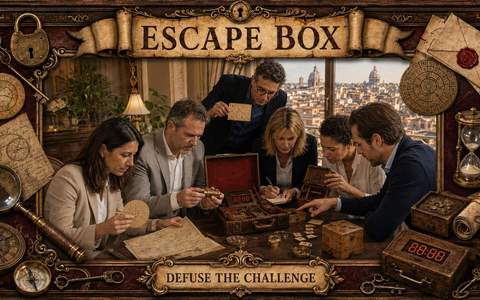
One of the most suitable formats for this kind of experience is the Amazing Race, which combines treasure hunt, city game and team building.
The route can start from Piazza Navona and develop through the historic center, involving symbolic places and different neighborhoods.
The real challenge is not simply getting there first.
Teams must decide, distribute tasks, interpret clues, manage time and—above all—communicate.
It’s exactly this element that turns an apparently simple game into a team-dynamics development activity.
[In-depth: Amazing Race and urban games]
The Fountain of the Four Rivers: a perfect starting point
In the center of the square, the Fountain of the Four Rivers dominates, one of Gian Lorenzo Bernini’s most famous masterpieces.
The fountain represents four great rivers associated with the continents known at the time: the Danube for Europe, the Ganges for Asia, the Nile for Africa, and the Río de la Plata for the Americas.
The monument is also particularly interesting from a team-building perspective because it contains a fundamental concept: diversity that builds a whole.
Four different representations, four territories, four identities, brought together within a single composition.
It’s a perfect metaphor for talking about work groups.
Each participant brings different skills, personalities, experiences and points of view. The value of a team doesn’t come from making everyone the same, but from the ability to put these differences into relation.
So an observation test in front of the fountain can turn into a real collaboration activity: recognizing symbols, linking elements, solving riddles and reconstructing a story requires individual attention, but also collective discussion.
The game of details
The Fountain of the Four Rivers also offers many elements that can be used to create a photo hunt or an observation challenge.
Animals, plants, sculptures, symbols and architectural details can become part of a sequence of clues.
The team that observes best can gain an advantage.
The one that communicates best can solve the riddle first.
The one that assigns tasks correctly can complete the challenge in less time.
In this way, art becomes play and play becomes a training ground for relational skills.
Sant’Agnese in Agone: when history becomes entertainment
Opposite the fountain is the Church of Sant’Agnese in Agone, another key element of the Piazza Navona setting.
The current building was begun under Innocent X and later modified by Francesco Borromini, who strongly shaped its façade and architecture.
The presence of the church also allows you to introduce a narrative dimension into the route.
A simple visit can, for example, turn into a test in which participants must reconstruct a historical episode through clues placed along the route.
Or you can turn the relationship between Bernini and Borromini into a creative challenge.
Two teams can receive two different points of view and try to support their interpretation through a mini performance.
The result is a sort of urban theater, where participants are no longer just spectators but become protagonists.
Bernini vs Borromini: a perfect challenge for the team
Rome is full of artistic rivalries, legends and anecdotes.
The relationship between Bernini and Borromini offers one of the best-known narrative ideas and can be used to create an original competition.
The famous story, according to which some statues of the Fountain of the Four Rivers would have been designed as a kind of provocation toward the Church of Sant’Agnese, belongs to the city’s legendary tradition—but precisely for that reason it’s perfect for a game.
Teams could be given a set of statements and asked to distinguish between history, legend and interpretation.
Or they could create a short theatrical scene in which they defend one of the two artists.
Competition thus becomes an exercise in creativity, communication and argumentation skills.
Team games between art, movement and creativity
Piazza Navona allows you to develop many different types of activities.
You don’t necessarily need to organize a traditional sports competition.
The concept of sport can be reinterpreted through short, dynamic and accessible challenges for people with different levels of physical preparation.
Urban relays
A relay can be built through a series of micro-challenges placed along the route.
It doesn’t necessarily mean running: a team may have to solve a riddle, another complete a photo challenge, another recognize a monument, or reconstruct a sequence.
Speed matters, but it’s not the only determining factor.
Orienteering in the historic center
The center of Rome is an ideal setting for orientation activities.
Piazza Navona can represent one of the checkpoints of a larger route that involves other POIs in the historic center, such as Campo de’ Fiori, the Pantheon, Piazza della Rotonda, Piazza di Pasquino and the streets of Rione Parione.
The group must decide which route to follow and how to distribute its resources.
In this way, the city becomes a giant chessboard.
Photo challenge
One of the most immediate formats is the photo challenge.
Each team receives a list of subjects, emotions or situations to represent.
It’s not enough to take a photo: you must interpret the assignment.
A fountain can become the symbol of collaboration. A statue can represent a group member. An architectural detail can become the central element of a story.
Creativity becomes the true evaluation criterion.
Street artists and the value of performance
Piazza Navona has always had a strong relationship with entertainment.
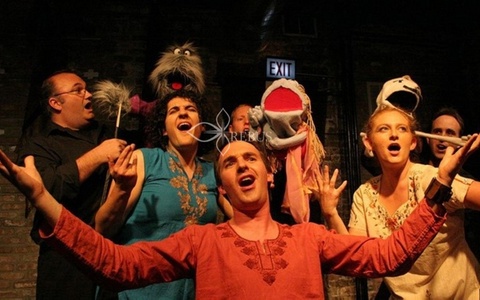
The presence of artists, portrait-makers and performers helps create an atmosphere in which the audience is never completely separated from what’s happening.
This feature can also be leveraged in a corporate activity.
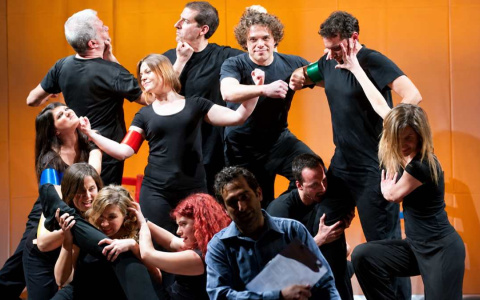
A team can be given a few minutes to prepare a small performance.
You don’t need to be actors.
In fact, the most interesting results often come exactly when people used to very structured professional roles suddenly have to step out and play along.
Someone will suggest the idea.
Someone else will build the story.
A participant will think about the visual part.
Another will handle the interpretation.
And someone—maybe initially more shy—could become the protagonist.
It’s in these moments that team building produces one of its most interesting effects: it creates a space where people can show themselves differently than in the normal work context.
From play to collaboration: what you bring back to the company
The value of an activity in Piazza Navona shouldn’t be measured only by fun.
A good team building should leave something behind even after the experience is over.
Activities can be designed to train different skills:
-
communication;
-
listening;
-
leadership;
-
problem solving;
-
time management;
-
decision-making ability;
-
creativity;
-
collaboration;
-
mutual trust;
-
handling unexpected situations.
A team that, during a treasure hunt, realizes it’s losing time because everyone is trying to take charge can recognize a similar dynamic in business life too.
A group that achieves an excellent result because it assigns roles quickly can instead discover an effective organizational model.
So the game becomes a safe environment in which you can observe group dynamics without immediately turning them into a corporate problem.
Piazza Navona’s POIs as narrative stops
One of the most interesting elements in designing urban team building is the ability to use Point of Interest as chapters of a story.
Piazza Navona can be the heart of the route, while the surrounding points of interest become the next stops.
Fontana del Moro
Located in the southern part of the square, the Fontana del Moro can become a stop dedicated to observation and visual memory.
Fontana del Nettuno
At the northern end stands the Fontana del Nettuno, another easily recognizable element that can be included in photo challenges, quizzes or clue-based routes.
Palazzo Pamphilj
The large palace that dominates part of the square allows you to introduce into the story the history of the Pamphilj family and the Baroque period as well.
Pasquino
Not far away you’ll find Pasquino, one of Rome’s famous talking statues.
It’s a particularly interesting POI for activities dedicated to communication, satire and creativity.
For example, a group could invent its own “Pasquino message” aimed at the world of work.
Campo de’ Fiori
The route can then continue toward Campo de’ Fiori, creating a real connection between two of the most characteristic squares in the historic center.
In this way, Piazza Navona is not considered as an isolated place, but as the central point of a broader urban experience.
Piazza Navona at night: when team building becomes entertainment
The same activity can completely change the atmosphere when it’s organized in the late afternoon or in the evening hours.
The lights, historic buildings and fountains create a particularly captivating setting.
A treasure hunt can take on a more theatrical tone.
A photo route can become a challenge dedicated to light and perspectives.
A narrative test can turn into a small urban murder mystery.
A performance can conclude the day right in the heart of the square.
The advantage is that you can build a real narrative arc: start, discovery, competition, surprise and finale.
A great open-air theater for team building in Rome
Piazza Navona shows that team building doesn’t necessarily have to take place in a meeting room, a hotel facility, or an event-dedicated space.
Sometimes it’s the city itself that offers the best stage.
Here, Roman history meets Baroque; art meets play; movement meets creativity; and competition meets collaboration.
The result can be an experience built around people, not just around an activity.
Because the real goal isn’t only finding the treasure, getting there first, or solving a riddle.
It’s discovering how the group reacts when the scenario changes.
Who takes the initiative?
Who observes?
Who listens?
Who proposes solutions?
Who manages to stay calm when things don’t go according to plan?
These are the questions that turn a game into a team-building experience.
And Piazza Navona, with its history of games, competitions, festivities and entertainment, seems to have been waiting for centuries to become a big playing field again.
Sources and further reading
To learn more about the history of Piazza Navona, the Stadio di Domiziano, the Fountain of the Four Rivers and the other monuments mentioned, the official fact sheets from Turismo Roma dedicated to the square, the Fountain of the Four Rivers, the Fountain of Neptune, Sant’Agnese in Agone and the itinerary devoted to Bernini’s sites are especially useful.
For those who want to turn the historic center into a true game route, the Amazing Race format is particularly suitable because it combines treasure hunt, urban game and discovery of the city.
FAQ – Piazza Navona and team building
Is Piazza Navona suitable for a corporate team building?
Yes. Its central location, the richness of monuments and the layout of the space make it particularly suitable for urban activities, treasure hunts, photo challenges and team routes.
What activities can be organized at Piazza Navona?
Urban games, Amazing Race, treasure hunts, photo challenges, orientation activities, cultural quizzes, creative challenges and narrative routes can all be designed.
Is it possible to connect Piazza Navona with other places in Rome?
Yes. Piazza Navona can be included in a broader itinerary together with the Pantheon, Campo de’ Fiori, Piazza di Pasquino and other POIs in the historic center.
Do the activities necessarily have to be sports-based?
No. The concept of sport can be reinterpreted through dynamic challenges, urban relays, orientation games and activities that combine movement and problem solving.
Is Piazza Navona also suitable for international groups?
Yes. The activities can be built with visual instructions, photo challenges, riddles and dynamics that are easy to understand even for participants of different nationalities.
What is the real value of team building in Piazza Navona?
The value lies in combining fun, discovering Rome and observing group dynamics, while stimulating communication, collaboration, creativity and decision-making ability.
If you want to live this experience or something similar, click here—you’ll find our proposals:
Request a free quote
Request a free quote and receive all the information about your Team Building experience.