













































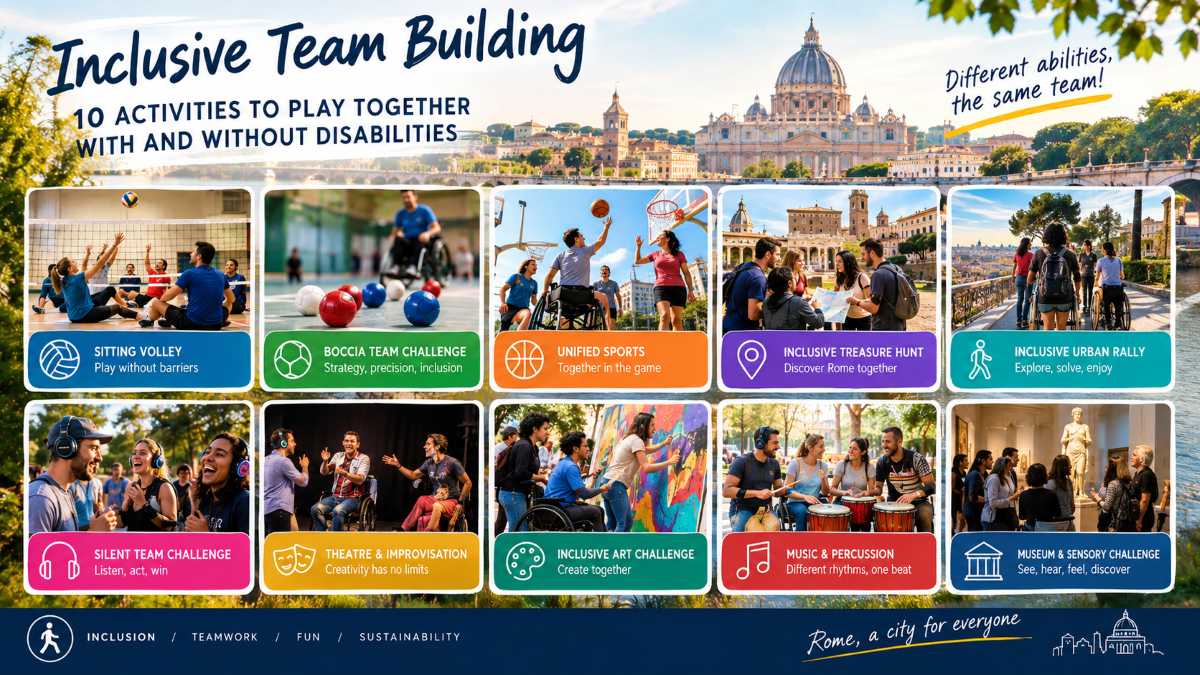
Inclusive Team Building: 10 activities that allow people with and without disabilities to play together
A team steps onto the field.
There are no parallel paths, “special” activities for someone, or participants waiting their turn on the sidelines of the game.
There are different people, different skills, and one shared goal.
This is the idea behind Inclusive Team Building: designing experiences in which people with and without disabilities can collaborate, have fun, and compete together, with rules, tools, and environments designed to enable truly meaningful participation.
In the business world, the issue of inclusion is becoming increasingly important. But an inclusive event does not simply come from choosing an accessible venue or adding a person with a disability to an activity that already exists.
The real challenge is different:
how can we design a game in which everyone has an important role?
Sport, creativity, technology, culture, music, and outdoor activities can offer many possibilities. The starting point, however, must always be the person: needs, preferences, functional abilities, communication methods, and environmental conditions must be assessed before the event.
The UN Convention on the Rights of Persons with Disabilities, Article 30, also recognizes the right to participate on an equal basis in cultural life, recreation, leisure, and sport, and it also references access to sporting and recreational activities.
The inclusive team building therefore becomes a concrete opportunity to turn this principle into experience.
What is Inclusive Team Building?
An inclusive team building activity is a corporate activity designed to allow people with different characteristics and abilities to take part in the same experience.
It doesn’t necessarily mean that everyone must do exactly the same thing in the same way.
It means that everyone must be able to contribute to the group’s outcome.
This distinction is essential.
In an orienteering race, for example, one person might focus on navigation, another on reading clues, another on photography, and another on communicating with the rest of the team.
The strength of the group comes precisely from complementarity.
From “participation” to “belonging”
A truly inclusive activity doesn’t limit itself to asking:
“Can the person participate?”
The more interesting question is:
“Can the person feel like they belong to the team?”
It makes a substantial difference.
The Unified Sports® model of Special Olympics is one of the best-known examples: people with and without intellectual disabilities train and compete in the same team, working toward shared goals. Special Olympics also emphasizes the importance of “meaningful involvement,” meaning that every player has a significant role during the activity. (SpecialOlympics.org)
This principle can also be applied to the world of corporate team building.
10 Inclusive Team Building Activities
There is no single activity that is universally accessible to all people.
A format must be adapted to the real group taking part.
So the ten proposals below represent design formats that can be modified based on the participants’ motor, sensory, cognitive, and communication needs.
1. Sitting Volley: the team plays on the same level
The Sitting Volley is probably one of the most immediate examples of a sport in which people with and without disabilities can share the court.
It’s played seated on the floor, with a court and net adapted from traditional volleyball.
The Italian Paralympic Committee describes it as a sport that can be practiced together by people with physical disabilities and people without disabilities, while FIPAV presents it as a discipline focused on cooperation and inclusion. (Comitato Italiano Paralimpico)
The business challenge
Teams can face each other in short matches, alternating play moments with mini-challenges on communication.
The score doesn’t necessarily have to depend only on points scored.
Rewards can also be given for:
-
collaboration;
-
communication;
-
role rotation;
-
strategy;
-
involvement of all players.
The result is a sports activity in which individual difference becomes a natural part of the team.
2. Boccia Team Challenge
Boccia is a particularly interesting discipline for inclusive team building because it allows people to work on accuracy, strategy, and control of movement.
The Italian Paralympic Committee includes it among Paralympic sports and in 2026 the CIP also reported an agreement between the Italian Bocce Federation and UILDM aimed at spreading Paralympic boccia practice and promoting inclusion and access to sport. (Comitato Italiano Paralimpico)
Strategy before strength
The team must decide:
who throws?
From which position?
Which trajectory to choose?
Which ball to use?
Which player should attempt the decisive shot?
In this way, physical performance is not the only determining factor.
Strategy becomes essential.
For a company, it’s possible to turn the match into a Boccia Team Challenge by introducing bonuses linked to the ability to collaborate and plan together.
3. Unified Basketball and Team Sports
Basketball, soccer, volleyball, and other sports can be transformed into inclusive experiences through formats inspired by the principles of Unified Sports.
Special Olympics uses exactly this approach to field athletes with and without intellectual disabilities. In 2026, the model also took center stage in the Unified Football World Cup in Paris, with teams made up of athletes and Unified Partners. (SpecialOlympics.org)
It’s not just about who scores
The corporate format can include rules that encourage ball circulation and the involvement of everyone.
For example:
a goal can be valid only after a certain number of players have taken part in the action.
So the team must learn to look for the teammate—not just the goal.
The focus shifts from individual performance to building the collective outcome.
4. Inclusive Treasure Hunt in Rome
Rome can become a huge game map.
An inclusive treasure hunt can be built using photographs, QR codes, audio, simplified texts, accessible maps, and multisensory clues.
The route can be developed in selected locations using information from the Rome Accessible portal, which collects verified accessibility data for museums, monuments, parks, and other points of interest. (Turismo Roma)
A clue, many ways to find it
The same clue can be available in different formats:
-
text;
-
audio;
-
image;
-
symbols;
-
QR code;
-
audio description;
-
tactile element, when appropriate.
The team then has to decide which method to use.
There is no “support” participant.
Every person can become the key to solving part of the mission.
5. Inclusive Urban Rally
Another option is to turn part of the city into an accessible urban rally.
Not a race for speed, but a mission with checkpoints.
The route can involve cultural and urban POIs, selected in advance based on the group’s characteristics.
Possible areas to evaluate include, for example, Villa Borghese, the Capitoline Museums, the Ara Pacis Museum, or other places included in the Rome Accessible network. (Turismo Roma)
The city as a game platform
Each checkpoint offers a different test.
A photograph.
A riddle.
A sound recognition challenge.
A historical question.
A puzzle.
An orienteering challenge.
A short creative mission.
The route must be designed by checking in advance surfaces, slopes, distances, restrooms, entrances, and communication methods.
Accessibility cannot be left to improvisation.
6. Silent Team Challenge
Headphones become the tool for a communication challenge.
But this time the game isn’t simply about listening to music.
Each team receives a set of audio messages and must turn them into coordinated actions.
Part of the group may receive visual information.
Another part receives sound information.
And another part receives a sequence of symbols.
The goal is to reconstruct the mission together.
Communication without a single language
The format allows you to work on the concept that a team doesn’t communicate through a single channel.
Words, gestures, images, sounds, symbols, and digital tools can all become part of the same strategy.
It’s especially interesting for international and multinational teams.
7. Inclusive Theatre and Improvisation Workshop
Theatre can become a powerful team-building tool because it doesn’t necessarily require athletic performance.
A scene can be built through voice, expression, movement, images, or objects.
The format can be designed so that each participant chooses their own channel of expression.
“Yes, and…” for everyone
The improvisation principle “Yes, and…” becomes a team rule.
Each participant must accept the other person’s idea and add something.
No one can erase what was contributed before.
The result is a collective story.
The activity can be further adapted by adding subtitles, LIS sign-language interpreters, visual supports, or alternative participation methods, based on the group’s specific needs.
8. Inclusive Art Challenge
A large table.
Canvases, colors, materials, photographs, textures, and objects.
The mission: create a collective artwork.
Not a painting made up of many small individual works, but one single piece created by the team.
Each participant leaves a trace
Those who prefer working with color can take care of painting.
Those with greater manual skills can build three-dimensional elements.
Those who prefer composition can organize the shapes.
Those with narrative skills can build the concept.
The final result becomes a very simple metaphor:
the artwork exists because all the contributions that make it up exist.
In Rome, a format like this can also be developed in a cultural or creative location selected among the spaces that the Rome Accessible portal highlights for different accessibility needs. (Turismo Roma)
9. Inclusive Music & Percussion
Music allows you to build a team even without relying exclusively on words.
Drums, percussion, simple instruments, claps, and rhythmic sequences can be used to create a collective performance.
From noise to music
Each participant receives an instrument or a role.
One group keeps the rhythm.
Another creates a sequence.
Another introduces a variation.
Another still coordinates the performance.
The challenge is to turn different contributions into a single composition.
For people with different communication methods, visual signals, vibrotactile cues, or gestural signals can be provided, always based on the group’s actual needs.
10. Museum & Sensory Challenge
The last proposal takes the team inside a museum or a cultural space.
Not for a traditional guided tour.
The team must solve a mission.
In Rome, many POIs are included in the Rome Accessible system, including the Capitoline Museums, Centrale Montemartini, Ara Pacis, the Casal de’ Pazzi Museum, the National Gallery, and other cultural spaces with specific information about available services. (Turismo Roma)
Look, listen, recognize
The challenge can combine:
-
visual details;
-
audio descriptions;
-
available tactile elements;
-
historical questions;
-
photographs;
-
maps;
-
puzzles;
-
storytelling.
The team must piece together information obtained through different channels.
So the museum becomes a giant multisensory puzzle.
How to truly design an accessible Team Building activity
Choosing an activity isn’t enough.
Inclusion must be designed before the event.
1. Know the group
Before defining the program, it’s essential—while respecting privacy—to gather the information necessary about accessibility needs.
You shouldn’t start from assumptions about disability.
A person in the same disability category as another person may have completely different needs.
2. Analyze the venue
The venue must be checked in a concrete way.
You need to consider:
-
access points;
-
elevators;
-
ramps;
-
restrooms;
-
flooring;
-
distances;
-
parking;
-
transport;
-
lighting;
-
acoustics;
-
break spaces;
-
signage.
The official portal Rome Accessible distinguishes, among other things, accessible entrance, restrooms, wheelchair route, and services for people who are blind or have low vision as well as deaf people. (Turismo Roma)
3. Provide more than one communication method
A briefing that is exclusively oral can create a barrier.
For this reason, it’s possible to add:
-
text;
-
images;
-
pictograms;
-
captioned videos;
-
audio;
-
maps;
-
practical demonstrations.
The goal is to offer more than one “doorway” to the same information.
4. Design roles that are truly meaningful
The most important principle is to avoid turning a person into nothing more than the recipient of help.
The Unified Sports model insists on the meaningful participation of all players. (SpecialOlympics.org)
In team building, this can mean assigning real responsibilities:
captain, strategist, navigator, photographer, storyteller, time keeper, observer, coordinator, or player.
The role must have a real impact on the outcome.
Watch out for “surprise” activities
A common mistake is deciding to adapt an activity only on the day of the event.
That’s not enough.
A route with stairs doesn’t automatically become accessible just because someone helps people overcome them.
A game based exclusively on oral communication doesn’t become inclusive just because it’s explained more slowly.
A sports activity doesn’t become inclusive simply by placing a person with a disability on the team.
Inclusion must be built into the design of the experience.
Rome as a lab for inclusion
Rome offers an extraordinary wealth of places that can be turned into team-building settings.
The official portal dedicated to Rome Accessible includes parks, museums, monuments, and points of interest, allowing you to verify different accessibility characteristics. Among the places included are Villa Borghese, Villa Torlonia, the Capitoline Museums, the Colosseum Archaeological Park, the Archaeological Park of Ostia Antica, Centrale Montemartini, Cinecittà, and many others. (Turismo Roma)
Also Villa Borghese, for example, features accessible entrances and paved paths indicated among the services available for wheelchair mobility, while still requiring a prior assessment of the actual route. (Turismo Roma)
This makes it possible to design very different activities:
a cultural treasure hunt;
a photo rally;
a sensory route;
an urban challenge;
an art workshop;
a music challenge.
The POI isn’t simply the location.
It becomes part of the game.
The real goal: playing together
The value of inclusive team building isn’t measured only by whether everyone managed to complete a challenge.
It’s measured by how much the group truly collaborated.
One person may have a skill that another doesn’t.
A participant might spot a detail the others didn’t notice.
Another may find the strategic solution.
Another still may be essential in communication.
The team works when these differences become resources.
That’s exactly the most interesting cultural shift.
It’s not about creating a “for disabled people” game.
It’s about creating a game in which people’s diversity is part of the solution.
Inclusive Team Building: from diversity to collaboration
Sports, art, music, culture, and technology can become tools for building more inclusive corporate experiences.
Sitting Volley shows how a sport can be structured to bring together people with and without disabilities. Boccia puts strategy and precision at the center of the game. Unified Sports show how people with and without intellectual disabilities can train and compete together. (Comitato Italiano Paralimpico)
But the same principle can be applied to a treasure hunt, an art workshop, a music challenge, or a cultural visit.
The question shouldn’t be:
“What activities can we do despite disability?”
The question can become:
“What activities can we design so that each person’s characteristics contribute to the team’s success?”
It’s from this perspective that the true Inclusive Team Building is born.
An experience in which there are no “A team” players and “B team” players.
There is a team.
And the challenge is to win together.
If you want to experience this or other similar experiences, click here—you’ll find our proposals:
Request a free quote and receive all the information about your Team Building experience.
Request a free quote and receive all the information about your Team Building experience.https://teambuildingrome.com/ask-for-quote.php




