













































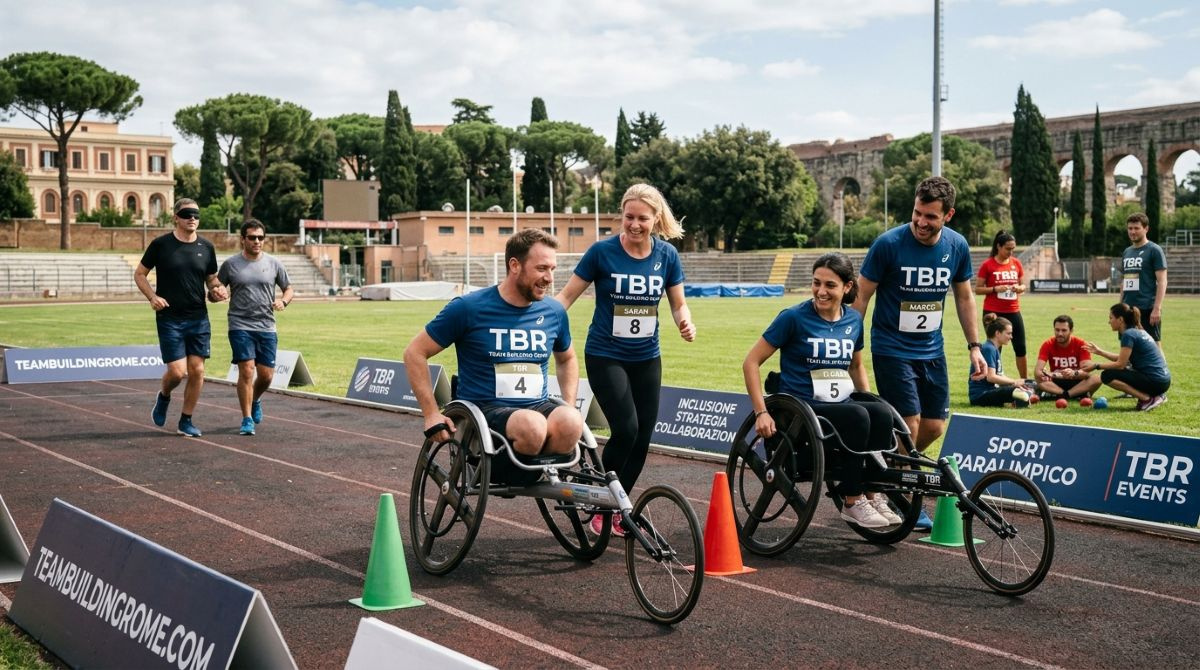
Paralympic Sport and Team Building: inclusion, strategy and collaboration
When sport becomes a language to build the team
A ball rolling slowly.
A wheelchair that changes direction.
A teammate who watches.
Another one who suggests a trajectory.
A team that must decide, in just a few seconds, what strategy to adopt.
You don’t need to run to create intense competition. You don’t need to jump, score, or come first to experience what it really means to work together.
Paralympic Sport offers a particularly interesting perspective even in the world of corporate team building: it shows how technique, strategy, communication and collaboration can become decisive when the outcome depends on the ability to coordinate people with different characteristics and roles.
From this idea comes Paralympic Sport and Team Building, an experience designed to bring into the corporate context some principles of Paralympic sport through accessible, adapted activities built around collaboration.
The goal is not to imitate a disability condition.
The goal is to understand—through play and sport—how important accessibility, communication, adaptation, trust and the recognition of individual skills are.
Rome and the history of Paralympic sport
The Eternal City where a new story of sport began
To develop this theme in Rome, there is an extraordinarily meaningful historical link.
In 1960, Rome hosted the first modern Paralympic Games, an event that marked a fundamental moment in the international development of Paralympic sport.
The program included eight disciplines, including athletics, swimming, wheelchair fencing, wheelchair basketball, table tennis, archery, billiards, and the so-called dartchery. (Paralympic)
Today, the Paralympic movement includes a much broader sporting landscape, with disciplines such as boccia, goalball, sitting volleyball, wheelchair basketball, wheelchair rugby, para badminton, para canoe, para cycling, para swimming and para athletics. (Paralympic)
Rome therefore offers a particularly evocative setting.
The city where that story took shape can become today the stage for a corporate experience dedicated to inclusion and collaboration.
What Paralympic Team Building really means
Don’t simulate disability—learn from the sporting experience
A key aspect in designing an activity like this concerns how it is presented.
A responsible team building initiative should not turn disability into a simple obstacle to “try out” for a few hours.
So it’s not about blindfolding someone to let them experience blindness, or asking someone who doesn’t normally use a wheelchair to use one with the idea of “understanding what it’s like to be disabled.”
A more conscious approach instead starts from the real Paralympic sport, from its rules, its strategies, and its ability to create competitive conditions through specific systems.
In Para sport, in fact, classification is specific to each discipline and serves to minimize the impact of disability on sporting performance, so that competition is determined as much as possible by sports factors such as technique, preparation, strategy and skill. (Paralympic)
It is exactly this principle that can become interesting for a company.
Not everyone has to do the same thing to contribute to the same result.
The challenge: one team, more roles, one strategy
The first exercise is learning how to communicate
Let’s imagine a corporate group divided into small teams.
In front of them, there is a series of adapted sporting challenges.
Each activity has clear rules.
But the real element of the challenge is not only individual performance.
The team has to decide.
Who performs?
Who observes?
Who communicates?
Who defines the strategy?
Who changes the plan when something doesn’t work?
Who keeps the group focused?
The result comes from the combination of all these functions.
It’s a mechanism very similar to that of a business organization.
A complex project rarely depends on a single person.
It depends on the ability to connect different skills.
Disciplines that can inspire Team Building
Boccia: precision, strategy and control
Boccia is one of the most interesting disciplines for team building because, although it seems simple, it hides a strong strategic component.
The team must evaluate distances, trajectories and positioning.
A wrong choice can completely change the scenario.
Transferred into the business world, the dynamic allows you to work on:
-
situation analysis;
-
planning;
-
precision;
-
communication;
-
error management;
-
adaptability.
Not always is the best solution the fastest one.
Sometimes it’s the one that helps build the best situation for the next move.
Goalball: listen before acting
When information comes through sound
Goalball offers another particularly interesting perspective.
The discipline was created for athletes with visual impairments and uses a ball equipped with bells, allowing players to orient themselves through sound.
In a corporate setting, the activity can be proposed through appropriate sports formats and with the guidance of qualified professionals.
The central theme becomes listening.
When visual information is not enough, the group must develop other communication channels.
The voice takes on a fundamental role.
Instructions must be brief.
Trust becomes important.
Communication must be precise.
It’s a powerful metaphor for contemporary work too, where information is often fragmented and comes from different channels.
Sitting Volleyball: coordination and space
A team that must move like a system
Sitting volleyball allows you to work on collaboration through team play in which movement and positioning in space have different characteristics compared to traditional volleyball.
The strength of the format is not in comparing who is faster.
It lies in the need to continuously read the situation.
One teammate covers an area.
Another one anticipates a possible play.
A third one communicates.
The point comes from the ability to coordinate.
It’s a perfect dynamic for introducing the concept of team awareness: not only seeing what I’m doing, but understanding what’s happening around me.
Wheelchair Basketball: strategy and decision speed
The court becomes a map of possibilities
Wheelchair basketball is one of the best-known examples of Paralympic sport.
The discipline requires reading the space, collaboration, passing, positioning and quick decisions.
In corporate team building, there’s no need to replicate a professional competition.
The format can be adapted into a fun sports activity in which the group faces small challenges such as:
-
passing;
-
precision;
-
shooting;
-
movement;
-
communication;
-
strategy;
-
time management.
The most interesting part comes when teams realize that an individual play is rarely enough.
The solution comes from the teammate.
The real challenge: changing strategy
When plan A doesn’t work
One of the most interesting moments in a sports team building experience happens when the initial strategy doesn’t produce the expected result.
A team may have a great plan.
But if the context changes, the plan must change with it.
This is where sport becomes an extremely effective metaphor for work.
Changing markets.
Clients with different needs.
New technologies.
International teams.
Projects that change goals and timelines.
In all these cases, having a strategy isn’t enough.
You need the ability to adapt without losing the final objective.
Inclusion: designing activities that are truly accessible
Accessibility is not a final detail
A team building dedicated to Paralympic sport should be designed from the start according to accessibility criteria.
This means considering:
-
location features;
-
accessibility of spaces;
-
routes;
-
services;
-
materials;
-
communication;
-
activity schedules;
-
individual needs;
-
participation modes;
-
the presence of qualified staff.
Inclusion is not simply adding a person with a disability to an already existing activity.
It means designing the experience so that people with and without disabilities can truly participate in the same project, with any necessary adaptations.
This principle also directly connects to Inclusive Team Building pathways, in which accessibility is considered an integral part of experience design.
Rome as a playing field
From sport to discovering the city
One of the advantages of organizing a team building in Rome is the possibility to combine sport, culture and local territory.
The route can be developed across different locations, selected based on the group’s characteristics and accessibility needs.
Among the settings that can help shape the event narrative, we find the Foro Italico, an area historically linked to sport in the capital; the Terme di Caracalla; the Parco degli Acquedotti; some equipped sports facilities; and other urban or green spaces suitable for group activities.
The place can become part of the challenge.
A challenge can take place outdoors.
An activity can be followed by a cultural walk.
The route can end with a social moment.
In this way, the sports experience becomes part of a broader day dedicated to Rome.
From sport to corporate culture
Skills that emerge during play
A sports activity makes it possible to observe behaviors that often remain less evident in everyday working life.
Who communicates clearly?
Who tends to make decisions quickly?
Who listens?
Who can synthesize information?
Who encourages the group?
Who identifies an alternative solution?
Who can stay calm when the initial plan doesn’t work?
Team building shouldn’t turn into a psychological test.
Instead, the value lies in the opportunity to experience a concrete situation and then reflect on it afterward.
The debriefing moment therefore becomes essential.
The question isn’t only:
“Who won?”
But:
“How did we work together?”
Paralympic Sport and inclusive leadership
Leading doesn’t necessarily mean standing in front
One of the most interesting reflections concerns leadership.
During one challenge, a leader may emerge.
But in the next one, another person might have the decisive skill.
So the group learns to distribute responsibilities and leadership based on the situation.
It’s a particularly current concept in modern organizations.
Leadership can be:
-
situational;
-
distributed;
-
collaborative;
-
listening-oriented;
-
skills-based.
In this sense, sport becomes a kind of lab in which to experiment with a more flexible collaboration model.
A possible day of Paralympic Sport Team Building
From the introduction to the final challenge
A day can be structured through different phases.
1. Welcome and introduction
The group is welcomed and the meaning of Paralympic sport is presented, with particular attention to the history, disciplines and values of the experience.
2. Team formation
Participants are divided into small, balanced teams.
3. Discovering the disciplines
Teams try out different activities inspired by Paralympic disciplines.
4. Team challenges
The challenges become progressively more complex and require greater coordination.
5. Strategic Round
Teams must develop a strategy before tackling the final challenge.
6. Final Challenge
The skills acquired are brought together in a concluding challenge.
7. Debriefing
The group analyzes the dynamics that emerged during the experience.
8. Final sharing
The day ends with a reflection on the concepts of inclusion, collaboration and valuing differences.
What you will discover
The power of communication
An effective team doesn’t simply communicate a lot: it communicates the right information at the right time.
The value of listening
Listening becomes an operational skill, not only a relational one.
The importance of adaptation
An effective strategy must be able to change when conditions change.
Distributed leadership
The reference role can change depending on the competence needed.
Accessibility as design
An inclusive experience is created through the design of spaces, rules and participation methods.
The value of differences
Different skills and traits can become a resource for achieving a common goal.
Paralympic Sport and Team Building: a new idea of inclusion
The experience can be particularly interesting for companies working on Diversity, Equity & Inclusion, organizational culture, cross-generational collaboration, team bonding and accessibility.
But its value doesn’t depend on the ability to simply tell a “different” day story.
The real value comes from the quality of the design.
An inclusive team building should not ask participants to try for a few hours what it would be like to “live with a disability.”
Instead, it should allow everyone to discover how team dynamics change when communication, accessibility, strategy and collaboration are valued.
It’s an important difference.
And it’s exactly this difference that makes the format more respectful, contemporary and consistent with the meaning of Paralympic sport.
Rome 1960: from the past to the future
A story that began right here
Finally, there’s a suggestion that makes Rome especially suitable for this theme.
In 1960, the city hosted the first edition of the modern Paralympic Games.
More than sixty years later, Rome can become the place where—through a corporate experience—we tell how sport can help build a culture that is more attentive to collaboration and accessibility.
This isn’t about replicating a Paralympic competition.
It’s about taking some of its principles and turning them into a group experience.
The precision of boccia.
Goalball listening.
Sitting volleyball coordination.
Wheelchair basketball strategy.
Different disciplines.
Different rules.
Different skills.
But one common element:
the team works when every person can contribute to the result.
The challenge isn’t arriving first. It’s arriving together.
Team Building that starts from sport and reaches people
At the end of the day, the score may be important.
But it isn’t the only outcome.
The real result can be a team that has discovered new ways to communicate.
A person who found a different role than usual.
A group that learned to listen before deciding.
A team that understood that changing strategy doesn’t mean you failed.
And above all, a new awareness:
inclusion is not a side activity of team building. It can become the very way the team is designed.
Paralympic Sport therefore offers a powerful perspective for building contemporary, respectful and engaging corporate experiences.
In Rome, this perspective also takes on a particular historical meaning.
Because right here, in 1960, an important part of Paralympic sport history began to be written.
Today, that story can become a starting point for a new team experience.




