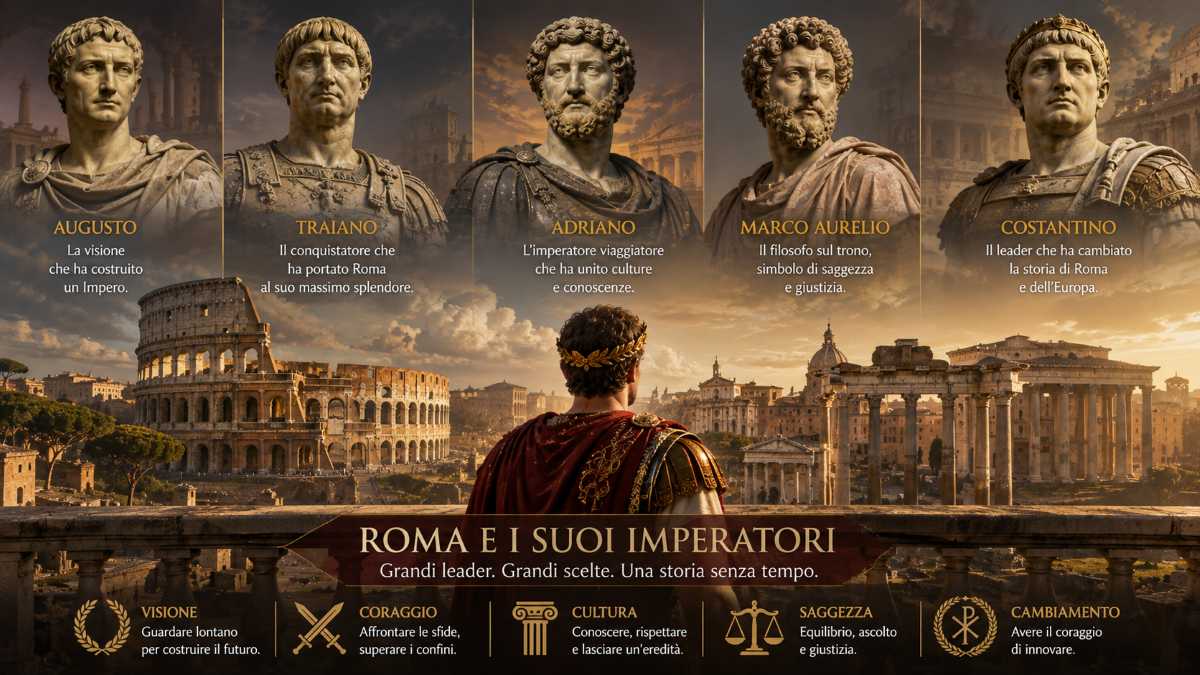
Rome Through an Emperor’s Eyes: A Journey in the Eternal City Between History, Strategy, and Team Building
Rome is not just a city to visit. It is a city to interpret. Every column, every arch, and every square tells the story of choices made by men who changed the course of history. Walking its streets means following in the footsteps of emperors who ruled the greatest empire of the ancient world.
But what would happen if, for one day, we could observe Rome through their eyes?
How would they see the Colosseum, the Imperial Forums, the Palatine Hill, or the Pantheon? What decisions would they make? What strategies would they use to lead their people?
This perspective is an extraordinary starting point for an immersive Team Building experience, capable of combining history, storytelling, gamification, and collaboration into an unforgettable event.
A Team Building Experience That Takes You Back Two Thousand Years
Each team receives a mission.
It is not a simple treasure hunt.
It is a mission assigned directly by the emperor.
The challenges to overcome do not require strength, but observation skills, logic, communication, and team spirit.
Participants become imperial advisers, explorers, strategists, and ambassadors.
Every monument holds a clue.
Every square tells a political choice.
Every route leads to a new discovery.
So Rome becomes an enormous historical stage.
A Story That Begins on the Palatine Hill
The sun lights up the ruins of the Palatine Hill.
The team observes the city from above.
Before them lies the heart of ancient Rome.
A scroll is delivered to the group.
"The Empire is at a decisive moment. Only those who know how to observe, collaborate, and choose wisely will be able to guide Rome toward a new future."
The first mission leads to the Imperial Forums.
Each stop tells a story of a different emperor.
Augustus teaches vision.
Trajan teaches the ability to innovate.
Adrian teaches the value of culture.
Marcus Aurelius teaches leadership rooted in balance.
At the end of the route, the group realizes that the true main character was not the emperor.
It was the team.
Emperors and the Lessons They Still Teach Today
Augustus: The Power of Vision
The first emperor understood that governing meant building the future.
He transformed Rome with major public works and a strategic vision designed to last for centuries.
In Team Building, this figure represents the ability to define shared goals and drive change.
Trajan: Innovation and Organization
Under his reign, the Empire reached its greatest extent.
The magnificent Market of Trajan is still today a testament to extraordinary organizational capability.
For a modern team, it highlights the importance of planning and managing resources.
Adrian: Know Before You Decide
A traveling emperor, curious and a great lover of culture, Adrian showed how important it is to observe before acting.
His philosophy inspires activities focused on listening, creativity, and discovering new perspectives.
Marcus Aurelius: Leadership Built on Balance
A philosopher before being an emperor, Marcus Aurelius reminds us that the true leader knows how to lead by example.
In Team Building, this quality emerges naturally during collaborative challenges.
Places Where You Can Relive Ancient Rome
THE SITES THAT Turn the City Into an Open-Air Classroom
Rome offers perfect settings for an immersive experience dedicated to emperors.
Among the most significant locations, we find:
Colosseum
A universal symbol of Rome’s greatness, it tells the relationship between power, spectacle, and public approval.
Imperial Forums
The political, economic, and religious center of the Empire.
Every stone preserves the memory of decisions that changed history.
Palatine Hill
According to tradition, this is where Rome was born.
Later, it became the residence of the emperors.
An ideal place to begin any narrative journey.
Markets of Trajan
Considered the first major shopping center in history, they are an extraordinary example of urban organization.
Pantheon
A masterpiece of Roman architecture, it still amazes people today for its technical perfection and harmony.
Arch of Constantine
A monument that celebrates victory and the change of an entire era.
The Skills Every Team Develops
Think Like an Emperor
Each challenge builds essential skills for everyday work.
Leadership
Guiding a team toward a shared objective.
Strategy
Analyzing the context before making decisions.
Communication
Sharing information and insights quickly.
Collaboration
Each participant contributes with different skills.
Problem Solving
Every mission requires logic, observation, and creativity.
Adaptability
Like ancient commanders, modern teams must also deal with unexpected events and changes.
Storytelling and Gamification: When History Comes to Life
Modern technologies make it possible to turn Rome into a large interactive game.
Tablets, digital maps, augmented reality, historical quizzes, and narrative missions allow participants to experience an engaging event.
They do not simply visit the city.
They become the protagonists.
Each team writes its own story.
Every decision changes the route.
Every success strengthens the group.
Why Choose a Team Building Inspired by Roman Emperors
Activities set in ancient Rome combine culture, fun, and training.
They are not just guided tours.
They are immersive experiences in which every participant becomes the protagonist of a compelling narrative.
The historical heritage of the Capital offers settings that are impossible to replicate elsewhere.
The city itself becomes a learning tool.
Every monument conveys a lesson.
Every route develops new skills.
Each team discovers that the qualities needed to govern an empire are surprisingly similar to those required to face challenges in the working world.
Because, yesterday as today, great results always come from the ability to build a strong, motivated, and united team.