













































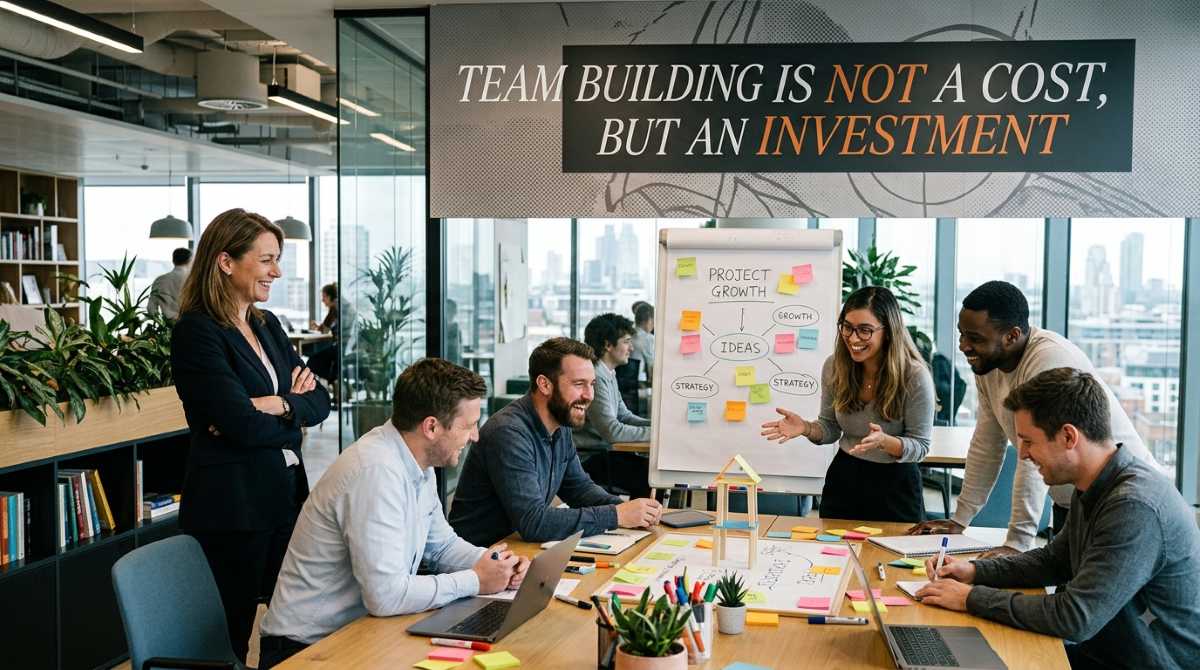
Why Team Building is an investment, not a cost
When a company evaluates a Team Building activity, one of the first questions that comes up is almost always the same: "How much does it cost?"
It’s a legitimate question.
But maybe it isn’t the right one.
The real question should be: "How much value does it generate?"
Because Team Building is not just a day away from the office, nor an occasional reward for employees. It is a strategic investment in people, relationships, and company culture.
Just as a company invests in technology, training, or innovation, it should also invest in human capital— the only element capable of turning an organization into a truly competitive team.
Value is measured over time
Many costs end the moment they are incurred.
An investment, instead, continues to produce benefits.
Team Building belongs to this second category.
A day spent together can improve communication for months.
It can encourage the creation of new collaborations.
It can reduce misunderstandings, conflicts, and operational slowdowns.
It can even help retain talent within the company.
For this reason, its value is not measured by the event price, but by the effects it produces over time.
A story that repeats in many companies
It’s Monday morning.
The meeting moves slowly.
Each department defends its own ideas.
Information arrives late.
Decisions take time.
A few weeks later, the same company takes part in a Team Building in Rome’s historic center.
The teams take on a treasure hunt between the Pantheon, Piazza Navona and Castel Sant'Angelo.
To win, you need to collaborate.
You need to listen.
You need to trust.
People start getting to know each other beyond their job roles.
They discover skills that had never surfaced in the office.
Once the experience is over, something changes.
Not because a magic happened.
But because relationships have become stronger.
And that’s exactly the return on investment.
The concrete benefits of Team Building
Improves communication
Many company issues stem from ineffective communication.
Experiential activities help participants listen better, share information, and coordinate more naturally.
Strengthens collaboration
Working together in an informal setting helps break down hierarchical barriers and fosters mutual trust.
When people get to know each other better, they collaborate better.
Increases a sense of belonging
Shared experiences create common memories.
These memories become part of company culture and strengthen employees’ sense of belonging to the organization.
Encourages Problem Solving
Each activity presents new challenges.
Teams learn to make decisions quickly, adapt to unexpected events, and find creative solutions.
Reduces stress
Getting out of routine helps restore mental energy, improving individual and collective well-being.
The return on investment (ROI)
Beyond the numbers
Many Team Building benefits can be observed in the medium and long term.
Higher productivity
A coordinated team works more efficiently.
Reduced conflicts
Better mutual understanding reduces misunderstandings and tensions.
Greater engagement
People who are involved feel valued and take part with more enthusiasm in company life.
Employer Branding
Companies that invest in people are more attractive to new talent.
Employee retention
A positive environment helps reduce turnover and keep valuable skills within the organization.
Rome: the ideal setting to invest in people
POIs that turn an activity into an experience
The Capital offers unique settings to create memorable activities.
Colosseum
A symbol of determination and history.
Pantheon
A masterpiece of engineering that inspires vision and innovation.
Piazza Navona
Perfect for dynamic, collaborative activities.
Trastevere
Its alleys encourage storytelling and team missions.
Campo de' Fiori
Ideal for observation experiences and problem solving.
Castel Sant'Angelo
The perfect backdrop for escape games and investigative games.
Villa Borghese
One of the most evocative places for outdoor activities dedicated to corporate well-being.
The skills that last
An investment in Soft Skills
Technical skills can be taught.
Interpersonal skills must be experienced.
During a Team Building, you practice:
Leadership
Communication
Empathy
Creativity
Time management
Problem Solving
Strategic thinking
Decision-making ability
These are skills that will continue to produce value long after the event is over.
Storytelling makes change memorable
People don’t remember a slide.
They remember an emotion.
A challenge.
A victory won together.
Storytelling turns every Team Building into a meaningful experience—capable of leaving a mark on both individual and collective memory.
And it’s precisely this shared memory that continues to positively influence day-to-day work.
Investing in people means investing in the future
Every company chooses where to direct its resources.
Technology.
Marketing.
Innovation.
All important investments.
But no strategy can work without motivated, engaged people who are able to work together.
Team Building represents one of the most effective investments for developing collaboration, trust, and organizational well-being.
Because the cost of a day is quickly spent.
The value of a close-knit team, on the other hand, keeps growing every day.





