













































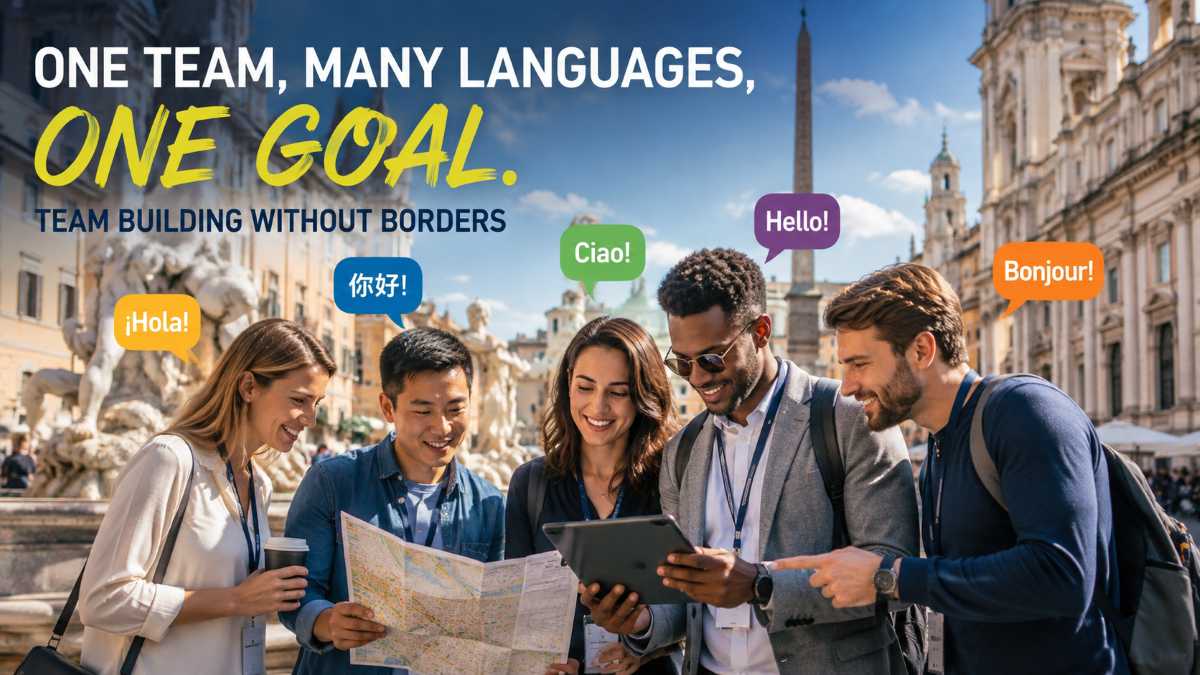
Multilingual Team Building for international companies: when diversity becomes a strength
Imagine a group of colleagues arriving in Rome from different parts of the world. There’s someone who lives in London, someone who works in Madrid, someone who has just arrived from Berlin, and someone who knows every corner of the city perfectly because they work there every day.
They meet in the same company, take part in the same projects, share goals and meetings. Yet they speak different languages, have different habits and, often, even interpret communication, time, leadership and teamwork in different ways.
So the challenge is not simply to get them to work together.
The real challenge is to turn these differences into a resource.
This is where Multilingual Team Building for international companies comes in: an experience designed to engage people from different countries, cultures and backgrounds through activities that can overcome language barriers and create a common language made of collaboration, play, creativity and shared goals.
Rome, with its international character and its extraordinary ability to bring together eras, peoples and cultures, can become the ideal place to experience this kind of journey.
Why international companies need multilingual Team Building
In a global company, speaking a common language doesn’t necessarily mean communicating in the same way.
English may be the official language of a meeting, but behind the words there are cultural differences that influence how people make decisions, deal with a problem, express disagreement, or interpret a colleague’s role.
In some professional contexts, communication is direct and immediate. In others, the personal relationship and the context take on greater importance. Some teams are used to making decisions quickly, while others prefer to analyze every possibility before choosing.
These differences can become an obstacle, but they can also turn into a major competitive advantage.
Multilingual Team Building brings these dynamics out of the usual office environment, allowing you to observe the group in a new, more spontaneous and engaging setting.
When a team has to solve a riddle, complete a mission, create something together, or navigate an unfamiliar city, people start communicating differently.
And very often they discover that, before language, what really matters is the ability to listen.
A common language that doesn’t need translation
Play as a universal tool
There’s something extraordinarily democratic about play.
No matter what the participants’ native language is, when faced with a challenge, a goal to reach or a problem to solve, the group must find a way to understand one another.
A gesture, a look, a drawing, a word spoken in the company’s common language, or perhaps an expression learned just a few minutes earlier can become tools for collaboration.
Multilingual Team Building can be designed specifically to highlight this dimension.
Instructions can be available in multiple languages, teams can be made up of people from different international locations, and the challenges can require different skills, so that every participant has the opportunity to contribute.
The goal isn’t to prove who speaks a certain language best.
The goal is to find out how well a team can communicate even when habits change.
From translation to collaboration
An effective international activity shouldn’t just translate an English, French, Spanish or German format.
A real multilingual Team Building is born by thinking about the group’s diversity from the very beginning.
This means designing activities in which language doesn’t become a barrier, but one of the elements of the game. It means using visual tools, hands-on challenges, technology, storytelling and moments of discussion that can involve everyone.
Multiculturalism isn’t simply “managed”.
It becomes part of the experience.
Rome as a meeting point for cultures
Few cities tell the story of the coming together of peoples like Rome.
As you walk through its streets, you can experience traces of the Empire, artistic influences from all over Europe, and evidence of a city that, over the centuries, has welcomed travelers, artists, merchants and different cultures.
For an international group, Rome can become much more than just an incentive destination.
It can turn into a shared grand stage.
From the Pantheon to Piazza Navona: a city to interpret together
A multilingual activity in the historic center can lead participants to engage with iconic places like the Pantheon, Piazza Navona, Campo de’ Fiori and the streets that connect the different historic neighborhoods.
Each team can receive missions, clues and content designed to be easily understood even by participants with different levels of language knowledge.
A tech-based treasure hunt, for example, can use images, maps, videos, quizzes and interactive tasks.
A colleague from Paris might notice an architectural detail. A colleague from New York might find the solution to a riddle. An Italian participant might share an interesting fact about the city.
The answer comes when all these skills are put together.
And this is the most important message of all: no one alone has all the necessary information, but a team can build a shared solution.
Trastevere and the value of different perspectives
Even neighborhoods like Trastevere can become the perfect setting for an experience dedicated to intercultural collaboration.
Its narrow streets, squares, shops and hidden details invite you to slow down and observe.
And it’s interesting to note how, often, different people notice different details of the same place.
What for someone is simply an alley can become, for another, a clue. An apparently secondary element can turn out to be decisive for completing a mission.
It works the same way at work.
Diversity of perspective can improve problem solving, generate new ideas and help the team identify solutions that a too-homogeneous group might not consider.
What activities work best for multilingual Team Building?
Digital and tech treasure hunts
Activities based on tablets and digital tools are particularly suitable for international groups.
Teams can receive multimedia content, images, videos, maps and interactive missions. This reduces reliance on long texts and makes the experience more immediate.
In addition, the digital format allows you to customize activities according to the company, brand values, the participants’ countries of origin and the event goals.
A route through the Roman Forums, the Capitoline Hill or Castel Sant’Angelo can therefore turn into a mission tailored to the team.
Escape games and problem-solving challenges
A mystery to solve is an excellent exercise in international collaboration.
To find the solution, participants must share information, compare hypotheses and coordinate their actions.
In a multicultural group, this process becomes even more interesting.
Those who tend to talk more must learn to listen.
Those who usually observe in silence can find the decisive detail.
Those with a very rational approach can collaborate with people who face the problem in a more creative way.
The result doesn’t depend on a single individual, but on the group’s ability to put different points of view together.
Creative Team Building
Artistic activities are another powerful universal language.
Creating a collective work, building a visual project or producing a composition in which each group contributes to a final result can help overcome many language barriers.
The message is simple, but extremely effective: each person can create their own part independently, but the result only gains meaning when all the parts are brought together.
So a creative Team Building can become a visual metaphor for an international company.
Different locations, different skills, different cultures.
One single project.
International Cooking Team Building
Cooking, too, has a universal language.
Preparing a dish together requires coordination, organization, time management and the ability to collaborate.
But it also offers something extra: the chance to share stories.
During a Cooking Team Building in Rome, an Italian recipe can become the starting point for discussing traditions, habits and personal memories.
Someone might explain how a similar dish is prepared in their country. Another might discover an ingredient they’ve never used before.
The result is an experience in which the team doesn’t just work together.
It starts getting to know each other for real.
The moment when differences stop being distances
There’s always a moment during an international Team Building when something changes.
At first, people naturally tend to look for those they already know—those who speak the same language, those from the same location.
Then comes a challenge.
The group needs a solution.
And suddenly people start mixing.
Someone translates a word. Someone else makes a gesture. A third person finds the solution. A fourth person coordinates the group.
The initial divisions become less important.
There are no more “those from London,” “those from Rome” or “those from Berlin”.
There is simply a team that must reach a goal.
And it’s exactly at that moment that Team Building becomes a concrete tool for corporate integration.
Multilingual Team Building and intercultural communication
Just speaking the same language isn’t enough
One of the most common mistakes is assuming that an international team is automatically integrated because everyone uses English as the working language.
Intercultural communication is much more complex.
The tone of voice, body language, the way people express disagreement and even silence can take on different meanings depending on the cultural context.
A Team Building experience helps bring out these dynamics naturally, without judgment.
Through play, people can try out new ways of communicating without the typical pressure of a meeting or a work situation.
Learning to ask, listen and verify
An effective international team develops several core skills:
-
listening ability;
-
clarity in communication;
-
attention to non-verbal language;
-
ability to ask questions;
-
handling misunderstandings;
-
collaboration between people with different approaches;
-
shared problem solving;
-
mutual trust.
Team Building doesn’t replace an intercultural training program, but it can be a powerful accelerator.
It allows people to experience directly situations in which these skills become necessary.
And what’s experienced together tends to be remembered much more easily than a simple theoretical presentation.
A customized format for every international company
There is no one-size-fits-all model.
A Team Building designed for a group of managers from ten different countries will have different needs than an activity meant to integrate two companies after a merger or to welcome colleagues from a new international location.
That’s why designing the experience becomes essential.
Before the activity: getting to know the group
To design an effective multilingual Team Building, it’s important to understand:
-
which languages the participants speak;
-
which countries they come from;
-
whether colleagues already know each other;
-
what the company goals are;
-
which group dynamics need to be improved;
-
how much time is available;
-
what level of physical activity is appropriate;
-
whether the experience should be mainly training, fun, incentive or celebratory.
These details make it possible to build a more inclusive format that is truly engaging.
During the activity: designing for inclusion
An effective international Team Building should prevent part of the group from becoming just spectators.
That’s why it’s useful to alternate different types of tasks: some based on logic, others on creativity, observation, hands-on skills, or the ability to communicate.
This way, every participant can find a space to express their skills.
Diversity stops being something to manage and becomes a real asset for the game.
Why Rome is an ideal destination for international companies
Rome is a city that doesn’t ask to be fully explained.
It invites you to discover it.
That’s what makes it perfect for international groups, because it offers different levels of experience. There are people who visit the city for the first time and are captivated by the great monuments. There are also those who come back for a second or third time and want to discover lesser-known places.
A Team Building can meet both needs.
From the grandeur of the Capitoline Hill to the views along the Tiber, from the squares in the center to the atmosphere of Trastevere, Rome offers settings capable of turning a corporate activity into a shared memory.
And a shared memory can become a starting point for building stronger relationships even after returning to the office.
The value of a shared experience beyond borders
An international company is made of numbers, strategies, markets and results.
But above all, it’s made of people.
People who need to collaborate even when they work thousands of kilometers apart. People who join video calls from different time zones. People who sometimes know a colleague’s face only through a computer screen.
Multilingual Team Building offers something that digital communication doesn’t always manage to create.
A real experience.
A challenge faced together.
A laugh after a mistake.
A solution found when it seemed impossible.
Then Rome becomes much more than a destination for a corporate event.
It becomes a meeting point.
And perhaps the real goal of an international Team Building is exactly this: not to eliminate differences, but to create an environment in which they can come together.
Because a strong team isn’t the one where everyone thinks the same way.
It’s the one where different people can build something together.
FAQ – Multilingual Team Building for international companies
Is multilingual Team Building also suitable for groups with very different languages?
Yes. Activities can be designed using visual content, digital tools, hands-on tasks and instructions available in multiple languages, reducing possible communication barriers.
What is the best language to organize an international Team Building?
It depends on the group’s composition. English is often used as a common language, but an activity can be structured to include multiple languages and non-verbal communication tools.
Is it possible to organize a multilingual Team Building in Rome?
Yes. Rome offers many ideal scenarios, from the historic center to Trastevere, from the Roman Forums to Castel Sant’Angelo, as well as indoor locations suitable for international corporate events.
Which activities are best suited to a multicultural group?
Digital treasure hunts, escape games, problem-solving activities, creative experiences and Cooking Team Building are particularly effective because they encourage collaboration through different languages.
Can Team Building help integrate colleagues from different locations?
Yes. A shared experience can make it easier to get to know each other, improve communication and create new relationships among people who normally collaborate only from a distance.
Is it possible to customize Team Building based on the company?
Yes. Activities can be tailored to company goals, the number of participants, the languages spoken, available time and the group’s characteristics.
Why choose multilingual Team Building?
Because it allows you to turn an international group into a more connected team, valuing cultural differences, improving communication and creating an experience that everyone can share, regardless of their starting language.
If you want to experience this journey or others like it, click here: you’ll find our proposals:
Request a free quote and get all the information about your Team Building experience.
Request a quote: https://www.teambuildingrome.com/ask-for-quote.php





